

The Everything Bubble: Why History Suggests Preparation Matters More Than Prediction
by QBC Analyst
Every major financial bubble has its own story. The Roaring Twenties were fuelled by electricity, the late 1990s by the internet, and the Global Financial Crisis (GFC) by an unsustainable housing boom. Despite their different catalysts, each was driven by the same belief: this time is different. Today, investors are embracing artificial intelligence (AI) with similar enthusiasm. AI promises to reshape industries, boost productivity and transform the global economy. At the same time, government debt has reached record levels, property prices are elevated once again, and financial markets have become increasingly concentrated in a handful of technology companies.
Gold currently trades at approximately AUD $5,811 per ounce, while silver sits near AUD $83.64 and platinum at AUD $2,318.67 per ounce. Although metals have softened as bond yields and the US dollar strengthened, the broader economic backdrop raises an important question: are today’s markets resembling the conditions that preceded previous financial crashes?
How concentrated are today’s financial markets?
One feature shared by many financial bubbles is the growing concentration of wealth into a small number of market leaders. Investors increasingly focus on first-generation companies expected to shape the future, often pushing valuations well beyond underlying fundamentals. Today’s AI boom has produced similar conditions. Amazon, Alphabet (Google’s parent company), SpaceX, Anthropic, OpenAI, in addition other heavy hitters such as Microsoft, and Oracle, have attracted hundreds of billions of dollars as investors position for what many believe will be the next industrial revolution.
Approximately one hundred years after the Roaring Twenties boom there are still echoes in the stock market sector for those who care to listen. In October 2025, the ten largest US companies accounted for 37.7% of the entire stock market, surpassing the previous record of 37.3% reached in 1932. Importantly, note that the previous record was not set during the boom itself but after the Wall Street Crash that caused the Great Depression. The largest companies of the era did not collapse immediately. As smaller initiatives failed investors sought the relative safety of established market leaders, increasing their share of the overall market before they too eventually succumbed to broader economic conditions. If history offers any guide today’s concentration in the technology sector could become even more pronounced before the cycle ultimately turns.
Combined with elevated property prices, record government debt and expensive equity valuations, some analysts have begun referring to today’s environment as the Everything Bubble.
What can the Roaring Twenties teach us about today’s AI boom?
Nearly a century ago, electricity inspired the same excitement that surrounds artificial intelligence today. Companies such as General Electric (appliances), RCA (radio) and AT&T (telecommunications) were viewed as the architects of a new economic era, transforming manufacturing, communications and everyday life. As investors borrowed heavily on margin, valuations became detached from earnings and confidence replaced caution. When sentiment finally turned in October 1929, the Dow Jones fell 25% in just four trading days. The market continued to lose almost half its value by mid-November before ultimately declining 89% between September 1929 and July 1932.
The technology endured; the speculative excess did not. AI is here to stay, but will its pioneering companies endure?
Are today’s AI leaders repeating the Dot-Com Bubble?
The internet boom (also known as the dot-com bubble) followed a remarkably similar path to the consumer euphoria experienced in the 1920s. Investors abandoned traditional valuation metrics in favour of growth and market share, convinced that the internet had rewritten the rules of investing. Between 1995 and March 2000, the Nasdaq increased fivefold before collapsing 76.8% over the following two and a half years. Of the companies that dominated the market at the time currently only three remain relevant: Microsoft lost approximately 64% in the subsequent crash, Amazon almost 95%, and Oracle 80%. Other companies such as Cisco, Intel, Dell, and eBay are still household names but they no longer command the same market influence as they did in the late 1990s.
One of the more striking parallels between the internet boom and today involves corporate confidence. Near the peak of the dot-com bubble, Motorola issued USD $300 million of 100-year bonds, a decision now viewed as emblematic of peak optimism. More than two decades later, Alphabet issued its own 100-year corporate bonds, attracting approximately USD $9.5 billion in investor demand. Just as capital once flooded into companies expected to build the internet, today’s investment is concentrated in businesses building AI infrastructure. The technology may change the world, but history suggests transformative innovation and speculative excess often arrive together.
Does banking and real estate still pose a threat to financial stability?
While technology stocks struggled after 2000, another bubble was developing elsewhere. Between 2001 and 2005, roughly 40% of new private sector jobs in the United States were linked to housing as the real estate industry boomed. Household mortgage debt rose from 61% of GDP in 1998 to 97% by 2006 as easy credit fuelled rapidly rising property prices. When defaults began, liquidity disappeared and banks with loose lending and investment practices were put under strain. When investment bank Bear Stearns collapsed in March of 2008 JPMorgan acquired it with the assistance of the Federal Reserve; next, Lehman Brothers filed for bankruptcy in September (traditionally “crash month” in the stock market), and immediately thereafter governments were forced into unprecedented bailouts to prevent a broader financial collapse. When American real estate failed, it took the already shaky banking industry with it by default.
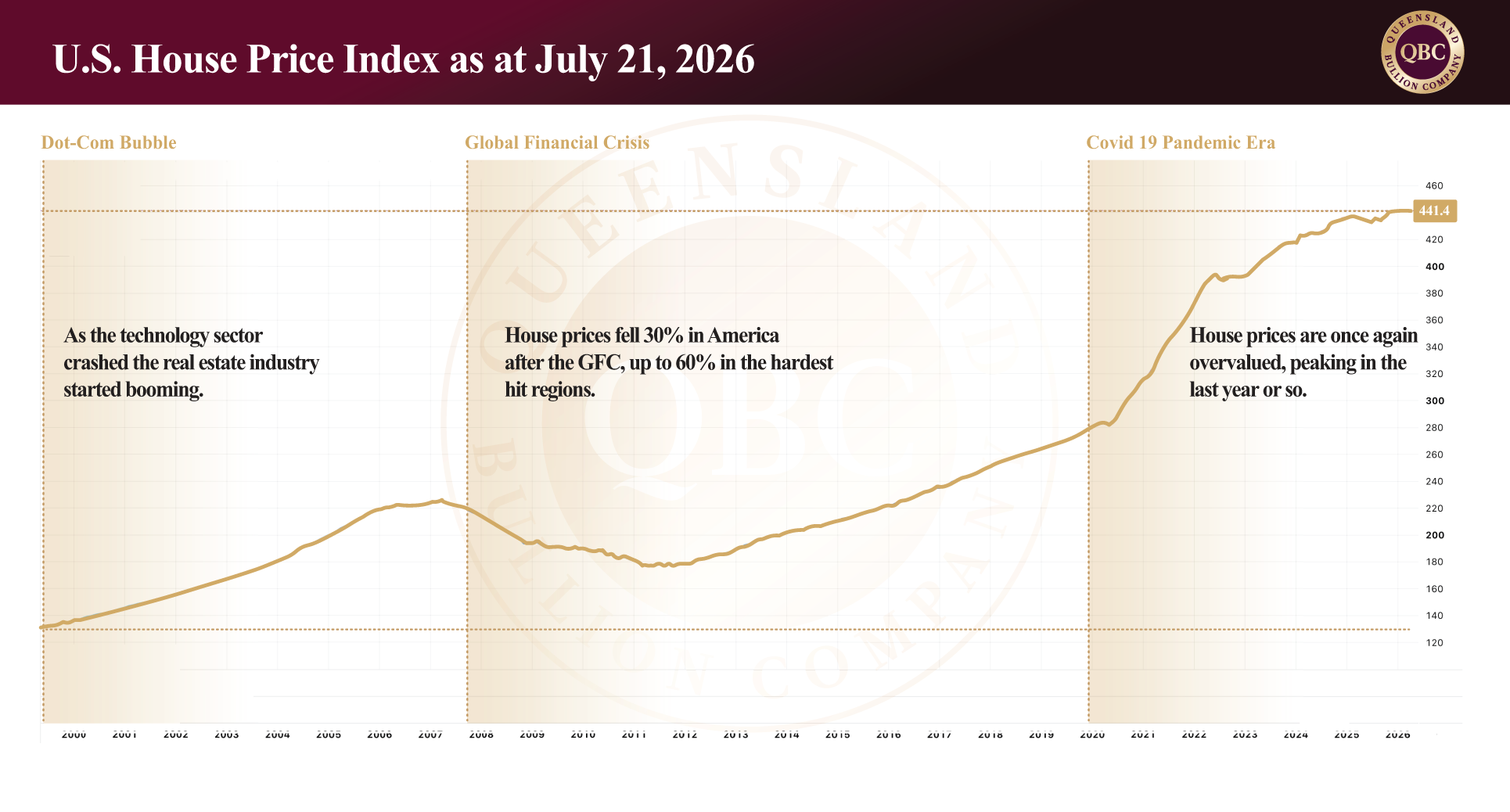
Once again, real estate appears overvalued. In the United States, the median price of a single-family home is now more than double its 2007 level while all forms of income have contracted in 2026.* Meanwhile, inflation has also steadily eroded purchasing power. What cost USD $1.00 before the GFC now costs approximately USD $1.62.
Australia tells a similar story. Since 2000, average wages have increased by around 40%, while residential property prices have risen by approximately 390%. During the GFC, US housing prices fell between 30% and 60%, while Australia’s property market declined by just 8.5%, largely due to government intervention; however, with Australian property values having so significantly outpaced wage growth over the past two decades, questions remain about how sustainable current valuations are should economic conditions deteriorate. Read more about Australian real estate and gold here.
Unlike 2008, however, today’s risks extend beyond housing and private banking to include record public debt, elevated equity valuations and slowing global growth.
Why are bond markets flashing warning signs?
The bond market is also sending signals reminiscent of previous financial volatility. The US 10-year Treasury yield has again reached levels (above 4.4%) not consistently sustained since October 2007, immediately before the GFC. Interestingly, yields tested these levels multiple times during the three years leading into that crisis before broader financial stresses emerged. Rising yields reflect growing concern over inflation, government borrowing and fiscal sustainability. Years of quantitative easing and deficit spending helped stabilise economies through successive crises but also expanded debt and reduced purchasing power. While history never repeats perfectly, periods of rising yields, tightening financial conditions and elevated asset prices have often preceded increased market volatility.
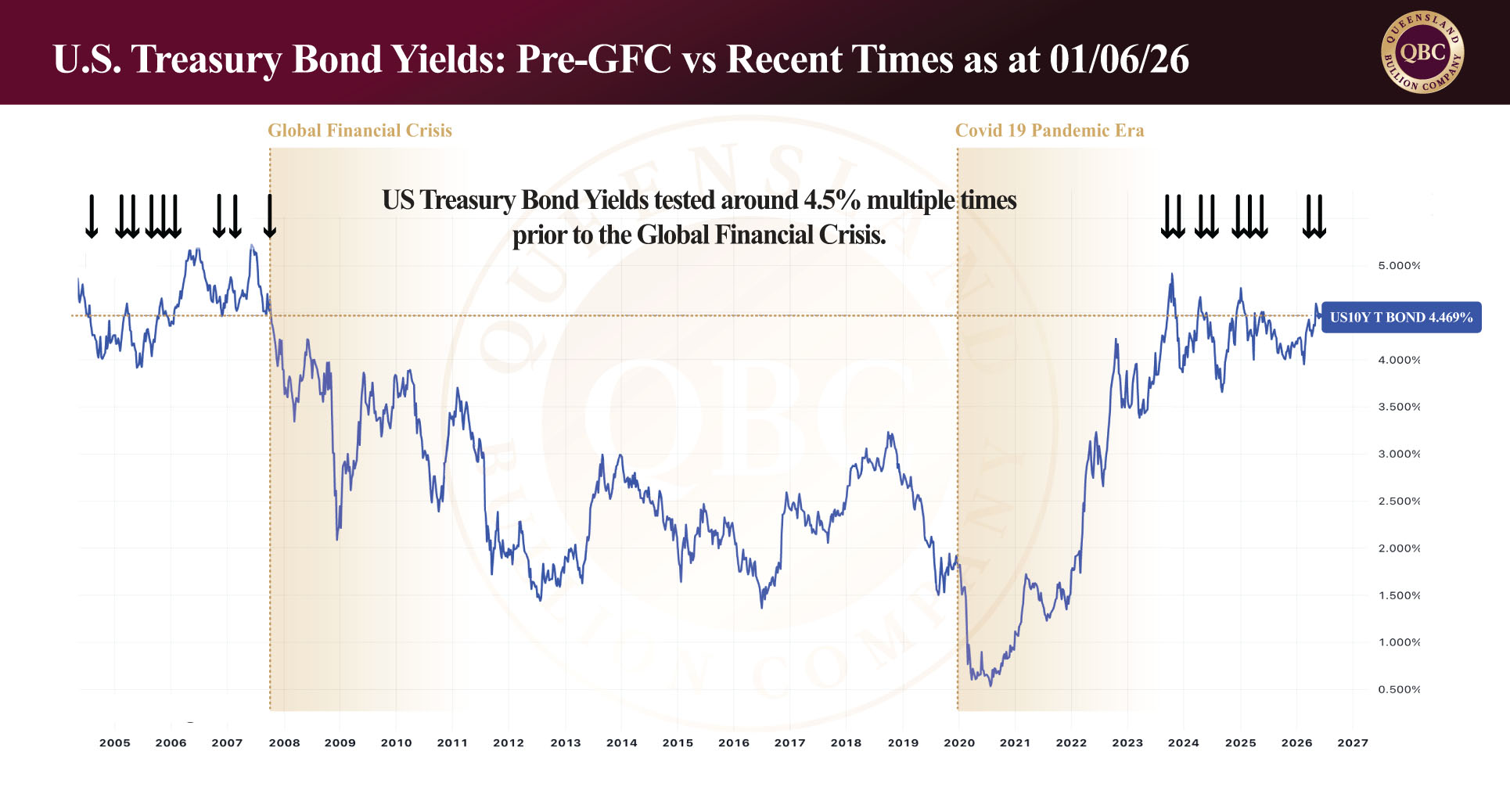
Read more about the graph above.
Does every bubble begin with the belief that this time is different?
Every financial bubble has been supported by a convincing narrative. In the 1920s it was electricity. In the late 1990s it was the internet. Before 2008 it was housing. Today it is artificial intelligence. The difference is that today’s market combines elements of several previous cycles. Record market concentration, revolutionary technological advancement, elevated property prices, expanding government debt, persistent inflation and geopolitical uncertainty have created conditions that resemble multiple historical bubbles rather than just one. While none of this guarantees another financial crisis it does suggest investors should be cautious of assuming today’s risks are fundamentally different from those that came before.
Predicting exactly when markets will turn has always been difficult. Preparing for uncertainty is far more practical. History shows that by the time economic risks become obvious, defensive assets have often already repriced. Insurance is rarely purchased after the event it is designed to protect against.
Recent weakness in gold and silver has largely reflected higher bond yields, a stronger US dollar and expectations that interest rates may remain elevated. Yet the long-term drivers supporting precious metals remain intact. For long-term investors, periods of softer precious metals pricing have often provided opportunities to either enter the market or build existing positions. Certainly, Bank of America has called sub- USD $4,000 in gold an opportunity to dollar-cost-average. Other investment houses have stated intentions to go overweight on gold again very soon. History cannot tell us when the next correction will occur, but it consistently demonstrates that those who prepare before uncertainty emerges are often better positioned than those who wait for certainty to arrive.