Posted on — Leave a comment

Trump and the USD Lead the Way to Blue Skies for Australian Gold and Silver Prices

AUD to USD

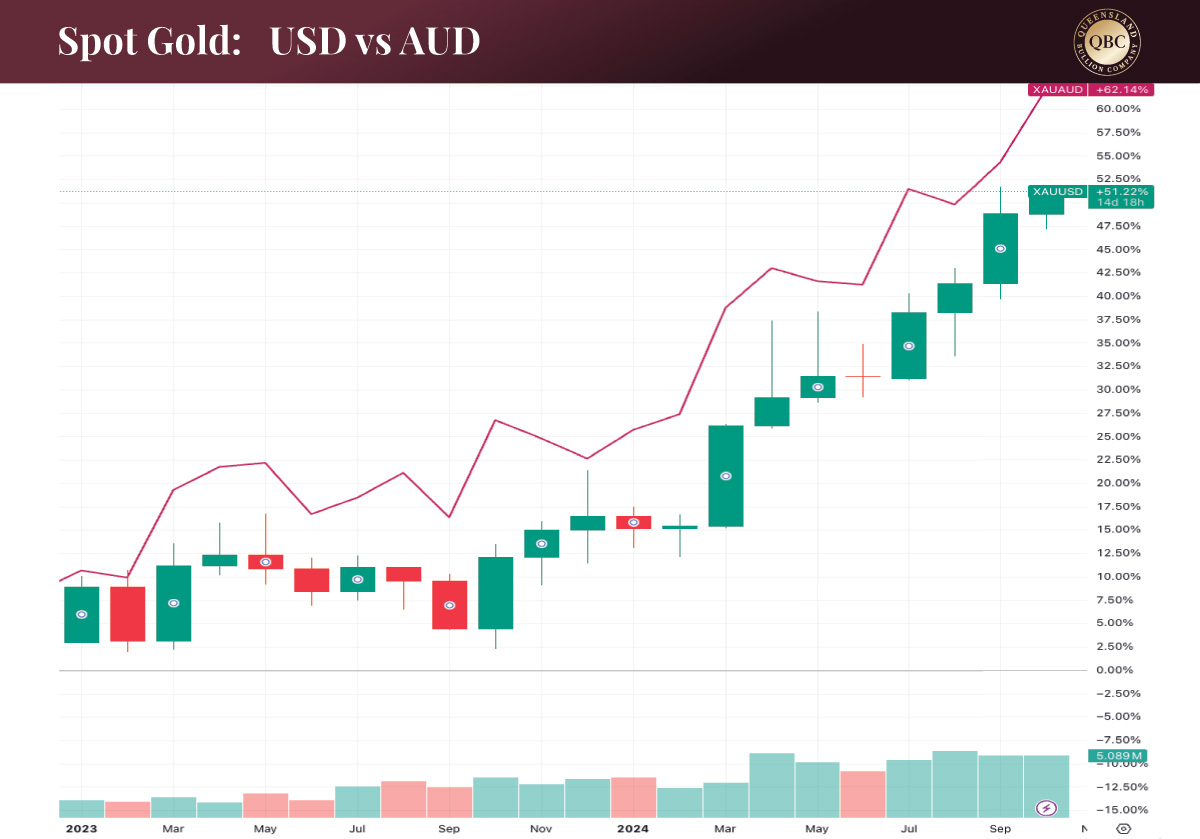
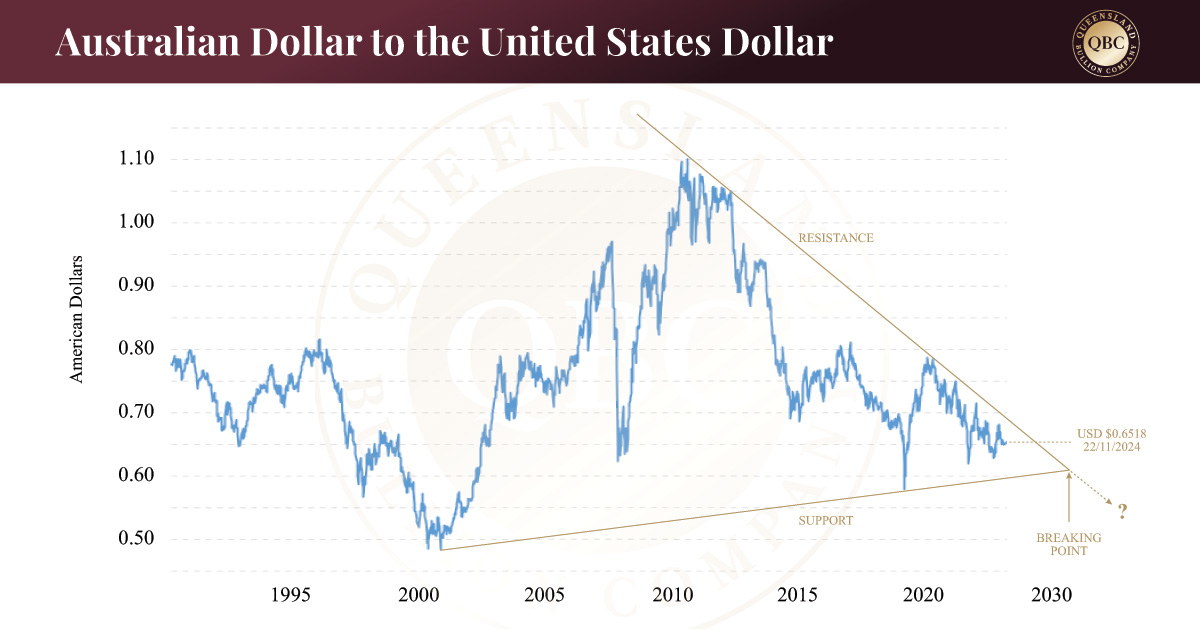
The anticipated appreciation of the Greenback bodes very well for gold and silver prices on the Australian market. With the Australian Dollar to United States Dollar exchange rate at 0.6518, gold currently trades at $4,102.34 indicating at 3.5% increase in the last week, silver is at $47.67 with a 2.6% increase in the same time, and platinum is $1,501.21.  This exchange rate has been a critical indicator for Australian precious metal prices, with both gold and silver enjoying gains above 32% over the last 12 months.

Enter the “Trump Turbulence” factor: Donald Trump has been a consistent source of uncertainty in global politics and finance. His bold and unpredictable actions have often caused disruption in markets, and as he prepares for a second term, it’s expected that his influence will continue to keep both political opponents and financial markets on edge. While much of the media attention around Trump’s leadership focuses on the drama and unpredictability of his decisions, it’s important to look beyond the mainstream focus when considering the markets—especially for investors in gold and silver.

For those holding precious metals in the Australian market it is not just Trump’s handling of geopolitical events that will influence the price of gold and silver. A key factor to watch is the Australian Dollar (AUD) against the US Dollar (USD), as it directly impacts the local price of gold and silver. The below graphs illustrates the current trend for the AUD/USD exchange rate points to further devaluation of the Australian Dollar. If the trend continues, we could see a breaking point in the coming years where support and resistance intersect.  At this point the AUD will either strengthen or weaken significantly against the USD. This is something to watch closely as it could have a direct impact on the value of precious metals in the Australian market.

AUD to USD


When looking at the broader picture, it’s important to consider the US Dollar Index (USDX), which measures the value of the USD against a basket of major international currencies. As discussed in our last article, Trump’s unpredictability, as much as it is welcomed by gold and silver, will have little impact on the macro-economic trends dictating the ebb and flow of the US Dollar Index and the price of precious metals alike.  Right now, the trends within the USDX suggests that the Greenback is more likely to strengthen than weaken in the near term. While Trump’s unpredictability may continue to stir volatility in financial markets, it is the macroeconomic forces that will have the most significant impact on the value of the US Dollar. If the USD strengthens, it could put downward pressure on the Australian Dollar leading to a potential decline in value.

For Australian investors, this means that the value of gold and silver is likely to increase in local markets as the AUD weakens against the USD. While we cannot predict exactly how low the Australian currency could go, what is clear is as the AUD declines against the Greenback, the price of gold and silver in Australia is set to rise. This presents a potential opportunity for those looking to hedge against currency risks and protect their wealth in uncertain times.
Posted on — Leave a comment

The Twin Presidencies of Trump and Biden and How it Affected Gold

gold gains

It feels like the recent retraction in precious metals has been significant but the truth is, it is still within the historical norm when the current aftermath of Trump’s second victory is compared to that of his first.  With gold currently trading at $3,970.78, silver at $47.52, and platinum at $1,477.84, it is worth stepping back and considering some of the trends established during Trumps first term to assess what this tells us about the current market, and what we can expect in the future.

On November 8, 2016, Trump stepped onto the world stage with a decisive win for the Republican Party in America.  The world gasped and metals went down.  Within a week the value of gold was down 3.4% and silver followed with a decline of 9% on the Australian market.  Similarly, nine days ago Trump returned, again riding the red wave and heralding yet another contraction for precious metals in the same week after the election, this time 3.5% for gold, and silver losing only 2.9%.  This illustrates that what feels like a somewhat violent contraction in the price of precious metals is really “situation normal,” suggesting that further consolidation (especially in silver) is hardly out of the question, even likely. Indeed some analysts believe that based on Trump’s first term gold may dip as low as $3,870 if it kept pace with American markets; however, the likelihood is unknown. To read more about the reasons for the current pullback read last week’s article.

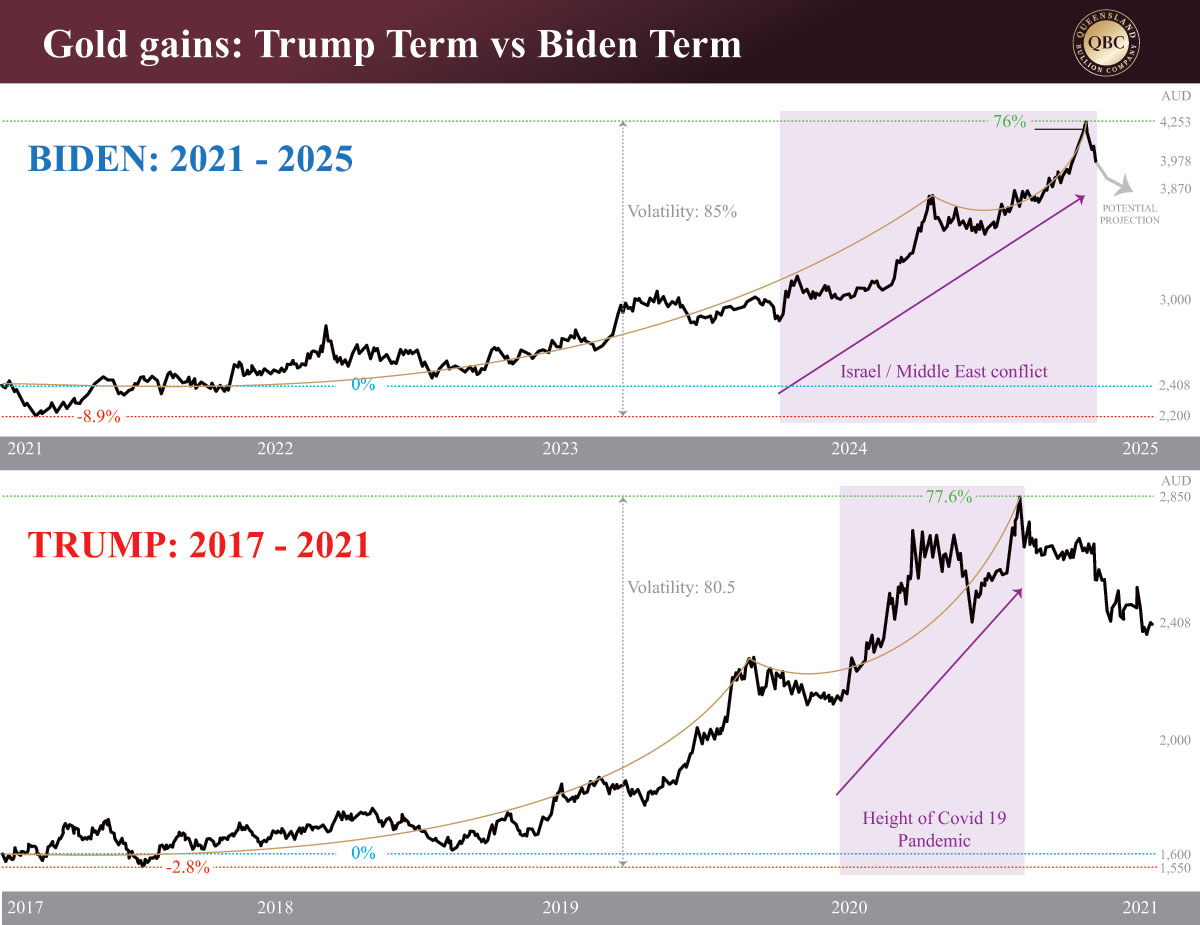
There are further extrapolations of interest when comparing gold’s performance during Trump’s first presidency versus Biden’s.  When Trump took office in January of 2017 gold was at $1660 and at the end of his term it was $2408, an increase of 50.5%.  From $2408, with governance under Biden gold is currently at $3978, an increase of 65%.  From this perspective one could argue that gold fares better under Democratic leadership; however, Biden still has two months of his term left when volatility is at its highest- at this point, nothing is sacred.

Volatility, on the other hand, deserves a mention. Based on the price of gold at the start of Trump’s term in 2017 it did not drop more than 2.8% during his term. At its highest, it reached 77.6% above the starting price.  This leaves a spread between the low and the high of 80.5%.  Applying the same formula to gold during Biden’s presidency produces a very similar result thus far at 85%.

Another interesting coincidence is that, based on the price of gold at the beginning of their terms, the increase in the gold price varied only 1.6% between the two presidents, with Trump achieving an increase of 77.6% and Biden 76%.

So far regarding gold both presidencies ­­seem eerily similar.  So was there anything different?  Apart from domestic politics, global events that affected gold prices has been the main difference.  The graphs below show very similar behaviour in the yellow metal but the underlying causes differ greatly.  The cause behind the main upward trend in gold under Trump was the Covid 19 Pandemic, while the breakout of conflict between Israel and Palestine et. al. has been the source of the upward pressure on gold under Biden.  Arguing whether either president was provocative or reactive to their relative emergencies is irrelevant.  The main take away is that, regardless of who is in power and what domestic challenge unfolds, global events are the dominating factor that affects precious metals, of which geopolitics plays a significant role.

So moving forward, what comes next?  Will Trump end the war in Ukraine as he pledged?  Signs are promising.  But what about Israel?  History paints this tiny country as a wildcard that the USA does not necessarily influence all that well.  Some would argue it’s the opposite.  Whether peace is possible in the Middle East is unknown.  At the time of writing resolution does not look possible. “Complicated” might be a positive spin.  So more importantly, if conflict breaks out in a larger way what does this mean for gold?  All gold bugs know the answer to this.  Anyone looking to add to their position might consider now as the perfect time to buy the gold dip.

Posted on — Leave a comment

Trump Win Sees Softer Gold and Silver Prices

Volatility was prominent as the world’s largest superpower headed to the polls to decide their future President on Tuesday with it continuing over the past two days.  During the election gold traded between $4,042.00 and $4,232.9a, an increase 4.7%, and is at $4,051.75 at the time of writing.  Not to be outdone, silver took a hit in the same range of 4.5%, currently trading at $48.34.  It seems the betting agencies had a better finger on the pulse than mainstream media, with the outcome of the election dictating a major shift in foreign policy in an already tumultuous geopolitical arena.  All this has a direct effect on precious metals so let us unpack the knowns and the unknown in the context of a confirmed Trump presidency.

Ultimately the fundamentals for the US economy and precious metals are still the same.  The National Debt Ceiling will still need to be lifted above $36 trillion, budget and trade deficits will continue to balloon, social security obligations will remain the number one cost on US books, and paper to physical ratios in precious metals will still be obscene. For precious metals, the markets are still poised to enter into a super-cycle that will challenge the bull run of the Great Depression dating in 2029.

The overnight pull back was a combination of weakening in metal pricing paired with a strengthening USD after the news of Trump’s victory. This put significant downward pressure on the price of gold especially when priced in Australian dollars.  Stop losses triggering automatic selling would have further exacerbated the situation, and a correction was not so surprising given the rate of gold’s recent and rather speedy rise.  Moreover it indicates that investors clearly have more confidence in a Trump administration’s ability to manage America’s economy.  Evidently, investors using gold and silver to hedge against inflation and uncertainty will move back into more high-risk and high-yield asset classes now that a Harris administration has been ruled out.  Whether Trump can control inflation is yet to be seen.

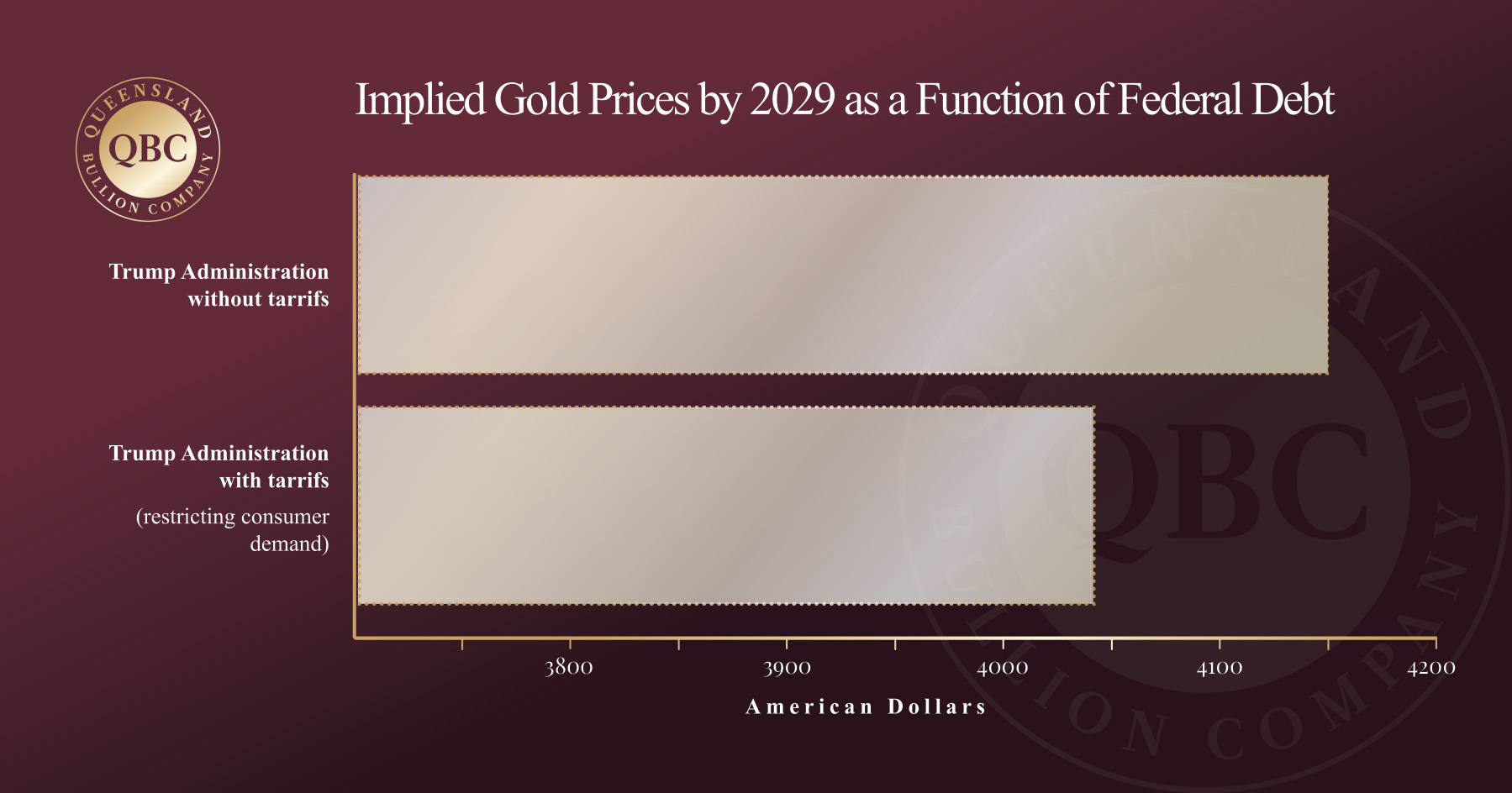
Below is a graph of anticipated gold prices at the end of Trump’s second term based on federal debt levels.

As mentioned, foreign policy is what will pose the biggest catalyst for precious metals.  Trump came out with fighting words during his campaign which included 100% tariffs on countries dumping the Petro-dollar and showing strong support for Israel in their aggressive campaign in the Middle East.  Indeed this is reflected in how the news has been received internationally, with Netanyahu one of the first to congratulate Trump while Putin refuses to do so directly.  One does wonder at this point how much of the strong man’s words is pure bluff.  Some analysts believe that much of it is actually more representative of a big stick, a negotiating tool he can pull out of his pocket if and when he needs.  All this adds to more uncertainty.  Trump does not dictate whether world conflict escalates but he can influence it.

Moving forward, it remains to be seen how the world’s largest superpower will exert its influence. One thing is for certain, though, and that is the current pull back in gold and silver makes a perfect discounted buying opportunity before they start their projected accent again.

Posted on — Leave a comment

Who Will Pull the Silver Squeeze Trigger and Send Physical Silver Skyrocketing?

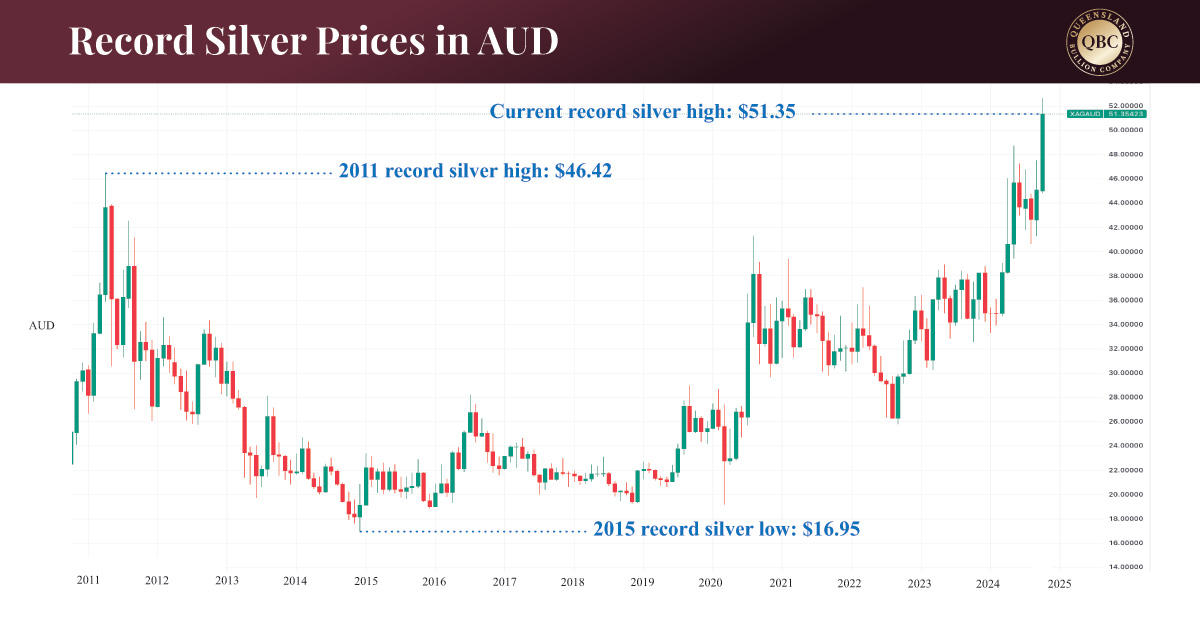
There is plenty of talk about increasing silver prices in the current market and it is not hard to understand why.  At the time of writing silver trades at an all-time high of $51.72, as does gold $4,239.12, and platinum at $1,562.06.  The expectation is that all metals will continue to rise to new heights, with analysts citing various reasons especially for silver that include a rise in demand, a shortfall in supply, and the inability for derivative silver markets to maintain momentum under current geopolitical pressures. It is an interesting convergence of circumstances. Let us unpack them one by one, saving the best for last.

Part of silver’s intrinsic value is linked to its use in various industries.  Some of the attributes that create an industrial need include use in  green technology, electronics, medicine, optics, corrosion resistance, reflectivity and heat conductivity.  Industrial use accounts for 56% of the demand for silver over the last five years, with the largest consumers including America, China, Russia, India, Canada, Japan, Germany and South Korea.  Modern life does not exist without silver’s industrial applications and this builds in a solid fundamental basis when considering silver for investment purposes.

Additionally, the military appetite for silver is not to be ignored.  Some applications of silver in the defence industry include use in radar systems, night vision equipment and munitions.  However, information is scant at best given government agencies generally do not report on silver inventories.  But even still, what is known is that the US removed 430 million ounces of silver from West Point Bullion Depository for the purposes of military applications. Actions like these that do come to light lead many investors wary of government-released information on its usage of silver.

Most physical silver holders are aware there is a shortfall in silver supplies.  Several factors contribute to this constrained position.  Firstly, global production peaked in 2016 and has declined ever since. Secondly, only 25% of physical silver is derived from primary silver mines. And thirdly, new deposit discoveries have decreased by 50% over the last 10 years.  When considering that geopolitical tensions are driving an increase in demand it becomes obvious that, as a depleting asset, the supply-demand imbalance is poised to worsen with no easy fix in sight.

So humanity finds itself in a unique position wherein, whilst every effort is made to develop sustainable energy and green technology, we also actively indulge the bellicose part of our nature and threaten to blow each other up with nuclear bombs.  What is the common thread?  Silver.  And while we lose ourselves in this real-life tug-of-war like set of agendas, what do financial institutions do?

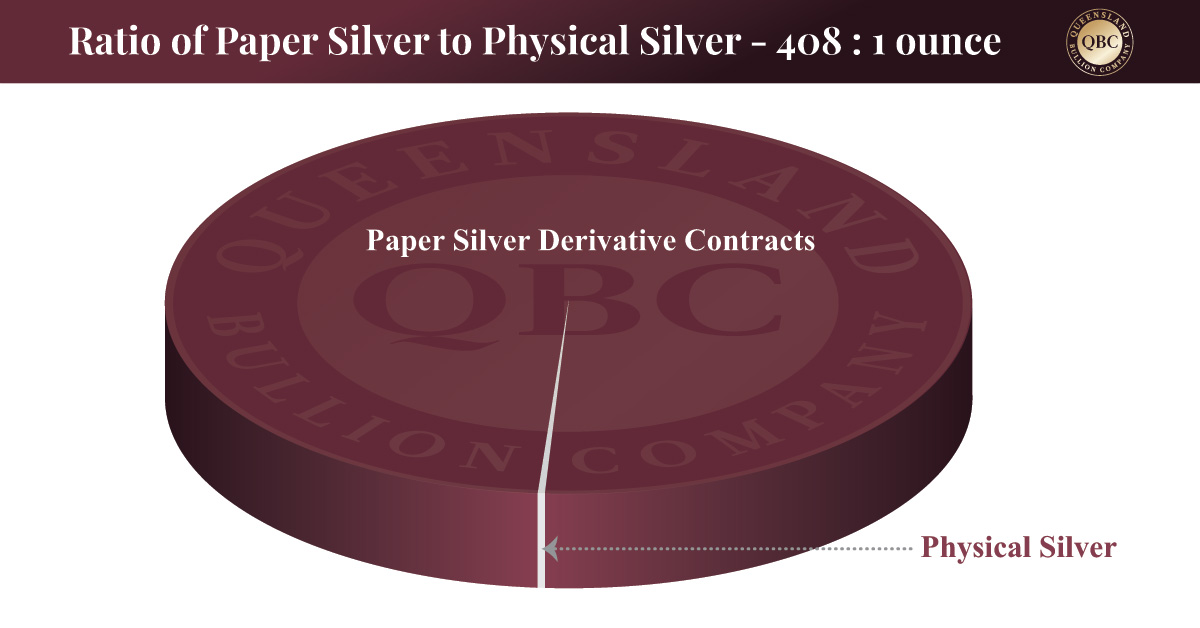
The financial institutions flood the market with derivatives that suppress the price of silver.  They have been doing this since the crash in silver prices in 2011 from a high of $46.42 down to $16.92 in 2015. The disparity between the paper silver market and physical is almost inconceivable.  For every one ounce of real silver there are 400 – 450 silver paper claims.  This reeks of the same fractional-trading corruption found in fiat currency.  Likewise, COMEX registered inventories are the lowest ever and less than 0.25% of futures contracts actually stand for delivery.  Concurrently, in their quest to be Basel III compliant, major banks have developed a healthy appetite for silver that exceeds annual global mine supply.

paper silver physical silverIt is now clear why the price in silver is rising.  As it rises banks race to exit or reduce their short positions on paper silver derivatives.  In turn this creates the very situation they seek to avoid, a rise in silver prices.  To read about how BRICS central banks are placing upward pressure on silver prices read our previous article HERE.  It appears things are finally catching up on the banks that have suppressed the price of silver.  Factors outside their control are putting upward pressure on the price of silver and they are forced to reduce their exposure by decreasing their position in the silver derivative markets.  As these markets contract so too does manipulation of the price of silver, allowing it to correct according to larger market influences.  The end result is that the very banks who sought to supress the price of silver are now ushering in a new era for the white metal with more than just silver linings to look forward to for those backed with physical.

If you are interested in buying silver online, you can can create an account and begin the process here.

Posted on — Leave a comment

The Gold Market, the US Presidential Election, and a BRICS Precious Metals Trading Platform

As gold continues its upward trend in Australia it is easy to lose sight of all the factors that affect the precious metals market.  With gold coming off its all time high at the time of writing, trading at $4,105.50, silver trading at $51.45, and platinum at $1,574.82, it is still currently the super star in the bullion world.  The price of gold in Australia continues to be buoyed by a strong American Dollar (read more about this HERE), yet in the States and abroad there is an undercurrent of uncertainty shadowing gold’s climb to new heights.

While an increase in purchases from retail investors is noticeable, it is interesting that despite all-time highs there is a lack of evidence of substantial inflows heading into gold.  This is said to be largely due to anxiety related to the upcoming US presidential election.  So what justifies this anxiety?  The answer is simply, volatility.  While official ABC News polls put Kamala Harris more likely to win with 48% of the vote (versus Donald Trump at 46%), blockchain-based election betting site, Polymarket, says a red wave is coming with Trump given a 60% chance of winning by punters on the ground.  The political uncertainty caused by the election and the inevitable financial consequences is a reasonable cause for pause by those with serious skin in the game.  However it is possible that regardless of who wins, domestic politics will likely dictate expansionary fiscal policy which may deepen the US deficit and rekindle inflation – all of which is good for gold.

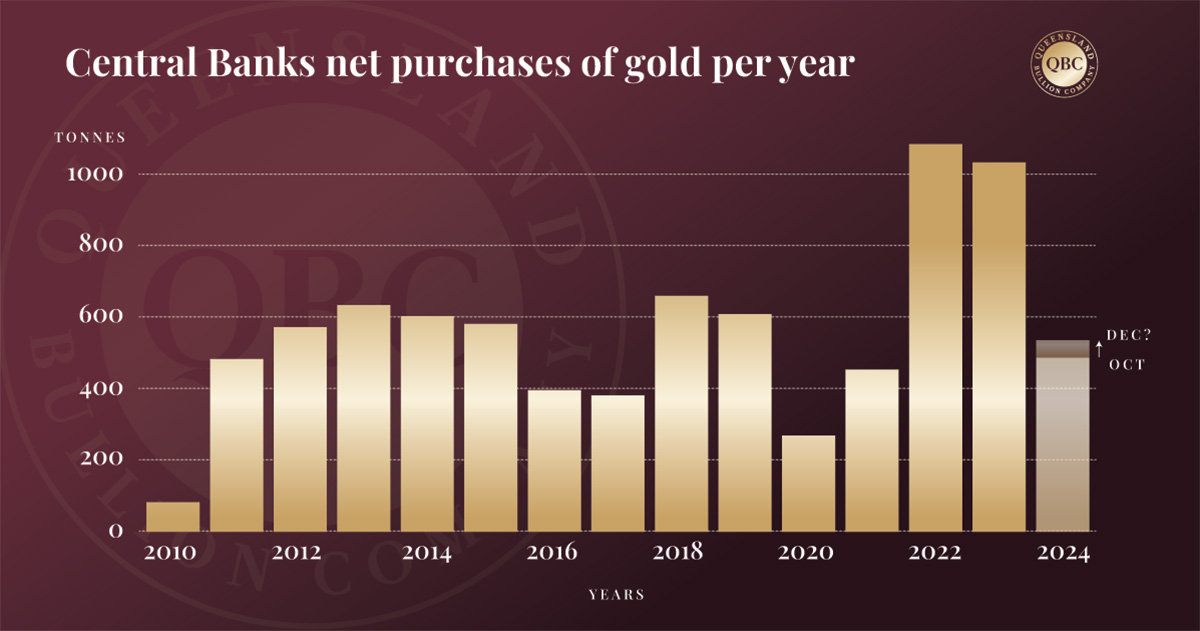
This pattern is playing out internationally as well. Central banks generally support encumbered governments (in this case, the Democrats), but on a global scale central bank net purchases for gold is forecast to be about half the amount compared to 2022.  Yes, it makes sense that, combined, central banks purchased over 1000 tonnes of gold in 2022 and again in 2023 when gold was cheaper, but comparative to where gold prices are expected to go during the coming anticipated bull market, gold is still heavily discounted; however, those reading our articles regularly will know it’s not so simple as considering just gold.  Read about how over the counter silver purchases change the overall landscape HERE.  So what has paused central bank buying?

central bank gold purchase

Like investors, nations are paying close attention to what policy will triumph as the world’s largest superpower heads to the polling booths.  And when contrasted with the business of BRICS expansion, one wonders how any American government can manage the mismatch of domestic and international fiscal needs.  As the front-runner, Trump has executed a hard-line campaign based on 100% tariffs on imports for all countries who move away from the waning Petro Dollar.  Concurrently, Putin has welcomed another 14 members into BRICS, including Turkey (a NATO member since 1952) and most recently Iran.  It is one thing to push a global decentralised finance system, but what would happen if BRICS were to formalise as a military block to challenge NATO, and what would this military alliance mean for precious metals?  Does the inclusion of Iran in BRICS signal we are one step closer to World War III?

One thing that is historically proven is that conflict results in a steady rise in precious metal prices.  What will also push metals further is the BRICS nations intention to start their own members only Precious Metals Exchange.  Russia cites price indicators, standardisation of trade, accreditation, clearing and auditing purposes to justify the initiative, but clearly this is also part of a continued de-dollarisation effort.  Experts suggest that as the BRICS anti-West agenda unfolds on the world stage it will potentially hasten a financial re-set wherein precious metals will be front and centre on the upward trend, enjoying a certain level of protection from downward pressure as Western nations use it to essentially hedge against financial ruin.

Moving forward, when considering all-time high gold prices, it is important to understand the risks.  While the US election and growing geopolitical tensions both introduce uncertainty and therefore potential volatility to the markets, ultimately large investors and central banks cannot sit on the sidelines forever.  When they decide to join retail investors in purchasing gold in a significant way, it is possible that a bank of suppressed buying could finally flood the markets.


Disclaimer: The views expressed in this article are those of the author and may not reflect those of Queensland Bullion Company Pty Ltd or any other associated entities. The author has made every effort to ensure accuracy of information provided; however, neither Queensland Bullion Company Pty Ltd nor the author can guarantee such accuracy. This article is strictly for informational purposes only. It is not a solicitation to make any exchange in commodities, securities or other financial instruments. Queensland Bullion Company Pty Ltd and the author of this article do not accept culpability for losses and/ or damages arising from the use of this publication.

Posted on — Leave a comment

Five Reasons Why This Gold Run is Set to Continue

Gold has enjoyed a stellar rise in 2024 and many analysts believe the party is not over. When adjusted for inflation, the price of gold has still not hit an all time high even as it currently trades at $4,011.96, with silver at $47.61 and platinum at $1502.66. For the Australian investor, breaking the $4,000 barrier is a significant psychological marker with many waiting to see if gold’s upward trajectory can be sustained. There is significant evidence that gold is set to continue the increase as we move into 2025, with major banks supporting this notion including Goldman Sachs, JP Morgan, Bank of America, Citibank, UBS making up the choir. Let us unpack five reasons below.


Credibility and solvency among nations

As a response to Basel III reserve banks have been hedging themselves against potential financial crises by increasing gold holdings for many years.  This is good news for gold investors as the Basel Committee on Banking Supervision (BCBS) had upgraded gold classification from a Tier 3 asset to a Tier 1 asset with a 0% risk weighting.  This is expected to continue to have a positive effect on precious metals moving forward.

As an example, Poland is one of the fastest growing economies in Europe and has stated intentions to increase their gold reserves to 20% or their portfolio.  In 2020 Poland’s gold holdings were less than 10%, it currently stands at 14.9% and they aim to meet their gold targets in the near future.  Echoing BCBS sentiments, their reason for the increased gold holdings is to position themselves as credible and solvent economic partners in times of financial crisis.  Indeed even smaller countries are preparing in a similar manner.  For example the Czech National Bank has acquired 32.8 tonnes since March.

Read more about Russia, China and India’s related silver purchases HERE.


Lower interest rates

The Federal Reserve’s recent rate cut of 0.5% resulted in an increase in the value of gold and other metals.  The lower interest rate provided confidence in the market and those seeking higher returns are flooding back into the market for metals.  This in itself suggests a bullish outlook.  And while the Fed suggests slow future cuts CBA believes the Reserve Bank of Australia is set to follow suite in the near future setting a somewhat ominous trend.


Current rise of the USD

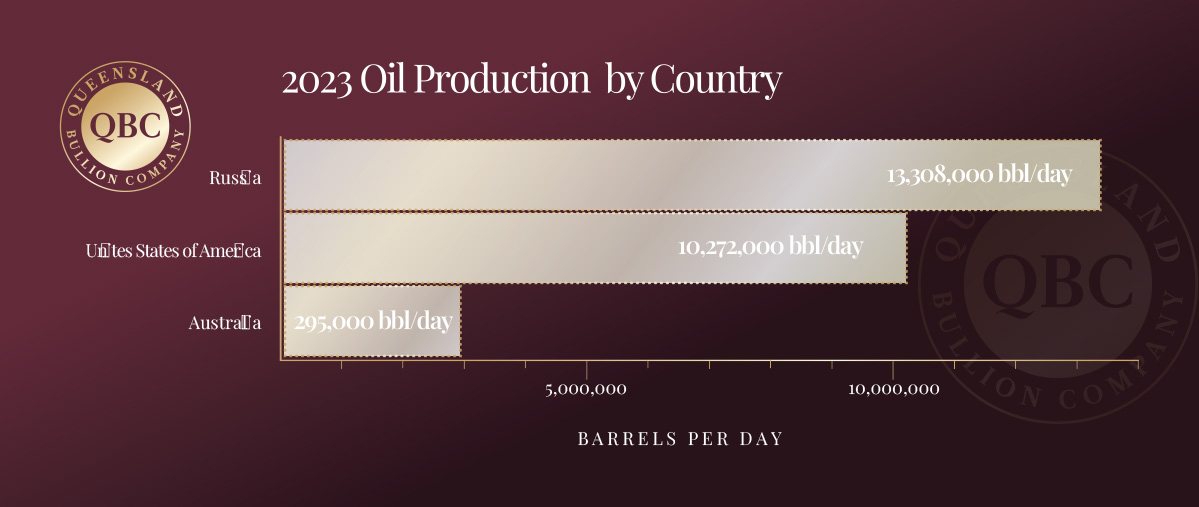
As the top safe haven currency, the American Dollar is the natural go to as the world teeters on the brink of conflict.  We have already discussed the implications of a rising USD on Australian gold prices in previous articles; however, what has not been explored is Europe’s potential role in the rising value of the Greenback.  As Europe heads into a cold winter energy supply will once again become a hot topic (pun not intended). With America now the world’s largest supplier of oil, producing 13,308,000 barrels per day (bbl/day), and without access to Russian oil (who produces 10,272,000 bbl/day), the logistics of European oil imports are a little more complicated and expensive than they used to be. This feeds into the growing instability in the region as strong economies need cheap energy. Add the very real prospects of war with Russia and one could say that Europe is staring down the barrel of a very accurate rifle.  As investors realise the implications of Europe’s position, a continued move away from the Euro into USDs looks probable, hence buoying the value of the USD longer than most anticipate.

Geopolitical conflict

While geo-political conflict appears to be going sideways both in Ukraine and the Middle East so too does precious metals.  Israel’s recent promise not to bomb Iran’s oil reserves fits squarely into the fog of war category.  More likely, any intention to bomb these reserves has been conveniently delayed until after the US elections when it can potentially happen on Trump’s watch.

Read more about the influence of geopolitics on precious metals HERE.


BRICS currency

Russia, as chairman of the BRICS Summit for 2024, is scheduled to make an important announcement during the summit held between 22 – 24 October this year.  Current conjecture around the announcement revolves around the potential unveiling of the BRICS unit of currency that looks to be 40% backed by precious metals.  As BRICS nations move towards trading in their own asset backed currency the value of gold and other precious metals will benefit from the built-in need for those countries to maintain high reserves to legitimise this new currency.


Summary

In summary, gold’s bull run may be just starting.  There are a number of economic flashpoints that could tip the scales in favour at any one time. Already gold has increased over 30% in the last twelve months.  The secret is to avoid the reactionary panic to such events and secure precious metals assets early.  As those in the industry state, it’s better to be prepared early than slightly too late.