Posted on — Leave a comment

Are We Already in Recession? How High Can Gold Go?

Gold reached an all-time high this on Wednesday this week in local markets topping out at $4,401 thanks to a strong US dollar.  With gold currently trading at $4,383.25, silver at $48.84, and platinum at $1,554.50, gold has once again taken centre stage with a robust start to the year.  Some analysts suggest gold prices could be as high as USD $3,380 by the year’s end, while others forecast a little lower.  Last week we touched on a number of factors that will influence the value of precious metals.  Now let’s revisit the most influential fundamental that will push the value of gold higher this year: recession.  How have we found ourselves in this position… again?


Federal Reserve rate-cutting cycles

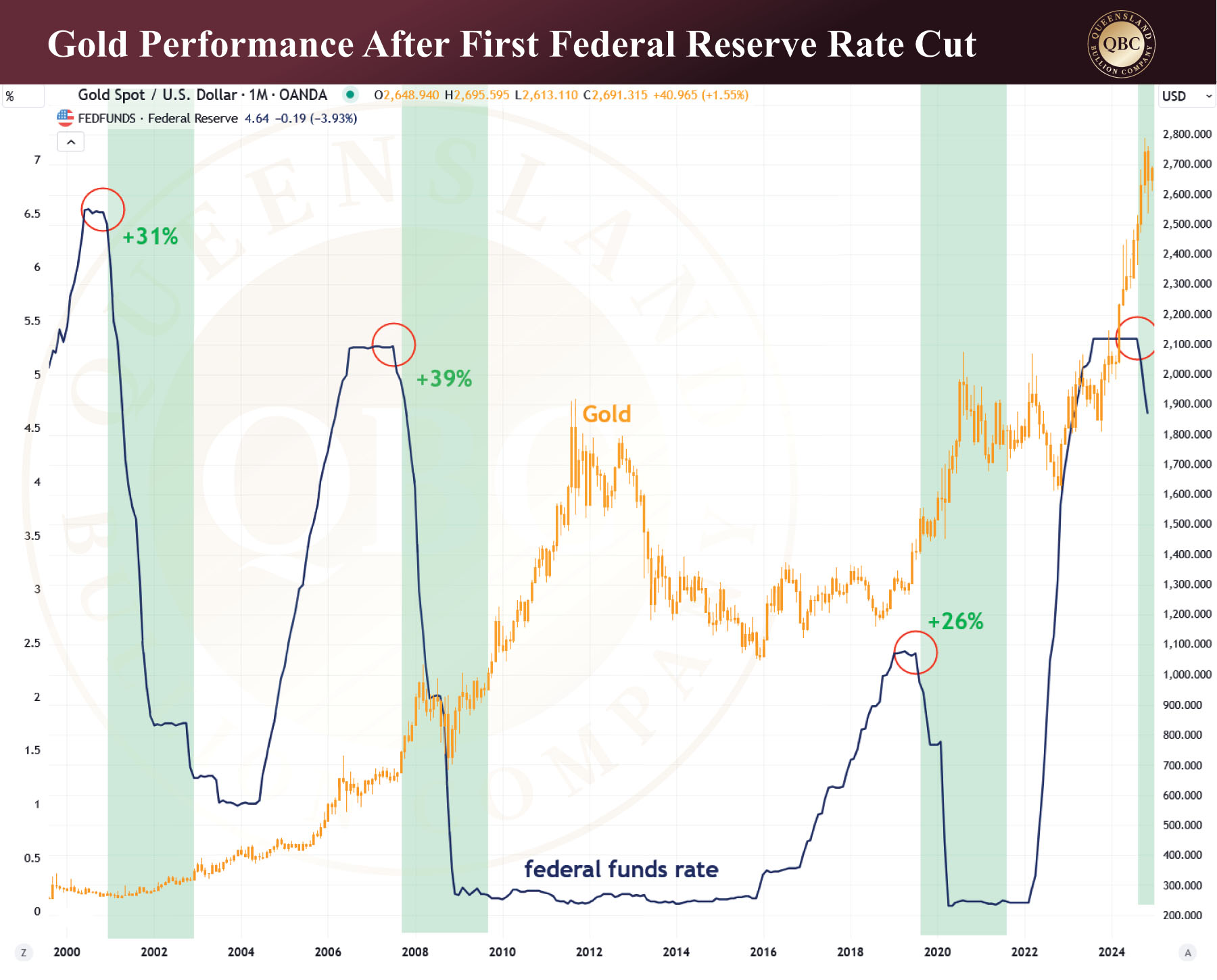
The Federal Reserve goes through cycles of rate increases and cuts in order to pursue its dual mandate of fostering maximum sustainable employment and price stability.  In order to meet these (sometimes opposing) goals, the reality is that they hike rates until “something breaks” or at least threatens to.  This is then followed by a rate-cutting cycle.  The more aggressive a rate cut is the higher the risk is of an incoming financial crisis, thus justifying the cut.  In 2008 the Federal Reserve started cutting rates on September 18th by 50 basis points (a fairly aggressive cut that was followed by the Great Financial Crisis).  Fast forward now to 2024, and the Fed has again cut interest rates by 50 basis points on September 18th, providing a perfect 17-year delta. The below graph illustrates how recessions generally follow rate-cutting cycles:

According to In Gold We Trust, over the last three rate-cutting cycles gold increased in value at an average of 32% within two years of the initial rate cut.  If this trend is applied to the September 2024 rate cut, gold could see prices as high as $4,554 and possibly higher by the end of this year .


Overvalued stock markets

Another indicator of recession is whether the stock market is over capitalised.  The stock market can be vulnerable to correction when it grows faster than the economy.  Also known as the “Buffet Indicator,” the Stock Market Capitalisation to GDP Ratio currently reveals this is the case in the US.  To date the indicator stands at 208.3% which is staggering; this is almost double what it was just prior to the Great Financial Crisis (GFC) when it was only 106%.  Australia does not need to feel left out.  The local stock market stands at 108.67%. While this is considered fair it is still more than what the American market was in 2008 and only needs to climb another 30% to match what it was prior the GFC.  Watch to see if our local stock market inflates further during the year to match its 2008 figure.  With significant overvaluation in the US stock market, we can expect America to lead the way when the correction finally comes.


Buffet and corporate insiders holding cash

Needless to say is that Warren Buffet is acutely aware of the insane overvaluation of the US stock market.  As CEO of Berkshire Hathaway, Buffet has traditionally positioned the company to hold cash before a recession and uses the above ratio as his main indicator to inform such choices.  As at the third quarter of 2024, Berkshire Hathaway held cash or equivalents of USD $325.2 billion, up by USD $48.3 billion from three months earlier.  And Buffet is not the only one to move into cash.  Stock sales in America by corporate insiders reached an all-time high after the election of then President-elect Donald Trump.  And where there are sellers there must also be buyers.  Recent surveys indicate that 56% of retail investors are bullish on the stock market’s prospects over the next 12 months.  Sadly, we are currently witnessing a transfer of wealth from retail investors to Wall Street purely based on different speculative perceptions of the US stock market.

Note also that Bitcoin and other cryptocurrencies tend to move in near lock-step with the US stock market, especially the NASDAQ where the overlap of investors are the highest.


Quantitative Tightening versus Quantitative Easing

Finally, in recent years the Federal Reserve has engaged in quantitative tightening (where they reduce their balance sheet of assets).  Usually this has a reductive effect on the price of gold, which is what makes gold’s performance last year absolutely stellar and very telling of where the market is really at.  While it is not always a marker of a coming recession, it is worth mentioning because of how it fits into a recession cycle.  During recession central banks will be compelled to reverse positions and switch to quantitative easing in trying to manage the corrections in the market.  This is important to precious metals because, amidst the environment of quantitative easing, the role of gold as a safe haven asset is highlighted significantly.


In summary, gold appears to be following the same patterns as its bullish trajectory during its 2007 – 2008 history.  Institutional responses to recession include massive increases in government debt, cutting interest rates back to zero (and then into negative territory), and injecting trillions of new dollars into the economy through quantitative easing.  All these responses support the increase of value in precious metals.

With recession signals flashing and the majority of retail investors none-the-wiser, it is imperative that the 1% of investors in the precious metals markets prepare as best they can for what is clearly spelt out for those who wish to see.  Being financially prepared for volatility and recession, in addition to any geopolitical curveballs that usually accompany fiscal corrections, allows one to be in a position of power to help others if one is inclined.  But one of the greatest gifts is the gift of knowledge.  Be the one to educate now and help others to help themselves before recession bites too hard.
Posted on — Leave a comment

Top Influencing Factors Affecting Precious Metals Prices in 2025

rare earth charts

2025 may see a convergence of factors that create perfect conditions for a financial crisis.  With gold trading at $4,374.39, silver hovering just under $50 at $49.97, and platinum at $1,531.35 it’s not necessarily at the forefront of the consumer’s minds.  Indeed, in America precious metals hit some psychologically important markers, again breaking through USD $2700 for gold and USD $30 silver which has investors looking up, as they should, given financial turmoil tends to support the price of gold and silver.

When peering behind the promising outlook for precious metals a grim reality stares back.  This is a reality that serves as a stark reminder why it is more important than ever for consumers to take steps to develop wealth preservation strategies (regardless of how small it may seem) and, if possible, wealth investment goals.

We have covered the topic of recession and currency enough in past articles, but what about cryptocurrency management, shorting stocks and deregulation?  How do these factor into the price of precious metals moving forward?

The Trump administration is upon us.  President-elect Donald J Trump has not been assassinated and is only days away from hosting the most lavish inauguration event in history.  When Trump takes office he is set to unleash a raft of deregulatory initiatives in the financial sector.  But how did we get here when history has proven multiple times that deregulation ultimately leads to financial catastrophe?  In the words of Dennis Kelleher, CEO of Better Markets (a Wall Street non-profit watchdog), “The financial industry uses its economic power to buy political power which it then uses to increase its economic power.”

Two examples of these deregulatory initiatives are the potential elimination the Federal Deposit Insurance Company (FDIC) and the Consumer Financial Protection Bureau (CFPB), both in place to regulate Wall Street and protect consumers.  Watch to see if these bodies exist in the future.  Ultimately, history illustrates that deregulation results in unsustainable artificially high levels of liquidity. And while economic crashes traditionally lag behind the aforementioned, it is an undeniable consequence that has been proven out many times over.

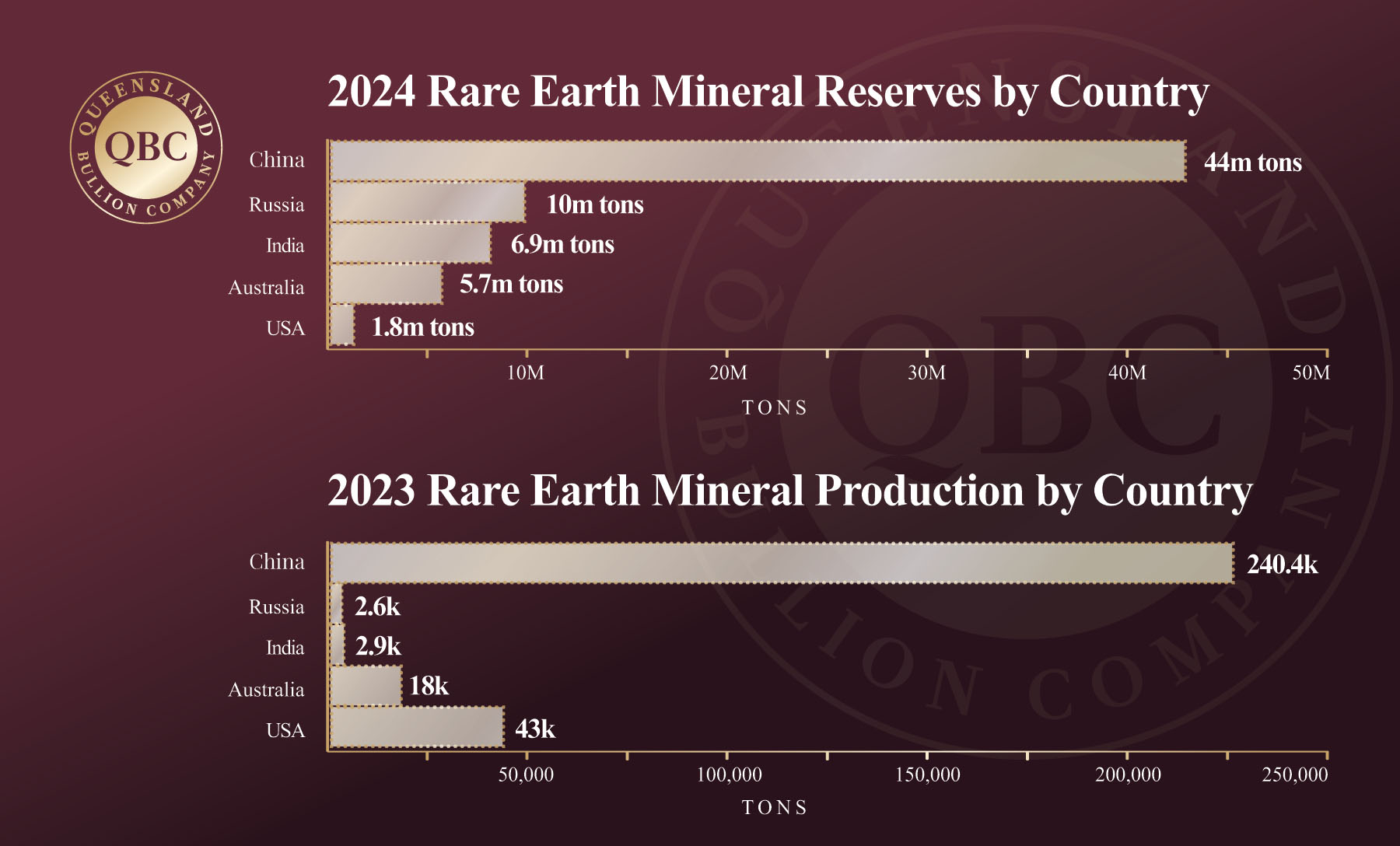
However, one initiative will have precious metals enthusiasts smiling.  Trump has been advised to reduce red tape for mining companies by removing environmental impact reports.  The aim is to reduce dependency on China for rare earth minerals which produces 90% of global supply.  These minerals are necessary for the production of goods with in the solar panel, electronic, and electric vehicles industries, the same industries that have a heavy dependence on silver.

The graph below illustrates rare earth mineral reserves and production by country.

Additionally, it would be remiss to avoid mentioning that Trump has set himself up as the Bitcoin President.  Since late July last year, after the Nashville Bitcoin Conference “Trump pump,” the price of Bitcoin rose over USD $30,000.  Coincidentally, while the Bitcoin price is at all time highs, this week the Department of Justice in America approved a government sale of USD $6.5 billion of Bitcoin.  This is a complete coincidence of course.  Even more interesting is how the government acquired the Bitcoin.  The government seized it from the Silk Road dark net marketplace.  There is a narrative potentially developing here, wherein Bitcoin may be linked in the future to financial corruption, hence calling on regulation of the market.  This is for two main reasons: less than one percent of investors hold Bitcoin; and, according to the FBI, 50% of financial fraud involves cryptocurrency. We remind the reader at this point that the Bank of International Settlements is well founded in instituting more prudential standards for crypto from January 1, 2025.  These standards categorise cryptos into two groups with a tiered approach, the top classification being subject to certain capital requirements (for example, being gold backed).  Moving forward banks are to apply a lot more scrutiny on high-risk assets held in their portfolio such as crypto-currency.  Meanwhile, gold has long held its tier one position as a zero-risk asset.


Lastly, another change brought in at the beginning of the year is reporting requirements for large short positions on the stock exchange, including short positions on physical gold and silver.  Rule 13f-2 of the Securities Exchange Commission (SEC) requires short positions exceeding USD $10 million or 2.5% of the company’s share to be reported on a monthly basis from now on.  This is designed to promote transparency that allows companies to identify market manipulation against their stocks and mitigate systemic risk.  Already momentum is building to punish those shorting stocks with a couple of high-profile initiatives already underway in this space.  Trump Media is on the hunt for those naked short selling DJT stock, as well as the potential formation of a class action initiative against those shorting certain precious metal mining companies in Canada.  It does not matter which stock sets a precedent.  It could have significant repercussions in the gold and silver sectors given the almost unprecedented level of shorting against these two metals.


In summary, there are many factors that point to the rise of gold and silver and the crashing of the financial system at large, potentially as early as the latter half of this year.  Those invested in precious metals have an advantage if such a scenario were to evolve and would do well to ensure that their loved ones are also looking into wealth preservation strategies as best as possible.  The future could be full of opportunities or heartbreak for those on Main Street, depending on how well they are prepared.

Posted on — Leave a comment

Australian Gold Prices Hold Firm as American Prices Take a Hit

American gold prices took a hit this week since the Federal Reserve announced another 25 point interest rate cut, yet the value of gold in the Australian market has managed to hold firm despite its counterpart losing steam. With gold currently trading at $4,197.36, silver at $47.66, and platinum at $1,506.74, Australian investors need to remember that this is largely due to market fundamentals ever present in the background, and not simply Lady Luck blessing the Lucky Country.

Gold dropped USD $65 overnight in response to the rate cut.  Federal Reserve Chairman Jerome Powell said, “I think it’s pretty clear we have avoided a recession… The US economy is performing very, very well, substantially better than our global peer group.”  Needless to say, there are many economists that will remind investors that recessions are always declared post-recession when the data proves it out.  The Fed also confirmed it has, at this point, revised down the number of rate cuts for 2025 and 2026 to only two, attributing the change in sentiment to higher inflation rates and global economic uncertainty.  “It’s common-sense thinking that when the path is uncertain, you get a little slower…. It’s not unlike driving on a foggy road or walking around in a dark room with furniture in it.”

Yet American gold prices were not the only asset to slump.  The S&P 500 fell nearly 3%, while the Nasdaq (Big Tech) plummeted 3.5%.  The Dow Jones Industrial Average (DJIA) has also dropped about 1,100 points, or 2.5%, the largest drop since August.  It is also the longest losing streak since 1974.  It was in 1974 that the stock market experienced one of its worst years to date, experiencing a 45% loss in value.  The devastating hit was the result of the continued conflict between Israel and the Middle East (headed by Syria and Egypt). The conflict triggered an oil embargo on Israel, the United States and other countries in support of Israel, the economic consequences resulting in the aforementioned historic dip in the stock market.  All of this sounds strangely familiar to the events unfolding in Syria today with the Isreali Defence Force claiming to have destroyed around 80% of the Assad Regime’s military capacity.  Let’s hope the West does not experience another oil embargo (post Inauguration Day) as we did before.

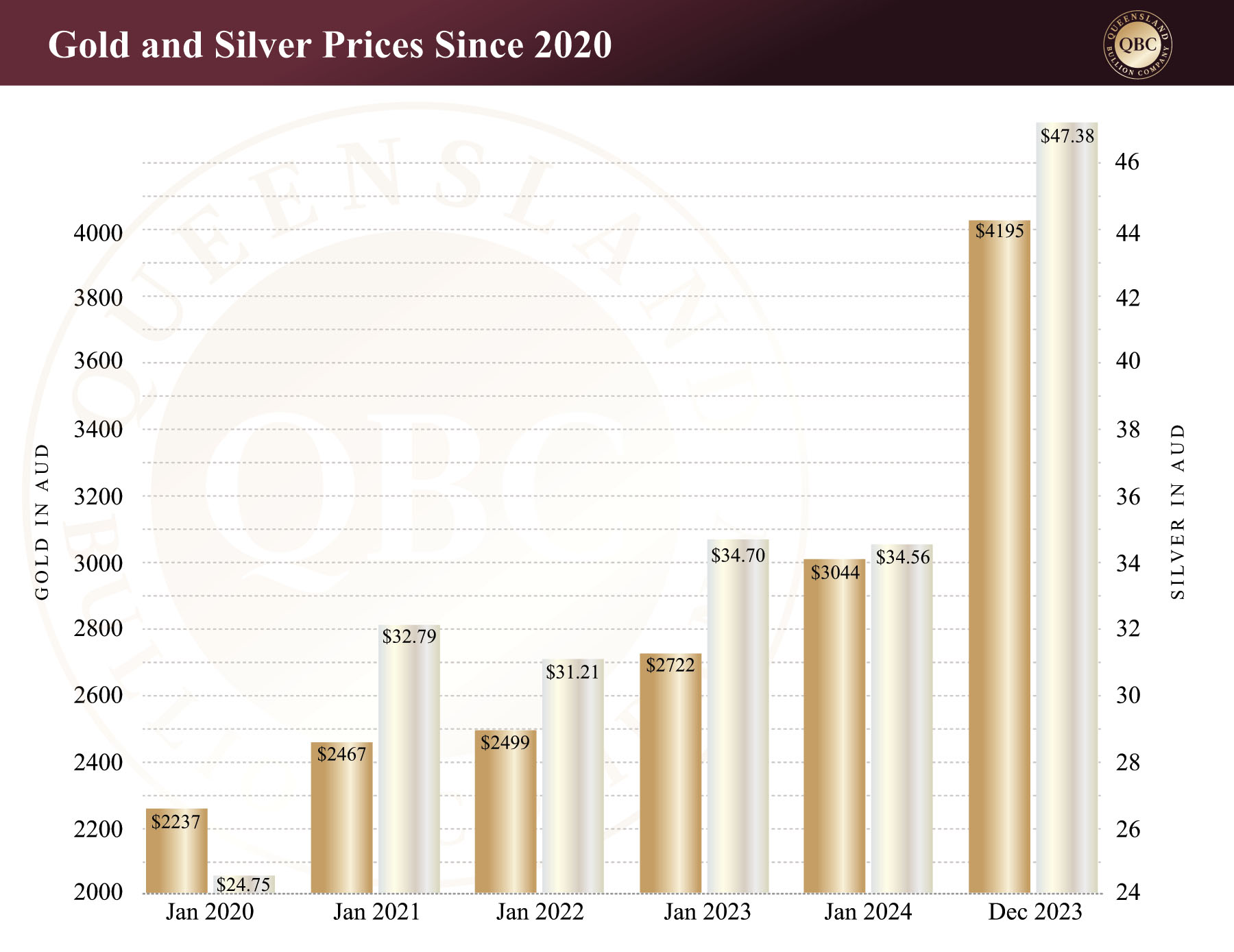
While American gold prices are not alone in experiencing a pullback, the Australian market has avoided the correction to date.  The main reason is the AUD to USD ratio.  Gold against the Greenback has lost value, but our local currency has lost value even more thus buoying local prices.  Indeed the Australian Dollar and the Euro appear to be competing to enter “crash” territory, while the American Dollar and the British Pound remain in positive territory.  If the Euro and other significant currencies tank look to a strengthening American Dollar as investors seek safety, and observe if Australian gold prices continue to benefit.  Regardless, the below graph illustrates the safe and steady climb of all gold bulls’ favourite metal.

Posted on — Leave a comment

2025 Outlook for Gold: Risk vs Reward

2024 has been a volatile yet satisfying year for gold which has ultimately enjoyed a 38.9% increase in value year to date. This past week it experienced a record high and the outlook remains promising for 2025. With gold currently trading at $4,226.04, silver at $48.97, and platinum at $1,489.09, we look to next year, eyes wide open, and assess the bullish and bearish influences on gold moving forward.

If there are any bearish reservations concerning gold one cannot avoid pointing the finger at Donald Trump. As President-elect of the world’s largest superpower his chaotic and unpredictable style (whether driven by impulse or a carefully-crafted strategy) creates uncertainty for gold investors. Election night showed that Trump can impact the price of gold quickly. Once a clear victory was evident gold prices dropped as investors moved to high-risk assets. Almost a month later gold has rebounded to outstrip the highs established on election day. Look to 20 January, 2025, for a move in precious metals depending on his strategy moving forward.

Trump’s promise of tax cuts, looser regulation and trade tariffs have investors worried about inflationary consequences. This is because tariffs could drive higher inflation which is generally positive for gold prices. However, next year will likely provide a backdrop of recession, in which case, different rules could apply. Normally, higher interest rates can increase the demand for a country’s currency due to the yield investors can receive. In the US a strengthened dollar has little impact on gold, but in Australian markets the value of gold priced in AUD will benefit accordingly. It becomes clear that Trump’s economic strategy will affect many moving parts that influence the price of gold, creating a murkiness that clouds predictions in the future.

On a positive note for gold investors, the “Bitcoin President” may need to rethink his promises in the coming year as new regulations are implemented by central banks regarding crypto currencies. The Group of Central Bank Governors have endorsed the Basel Committee’s global prudential standard for banks’ exposure to crypto assets. Central Banks must have these standards implemented by 1 January, 2025. This tighter, high-level scrutiny of crypto assets is good for gold which is already accepted as a zero-risk Tier 1 asset by central banks, highlighting a marked difference in how the Bank of International Settlements views the two extremely different assets.

Beyond the US, the economic world keeps ticking with central bank gold purchases to form the fundamental basis for higher gold prices in 2025. Eastern nations will continue leading the way after having witnessed how America weaponised its currency when they sanctioned Russia in 2022. Some Eastern countries have adopted fairly creative strategies that are outside the normal scope of over the counter (OTC) purchases when diversifying away from the dollar into hard assets such as gold and silver.

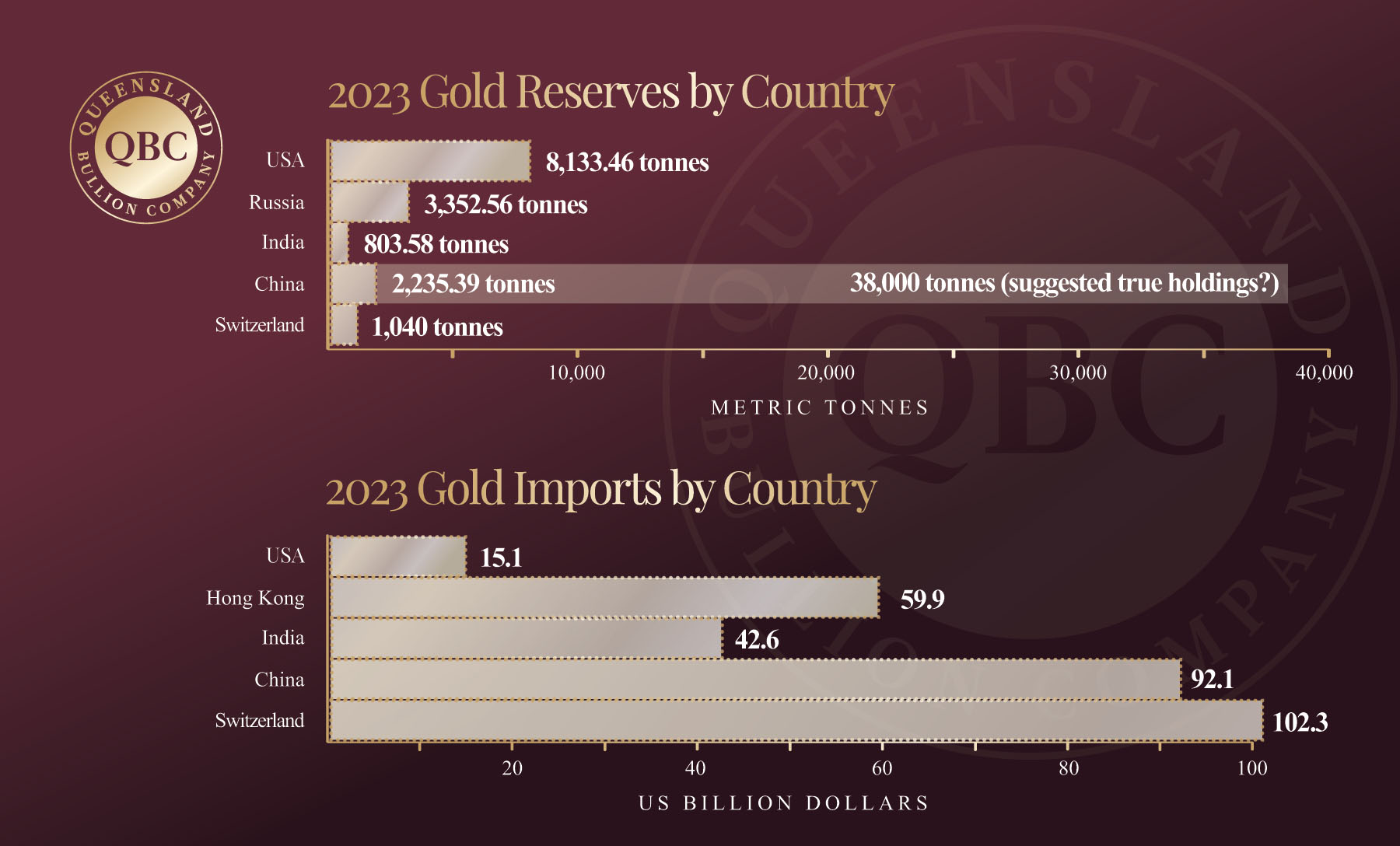
China is the perfect example. Not only is China the world’s largest producer of gold, they are also one of the largest importers (second to Switzerland). The Oriental Superpower has recently announced more economic stimulus meaning industrial demand for precious metals could increase. The graph below shows how much key countries held and imported in 2023.

China is also buying gold OTC after an official break of six months, but did they really stop? When official OTC transactions dried up the largest Eastern nation was still purchasing gold and silver in less than transparent ways by purchasing large amounts of unrefined gold cast bars directly from minors (mostly in South America). This makes assessing China’s true gold holdings fraught with danger; however, economist Alistair McLeod suggests that it could be as high as 38,000 tonnes. The World Gold Council puts China’s official holdings at 2,264 tonnes… If true, one must ask if the Chinese are prepared to invest so much in gold over time, what does this mean for the average investor. The answer is obvious.

In closing the gold’s general outlook for 2025 is positive to say the least, with some experts expecting spot price to average AUD $4,390. The more conservative analysts suggest that while gains made will be more subdued next year gold still has a lot to give. Other analysts suggest it could run up to AUD $4,630, an amount hot on the heals of AUD $4,709, the figure that a number of commercial banks forecast earlier in the year.

Posted on — Leave a comment

Gold Up 60% Since the Start of Russia’s Special Military Operation. What is Next?

Gold continues to recover in the Australian market despite a distinct lack of movement in the United States.  With gold currently trading at $4,118.97, silver at $48.95, and platinum at $1,489.77, it appears that the value of gold could move either way over the Christmas season, so let us take a close look at what has been building gold’s momentum both in the medium and short term. To read about the long-term implications for precious metals read our article on silver from last week.

Geopolitics is generally the most effective context to view medium-term trends in precious metals.  Since the beginning of the Russian Special Military Operation in Ukraine, gold has increased 60% in the Australian market.  This type of stellar performance is in part due to the conflict in Ukraine as a root cause.  With the US and other Western countries freezing (and in some cases, seizing) Russia’s central bank assets, many Eastern nations chose to diversify away from the USD in favour of physical gold and silver, hence, driving the price up on precious metals in general.  This driver will likely continue given the number of regional conflicts that could officially trigger World War III at any time (Russia vs Ukraine, Israel vs the Middle East, and China vs Taiwan to name a few, all of them, incidentally, potentially proxy wars for the US to justify resetting its financial system).

Another slow-burning issue affecting the price of precious metals is the elephant in the room that just won’t go away.  “Recession” is an ugly word and it is used more and more in current times.  Governments don’t use it lightly, but is it possible the West is already in one?  It would certainly explain some of the provocative behaviour from the Democrats as they prepare to leave office in America.  In the US, bankruptcies for companies holding USD $50 million or more in liabilities is on par with the statistics from 2008 Great Financial Crisis.  This is filtering down to individual households that are defaulting on credit card, auto, and personal loans, in addition to mortgages. Some analysts suggest that recession in America technically started in April this year and that it should end at a similar time in 2025.  Certainly the price of precious metals reflects this, but is this the end of the bull run for gold and silver?  Put simply, the answer is no.  If it really has started, fallout from recession would still need to play out, as would a financial reset, on a backdrop of global conflict.  Chaos is always good for gold and silver.

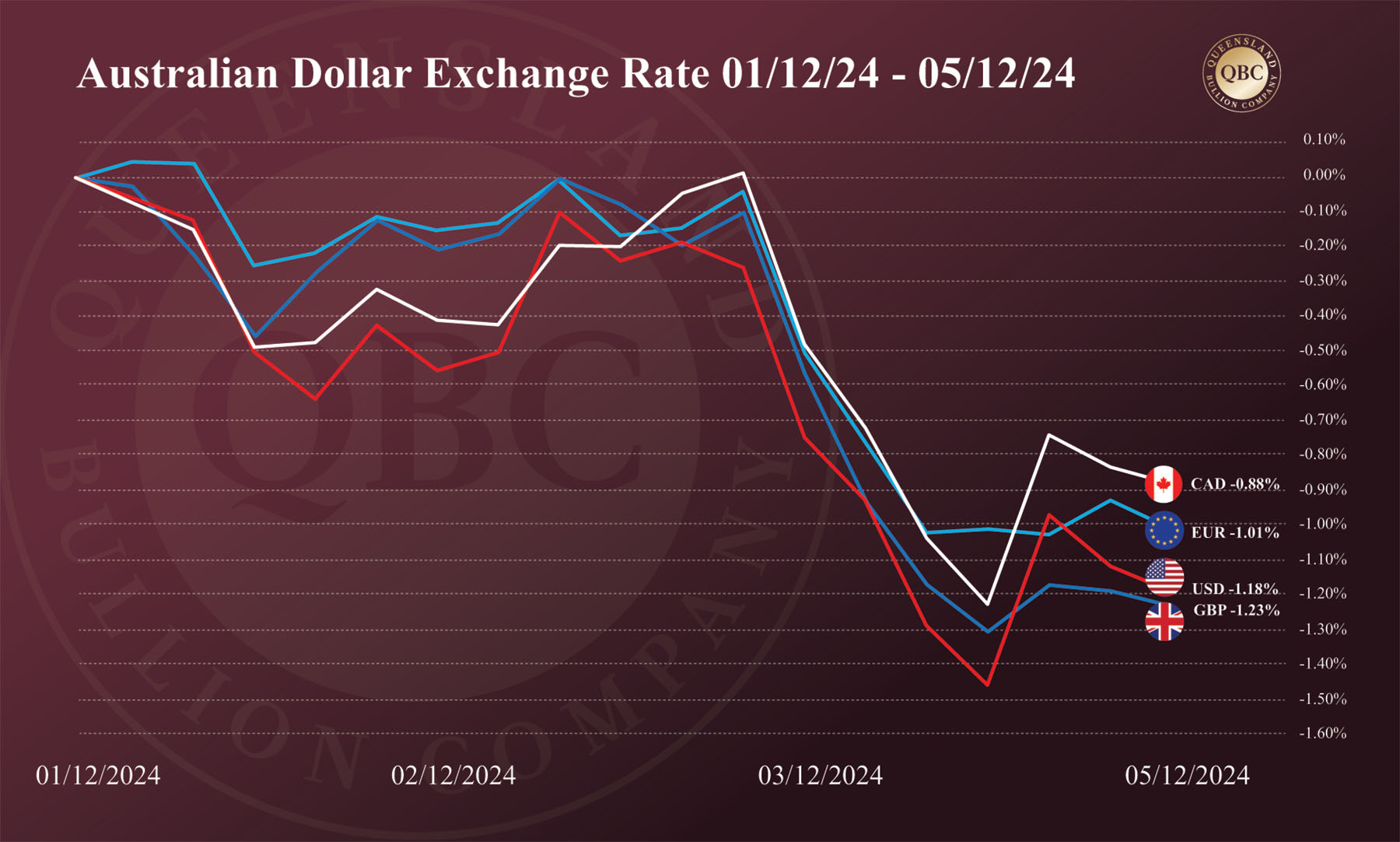
Lastly, and most importantly for Australian investors, is the immediate performance of our own currency.  The AUD took a nosedive in recent days which, in turn, increased the value of gold in local markets.  While the exchange rate against the USD is most important in affecting the price of precious metals in Australia, as per the graph below, it dived also against the British Pound, the Canadian Dollar, and the Euro in spectacular fashion.  Further, the outlook for our local currency is fairly unfavourable.  The Commonwealth Bank of Australia has warned that President-elect Donald Trump’s use of higher tariffs could turbocharge the Greenback’s rally and that the Australian Dollar could sink as low as $0.50 on the US dollar. This sentiment is echoed by National Australia Bank, with the writer expecting more banks to join the chorus over time.

aud exchange graph

With the weakening Australian dollar, recession looming, and global conflict sitting on a tinder box, travelling overseas may not be a high priority for Aussies in 2025.  Although, if one does need to travel, any bullion investor would advise to buy some gold to offset the expenses.

Posted on — Leave a comment

Five Reasons that Silver is Set to Skyrocket in the Near Future

The silver correction in the Australian market since the beginning of November now exceeds 11%.  With gold trading at $4,158.35, silver at $47.43, and platinum at $1,464.90, it is little wonder if retail investors feel a little overwhelmed momentarily; however, the prospects for precious metals for 2025 remain promising, in particular, silver.  Below we outline five reasons why silver will likely increase in the coming year.


Global recession will likely be declared next year.

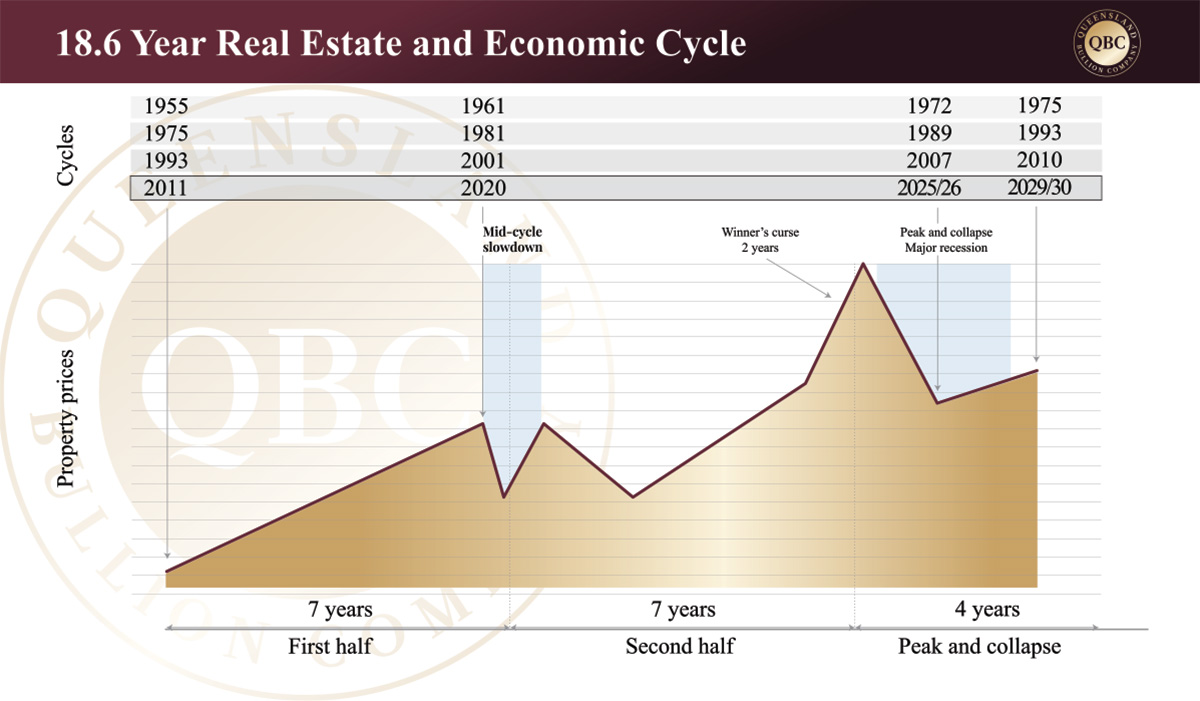
This is a big statement so what is it founded on?  Based on financial cycles where recessions occur every 18.6 years, it can be argued that a recession can be expected anytime from now if one applies this formula from the 2008 Global Financial Crisis (GFC).  The GFC officially occurred between December 2007 and June 2009.  However, be aware that recessions take years to wind up and wind down. View a timeline on how the GFC unfolded here.  As per most recessions the US government declared it retroactively in December 2008, twelve months late.  This means that Western world could already be in recession now, as many economists acknowledge, even though the Australian government is still spruiking blue skies and a healthy real estate industry. Silver tends to outperform gold in the pre-recession and post-recession stages.  Could the spike in silver prices this year herald a recession in 2025?  The odds are likely.  Although gold performed almost as well, perhaps the pre-recession spike is yet to come.

The below graph shows the 18.6 year real estate and economic cycle as it has played out since the 1950s.

Silver provides positive responses to FED and RBA interest rate cuts.

Historically silver responds well to central bank rate cuts.  For the last three announcements by the Reserve Bank of Australia silver has responded with an increase between 1 and 3%.  Interestingly, silver responds even better to US Federal Reserve rate announcements, averaging price increases between 3.3 and over 8% in Australian markets.  The general consensus is that if rates are to move next year it will continue to decrease.  Expect healthy responses from silver each time a central bank executes a rate cut.


Silver has seen physical production deficits for the fourth year running.

According to the Silver Institute, it has had slight growth in supply and (paper) demand but the global market is likely to close the year with a record physical deficit for 2024.  This will be the fourth year running with both 2023 and 2024 elevated by historical standards, and with deficits likely to persist in the foreseeable future. To read about why the price of silver is suppressed despite the physical deficit read our previous article.


To this point, the Silver Institute anticipates that industrial demand is set to increase by 7%, surpassing 700 million ounces this year.  The main driver is applications around the solar industry; however, two more drivers worth watching in the coming year derives from the rapid adoption of AI and storage of information because of the amount of energy both use (as well as physical demand in the form of chips and so on).  For example, the amount of data used in 2025 is anticipated to be 50% more than it was this year.  A simple ChatGTP search uses ten times more energy than a standard Google search.  While technology giants will be looking to nuclear power as a source of energy, smaller companies will likely turn to solar energy.  Further, as financial markets weaken institutions will look at how best to boost national economies, with the tech sector offering an easy answer as far as funding innovation goes.


The gold to silver ratio is unbalanced.

2024 has seen the gold to silver ratio sit at 1 ounce of gold to between 80 and 90 ounces of silver.  In recent times this ratio has averaged 1:63 over the last 50 years, and 1:56 over the last 100 years.  But thanks to the paper derivative market the ratio is now insanely high.  When the derivative market corrects, expect this ratio to adjust at the same time.


The USD to AUD exchange rate will push silver prices higher.

Finally, as discussed in our last article, the likelihood of the USD strengthening is high.  As it strengthens, and if the Australian Dollar does not, the price of silver locally will also increase. if you are interested in buying silver online, then you can visit this page on our website.


In summary, despite the talk of war, recession and associated societal discomfort, there is a lot to look forward to in 2025 for gold and silver bulls.  The super cycle may have already started, with governments yet to play catch up.