

Why are Central Banks Still Buying Gold at Record Prices?
by QBC Analyst
Only recently we examined the latest gold price forecasts from many of the world’s largest institutional banks. While several expect a period of consolidation or modest weakness in the short term, they all maintain a forecast between USD $4,800 and $6,000 by year end. At first glance, this appears contradictory. If gold is expected to soften over the coming months, why do these same institutions remain so confident about its longer-term prospects? The answer lies less with private investors and speculative traders, and more with the world’s central banks. Unlike retail investors, central banks do not buy gold in response to short-term price movements. They accumulate gold as part of a long-term reserve management strategy, often with investment horizons measured in decades rather than months. As a result, their buying has become one of the most important structural forces supporting the gold market today. Currently gold trades at AUD $5,828, silver at $82.80, and platinum at $2,307.72.
Central banks continue to buy gold at record levels
Central banks are among the largest holders of physical gold in the world. Collectively, they own around one fifth of all the gold ever mined throughout history, making them one of the single largest sources of demand for the precious metal. Far from reducing their holdings after gold reached record prices, central banks have continued to accumulate bullion at historically elevated levels. According to the World Gold Council (WGC), central banks purchased a net 244 tonnes of gold during the first quarter of 2026 alone, a 3% increase over the same period last year despite significantly higher prices.
This follows several years of extraordinary buying. Over the past four years, central banks have purchased an average of approximately 1,000 tonnes of gold each year, around double the annual average recorded during the previous decade. This sustained demand has coincided with one of the strongest bull markets in gold’s modern history. In 2025, total global gold demand exceeded 5,000 tonnes for the first time on record. During the same year, gold recorded 53 new all-time highs and generated an unprecedented market value of approximately USD $555 billion.
While jewellery, investment and industrial demand all contributed to this outcome, central banks have increasingly become the market’s most consistent long-term buyers.
Gold has overtaken US treasuries as a reserve asset
Perhaps the clearest indication of changing attitudes toward gold comes from the composition of official reserve assets. For decades, governments around the world relied heavily on US Treasury securities as one of the primary stores of national wealth. Treasury bonds offered liquidity, security and the backing of the world’s largest economy. That relationship is now changing. According to the European Central Bank, gold accounted for 27% of official global reserve assets at the end of 2025 (central banks combined), overtaking US Treasuries which represented 22% of reserves. The euro accounted for approximately 15%, while the US dollar itself continued to represent around 57% of global foreign exchange reserves.
Importantly, this is not a story about central banks abandoning the US dollar altogether. Rather, it reflects an increasing desire to diversify reserve assets away from instruments that carry counterparty risk and toward assets that exist outside the global financial system. Gold occupies a unique position in this regard. Unlike government bonds, physical gold is no one’s liability. The physical asset cannot be printed, defaulted upon or diluted through monetary policy. For reserve managers seeking long-term stability, these characteristics have become increasingly valuable.
Why the weaponisation of the US dollar is changing Reserve Bank asset management
One of the most significant catalysts for central bank buying emerged following Russia’s invasion of Ukraine in 2022. After Western governments imposed sanctions on Russia approximately USD $300 billion of Russian central bank reserves held overseas were frozen. At the same time, Russia was excluded from the SWIFT international payments network, severely limiting its access to the global financial system.
While these actions were directed at a specific geopolitical event, they also demonstrated an important reality to reserve managers around the world. Foreign exchange reserves held within another country’s financial system may not always remain accessible during periods of political conflict. Physical gold is fundamentally different. Gold stored within a country’s own borders cannot be frozen by another government, sanctioned by a foreign central bank or restricted through international payment systems. For many countries, particularly emerging economies, this reinforced gold’s role as a strategic reserve asset rather than simply an investment.
The World Gold Council’s latest Central Bank Gold Reserves Survey reflects this changing mindset. The survey found that concerns surrounding geopolitical instability, reserve diversification and sanctions have become increasingly important considerations when central banks determine the composition of their reserves. Of the survey participants, 81% expected gold to hold a larger portion of the collective asset pool, while 74% expect the US dollar’s share of global reserves to lower over the next five years.
Emerging economies are driving central bank gold buying
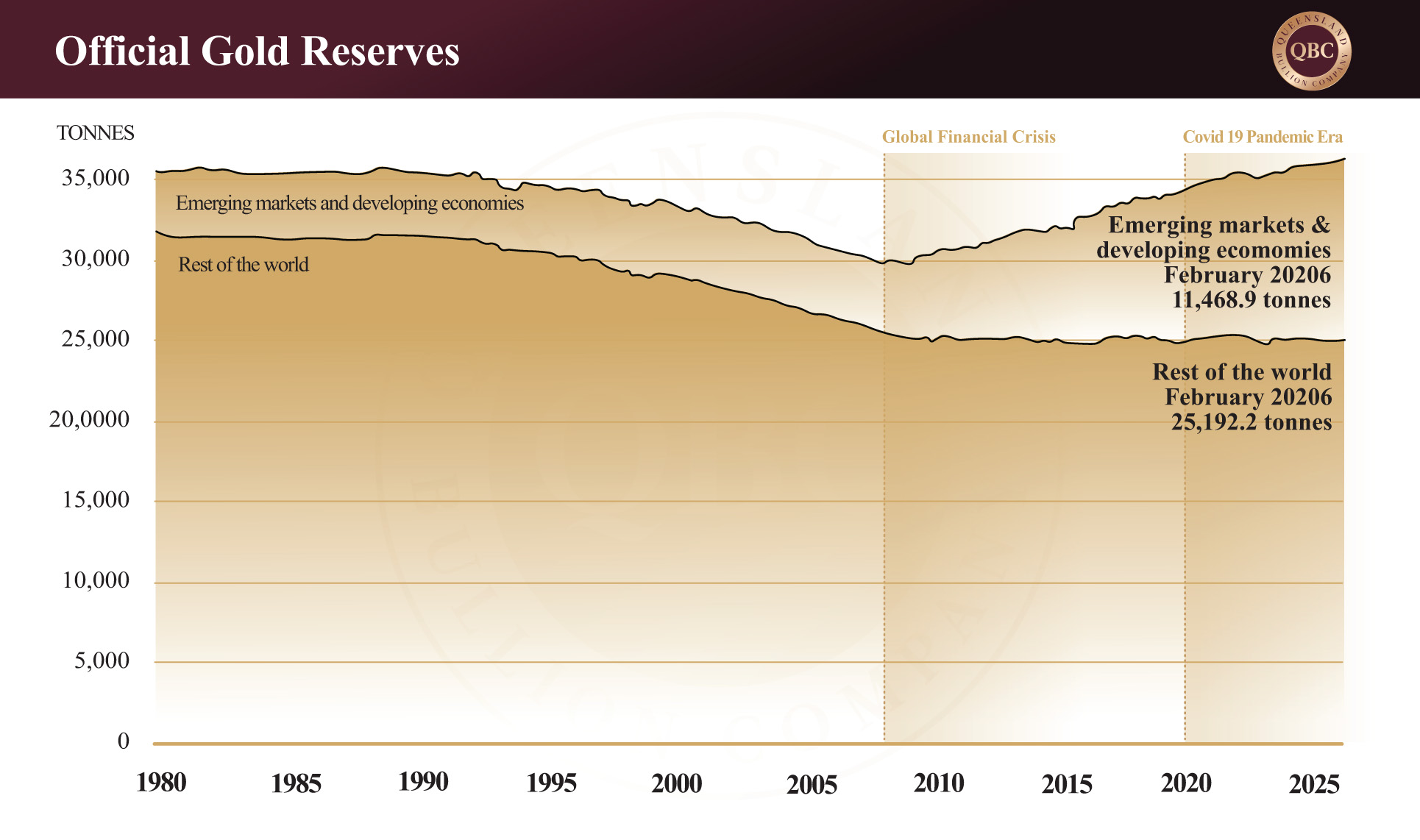
Although central bank buying has become a global phenomenon, Emerging Markets and Developing Economies (EMDE) central banks have been among the most active purchasers. Around 37% of EMDE central banks (surveyed by the WGC) reported “concerns about sanctions” or the “anticipation of changes in the international monetary system” as factors behind their decision to hold gold. Since the 2022 Russia Ukraine War broke out, China has added more than 350 tonnes of gold to its reserves. Poland has purchased approximately 320 tonnes, while India has added around 130 tonnes. Türkiye also accumulated hundreds of tonnes before reducing holdings in early 2026 to assist with domestic economic pressures after the price moved higher.
The motivations behind these purchases become even clearer when further examining the World Gold Council’s survey data. Among central banks in emerging and developing economies, 95% identified geopolitical instability as an important factor influencing reserve management decisions. Inflation concerns were cited by 84% of respondents, while 60% highlighted the growing significance of trade conflicts and tariffs. Each of these figures was materially higher than those reported by advanced economies. These nations are not simply reacting to today’s gold price. They are responding to a world that appears increasingly fragmented, where geopolitical relationships, trade policies and reserve management strategies are becoming more complex than at any time in recent decades.
Could central bank buying push gold to USD $8,000?
The influence of central bank buying can perhaps best be illustrated by Deutsche Bank, Germany’s leading international investment bank. Rather than publishing a conventional price forecast, the bank modelled a scenario in which gold’s share of global central bank reserves increases from around 30% today to 40% over the next five years. Under this assumption, Deutsche Bank estimated that gold could reach approximately USD $8,000 per ounce, representing almost 80% upside from current prices. Importantly, the bank stressed that this is not an official price forecast, but a conceptual exercise demonstrating the potential impact of continued reserve diversification. Since the Global Financial Crisis (GFC), central banks have accumulated more than 225 million ounces of gold, while official buying has expanded well beyond traditional purchasers such as China, Russia, India and Türkiye to include countries such as Kazakhstan, Saudi Arabia, Qatar, Egypt and the United Arab Emirates. Add to this the fact that many European banks continue to accrue despite the phenomenal amount of legacy gold reserves already held. Whether gold ultimately reaches USD $8,000 is almost beside the point. The significance of the analysis lies in illustrating how continued central bank demand could become one of the most powerful long-term drivers of the gold market.
What central bank gold buying means for investors
Considering these circumstances many institutional banks continue to publish bullish long-term gold forecasts despite expecting periods of short-term weakness. Short-term price movements are influenced by a wide range of factors, including interest rate expectations, inflation data, employment figures, currency movements and investor sentiment. These influences can easily push gold higher or lower over periods of weeks or months.
However, central bank buying operates on an entirely different timeframe. Reserve managers are making strategic decisions that may influence portfolios for decades. Their purchases are driven by diversification, geopolitical considerations, financial stability and the preservation of national wealth rather than short-term market volatility. While central bank purchases may moderate from the record levels seen in recent years, they are still expected to remain the market’s most reliable source of demand because concerns surrounding fiscal deterioration, currency credibility and reserve diversification remain firmly in place.
What does this mean for investors? Short-term pullbacks should not necessarily be confused with deteriorating long-term fundamentals. Daily market movements often reflect changing sentiment, while central bank buying reflects structural shifts occurring within the global financial system. If the world’s largest and most sophisticated reserve managers continue increasing their exposure to physical gold despite record prices, it suggests they see the role of gold becoming more important, not less, over the years ahead.
That does not mean gold will rise in a straight line. Markets rarely do; however, it does help explain why many of the world’s largest institutional banks remain comfortable forecasting periods of short-term volatility while simultaneously maintaining a constructive outlook over the next twelve months. Sometimes the most important signal isn’t found in tomorrow’s price action, but in what the world’s central banks are quietly doing behind the scenes.