
Part 1: Why Are the US and Japan Trying to Prop Up the Yen?
by Evie Soemardi
The Japanese yen is the third most actively traded currency in the world, but its importance extends well beyond foreign exchange markets. For decades, exceptionally low Japanese interest rates have allowed investors to borrow cheaply in yen and deploy that money into higher-yielding assets overseas, creating what is known as the yen carry trade. The strategy has helped channel enormous amounts of capital into global bond, equity and other financial markets, but changes in interest rates and persistent weakness in the yen is now creating problems for Japan and, increasingly, the United States. After falling to its weakest level in approximately forty years, Japan intervened heavily to support its currency before the US took the extraordinary step of joining the effort in August. The intervention initially strengthened it by 5.8%, although it has since surrendered roughly half those gains. At the time of writing, gold trades at approximately AUD $6,352 per ounce, silver at AUD $95.72 and platinum at AUD $2,590, placing renewed focus on precious metals as governments intervene to manage instability across currencies and sovereign debt markets.
What is the yen carry trade?
A carry trade is relatively simple in principle. An investor borrows money in a country where interest rates are low and invests those funds somewhere offering a higher return. The difference between the cost of borrowing and the return generated by the investment is known as the “carry”. For decades, Japan has provided almost ideal conditions for this strategy because interest rates remained close to zero while rates elsewhere were considerably higher.
A traditional yen carry trade might therefore involve borrowing Japanese yen, converting the funds into US dollars and purchasing US Treasury securities. The investor pays the comparatively low Japanese interest rate while receiving the higher return available in the United States. The same principle can be applied to equities, corporate bonds and other assets, meaning yen-funded capital has found its way into everything from US technology stocks to more speculative markets such as cryptocurrency.
The strategy becomes even more profitable when the yen depreciates. If an investor borrows yen, converts it into US dollars and the yen subsequently falls against the dollar, fewer US dollars are required to purchase the yen needed to repay the original loan. However, the opposite is equally important. A rapidly appreciating yen can turn a profitable carry trade into a loss, forcing leveraged investors to sell assets and repurchase yen to meet their obligations. It is this reversal that makes the carry trade important well beyond Japan.
How large is the yen carry trade worldwide?
The most accurate answer is that nobody knows exactly. There is no central register recording every yen-funded investment around the world. A Japanese bank lending yen overseas may be facilitating a conventional commercial transaction rather than a speculative carry trade, while hedge funds can establish leveraged positions through derivatives that are considerably harder to observe. Japanese households, insurers, pension funds and institutions also own enormous portfolios of foreign assets that may share characteristics with the carry trade without fitting its narrowest meaning.
Using a strict definition, analysts have previously pointed to approximately USD $350 billion in short-term external lending by Japanese banks as one indication of the size of yen-funded trades. Even this figure could simultaneously overstate and understate the true exposure. Some loans may have nothing to do with carry trading, while leverage and positions established outside the banking system could make the real financial exposure considerably larger. Japanese foreign portfolio investment alone stood at approximately ¥666.86 trillion, or USD $4.54 trillion at the time of the calculation, with more than half invested in interest-rate-sensitive debt securities.
Deutsche Bank has approached the question from an even broader perspective. Currency strategist George Saravelos combined the balance sheets of the Japanese Government, Bank of Japan (BOJ), Government Pension Investment Fund and state-owned banks to examine Japan as though these institutions formed one consolidated financial entity. The analysis characterised approximately USD $20 trillion of Japanese government debt and associated assets as an enormous form of carry trade: low-cost, short-term yen liabilities supporting assets that include higher-returning investments abroad.
Importantly, Deutsche Bank’s USD $20 trillion figure should not be interpreted as an estimate that speculative traders have USD $20 trillion invested in conventional yen carry trades. It is a conceptual analysis of Japan’s consolidated public-sector balance sheet. Its significance lies in demonstrating how deeply decades of inexpensive yen funding have become embedded in Japan’s financial system. There is therefore no credible single figure for the total yen carry trade. Depending on the definition used, the identifiable exposure ranges from hundreds of billions of dollars to trillions, while Deutsche Bank’s broader analysis demonstrates that the same underlying interest-rate dynamic extends across an approximately USD $20 trillion public-sector balance sheet. The inclusion of the private sector would only add to these figures.
Why Is the Japanese Yen Falling?
The fundamental problem is the difference between Japanese and overseas interest rates. The Bank of Japan’s policy rate remains around 1%, compared with the US federal funds target range of 3.50% to 3.75%. That difference gives investors a financial incentive to sell yen and purchase US dollars to access higher-yielding American assets. As more investors make that transaction, additional yen enters foreign exchange markets while demand for dollars increases, placing downward pressure on the Japanese currency. The recent US-Japan intervention changed market psychology, but it did not eliminate this underlying interest-rate differential.
Japan’s fiscal position adds another complication. The International Monetary Fund (IMF) estimates gross government debt at approximately 204% of GDP in 2026, leaving policymakers with limited room to increase borrowing costs aggressively without consequences elsewhere in the economy. After decades of exceptionally low rates, households, businesses, financial institutions and the Japanese Government itself have adapted to inexpensive money. Raising interest rates may support the yen, but doing so too quickly risks creating problems for borrowers, banks, asset prices and government finances.
Why does Japan need to support the yen?
A weaker currency is not inherently bad for Japan. Historically, depreciation supported major exporters by making Japanese products cheaper overseas and increasing the yen value of foreign earnings. However, the structure of the Japanese economy has changed as many large companies shifted production overseas, while the country remains heavily dependent on imported energy, food, raw materials and industrial inputs.
At some point, currency weakness therefore becomes inflationary rather than beneficial. Every barrel of oil, shipment of raw materials or imported component priced in US dollars becomes more expensive when translated back into yen. Those costs eventually reach Japanese businesses and households, eroding purchasing power and placing political pressure on the government.
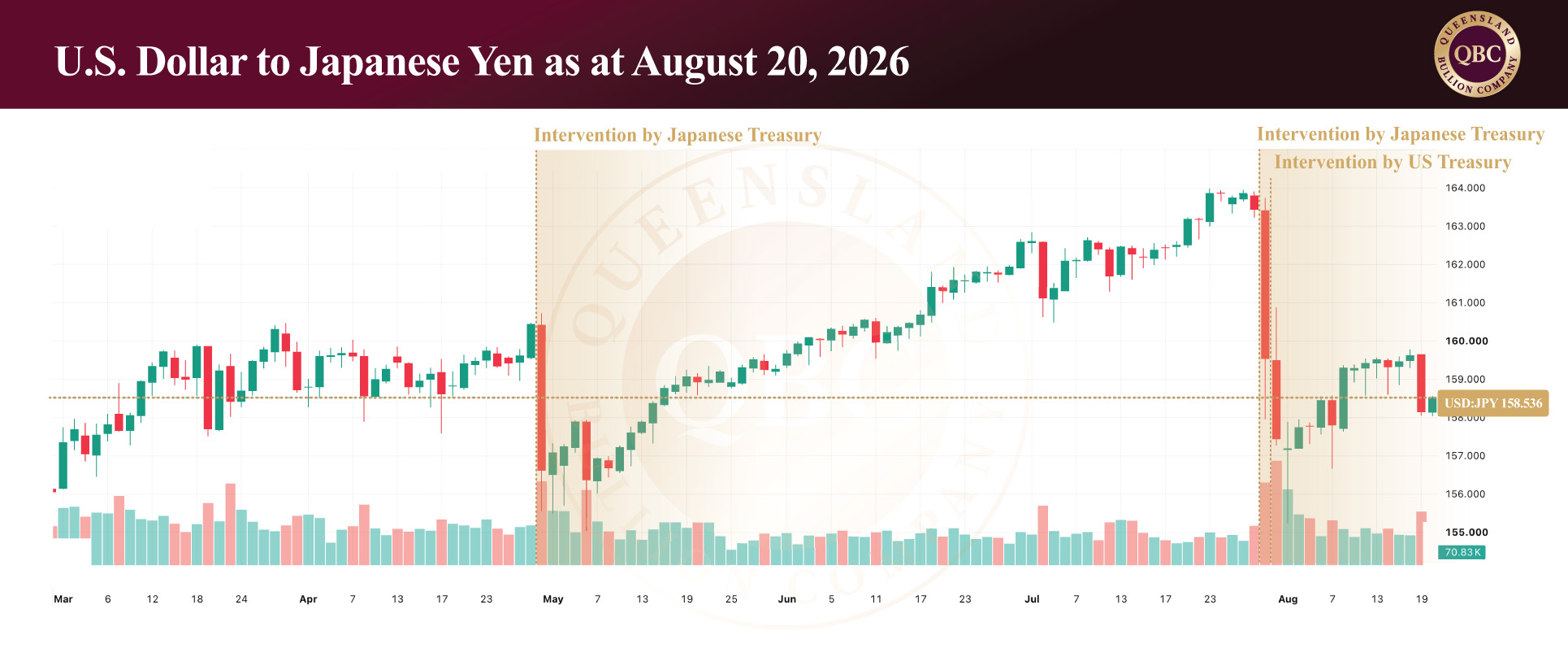
Japan has consequently become increasingly willing to intervene directly. Between 28 April and 27 May 2026 alone, Japanese authorities spent approximately ¥11.7 trillion, equivalent to about USD $73.5 billion at the time, supporting the yen after it moved beyond ¥160 against the US dollar. The more recent joint intervention was larger again in strategic significance because Washington participated directly. Japan reportedly deployed approximately ¥8.45 trillion, or USD $53 billion, while the US also purchased yen.
The difficulty is that intervention can influence price without necessarily changing the conditions producing that price. Selling foreign reserves and purchasing yen reduces the amount of yen circulating and demonstrates that authorities are prepared to defend the currency; however, as long as investors can borrow more cheaply in Japan than in the United States, the incentive underlying the carry trade remains. Intervention can therefore slow speculation and establish psychological boundaries, but without changes to interest rates it may struggle to permanently reverse the trend.
Why is the United States supporting the Japanese yen?
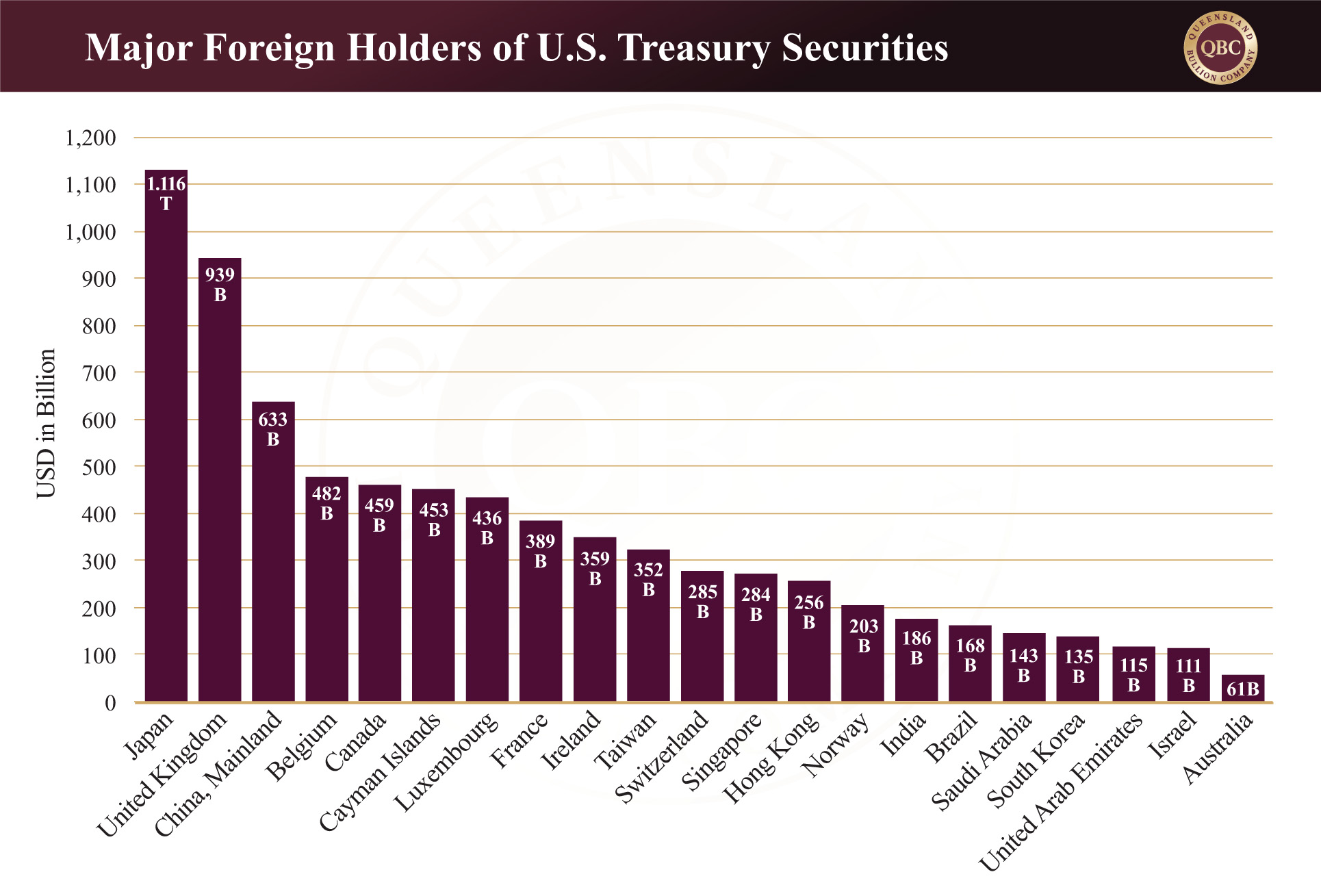
This is where a Japanese currency problem becomes an American bond market problem. Japan is one of the largest foreign holders of US government debt, with Treasury holdings exceeding USD $1 trillion. Those assets provide Japan with a substantial pool of US dollars that can be accessed when it needs to intervene in currency markets. To strengthen the yen, Japan can sell foreign assets such as US Treasuries, receive US dollars and use those dollars to purchase yen. Evidence suggests Japan drew heavily on foreign securities during its intervention earlier this year, with holdings falling by approximately USD $75.6 billion during May, broadly matching the scale of its currency intervention.
For Washington, that creates an uncomfortable problem. If both Japan and America concurrently sell large quantities of U.S. bonds the market can become flooded. Greater supply can push bond prices lower and yields higher, increasing borrowing costs throughout the American economy and potentially making it more expensive for Washington itself to service and refinance debt.
The US therefore has an interest in preventing Japan from becoming a forced seller of American government bonds. During the latest intervention, the United States reportedly sold euros from its reserves to purchase yen rather than selling US dollars, helping support the Japanese currency without directly adding pressure to the Treasury market or materially weakening the dollar.
This helps explain why an apparently domestic Japanese currency problem warranted direct American involvement. Washington is not simply supporting an ally. It is also protecting the stability of the world’s largest sovereign bond market and, by extension, its own cost of borrowing.
What does the yen intervention mean for global financial markets?
The joint intervention achieved something important. It demonstrated that Japan and the United States are prepared to act together and temporarily changed the psychology surrounding the yen. What it has not done is remove the underlying incentive driving the carry trade. Less than two weeks later, the yen had already surrendered approximately half of the gains achieved through intervention, with markets once again testing the willingness of policymakers to defend the currency.
More importantly, the episode demonstrates just how interconnected modern financial markets have become. Japanese interest rates influence the yen carry trade. The carry trade directs capital towards American bonds and equities. Yen weakness increases Japanese inflation. Defending the yen can require bond sales. Bond sales can push American bond yields higher, affecting borrowing costs, equity valuations and ultimately monetary policy throughout the world’s largest economy. Increased borrowing costs can stall economic growth. A currency problem that begins in Tokyo can therefore quickly become a financial problem in Washington and, from there, spread throughout global markets.
For precious metals investors, this interconnectedness is precisely what makes physical assets relevant. Gold and silver do not depend on the solvency of a bank, the repayment of a government bond or the maintenance of an interest-rate differential between two countries. Their prices will still fluctuate with currencies, yields and investor sentiment, but physical bullion itself exists outside the network of liabilities connecting governments and financial institutions. The recent intervention does not prove that a wider financial crisis is imminent, but it does seem to be hurtling in this direction.
That raises the more important question. If the yen carry trade is large enough to connect Japanese monetary policy with trillions of dollars of international assets, what happens if investors are eventually forced to unwind it? In the second part of this series, we examine how a rising yen could affect Japan, US Treasuries, international equity markets and the enormous pool of leveraged capital built around decades of inexpensive Japanese money.