
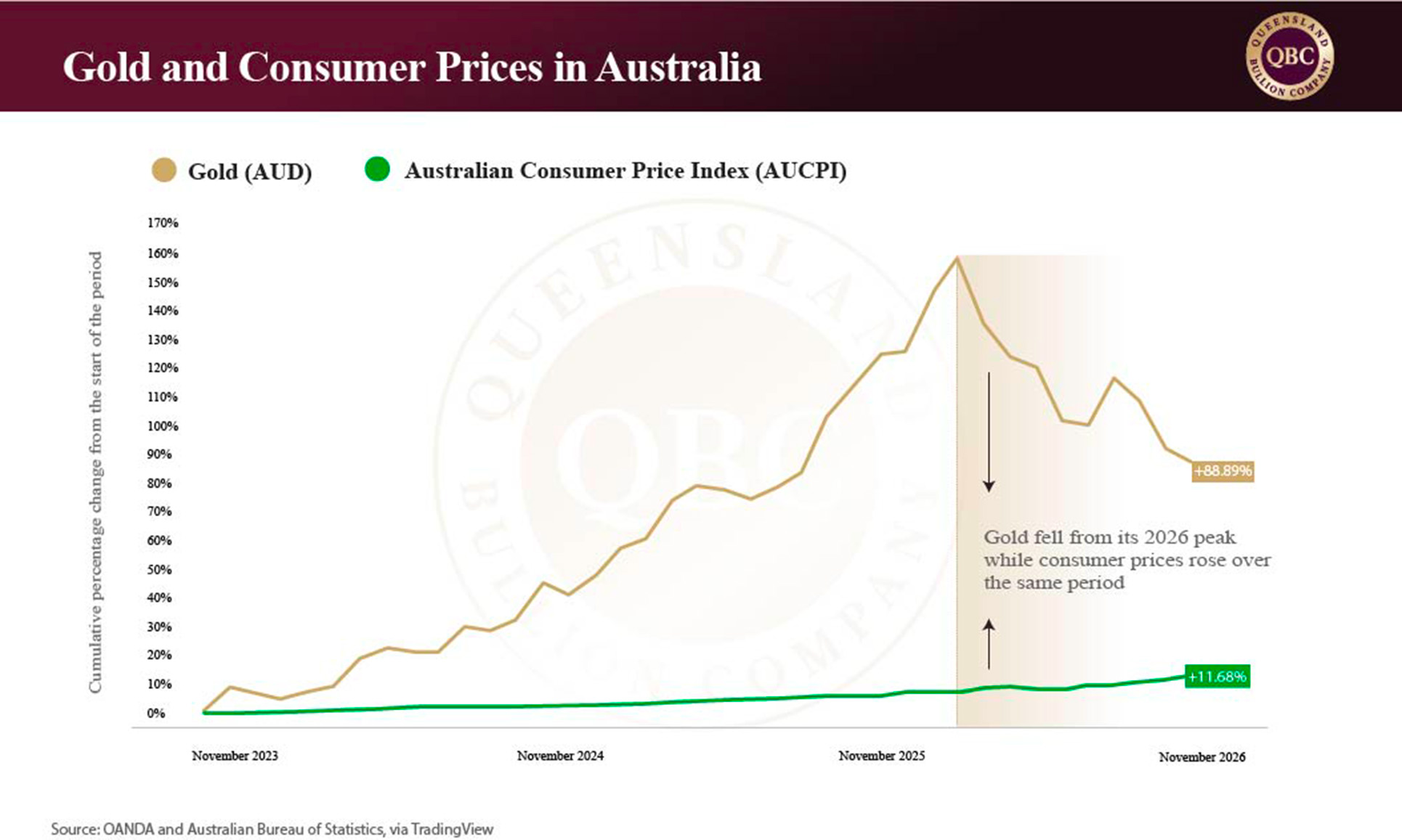
Gold is often described as an inflation hedge and a safe-haven asset. Neither description means the price must rise whenever inflation is high or financial markets are falling. In the short term, gold responds to several forces at once: real interest rates, the US dollar, central-bank policy, liquidity needs, investor positioning and confidence in the financial system. For an Australian buyer, the Australian dollar adds another layer.
Historically, gold has often served as a long-term store of value and portfolio diversifier rather than behaving like a simple one-variable trade. Its effectiveness still depends on the period, currency and purchase price.
Why can gold fall while inflation is rising?
Inflation does not act on gold in isolation. Markets first ask what central banks are likely to do about it.
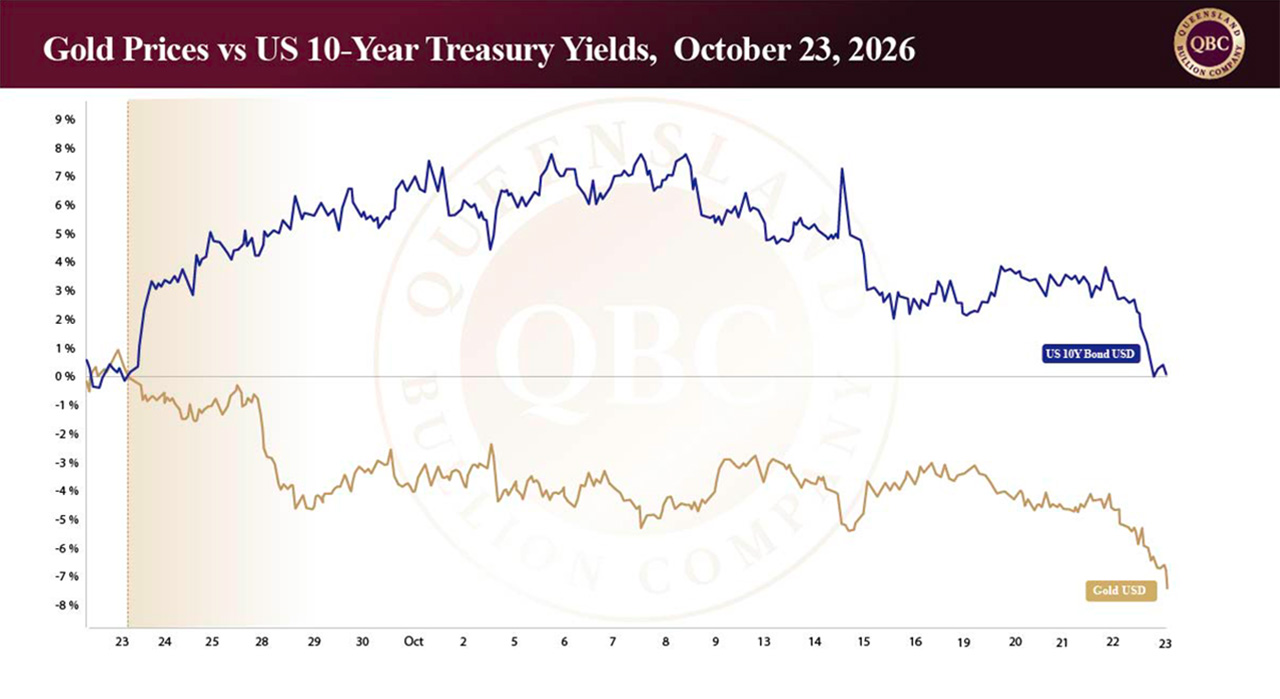
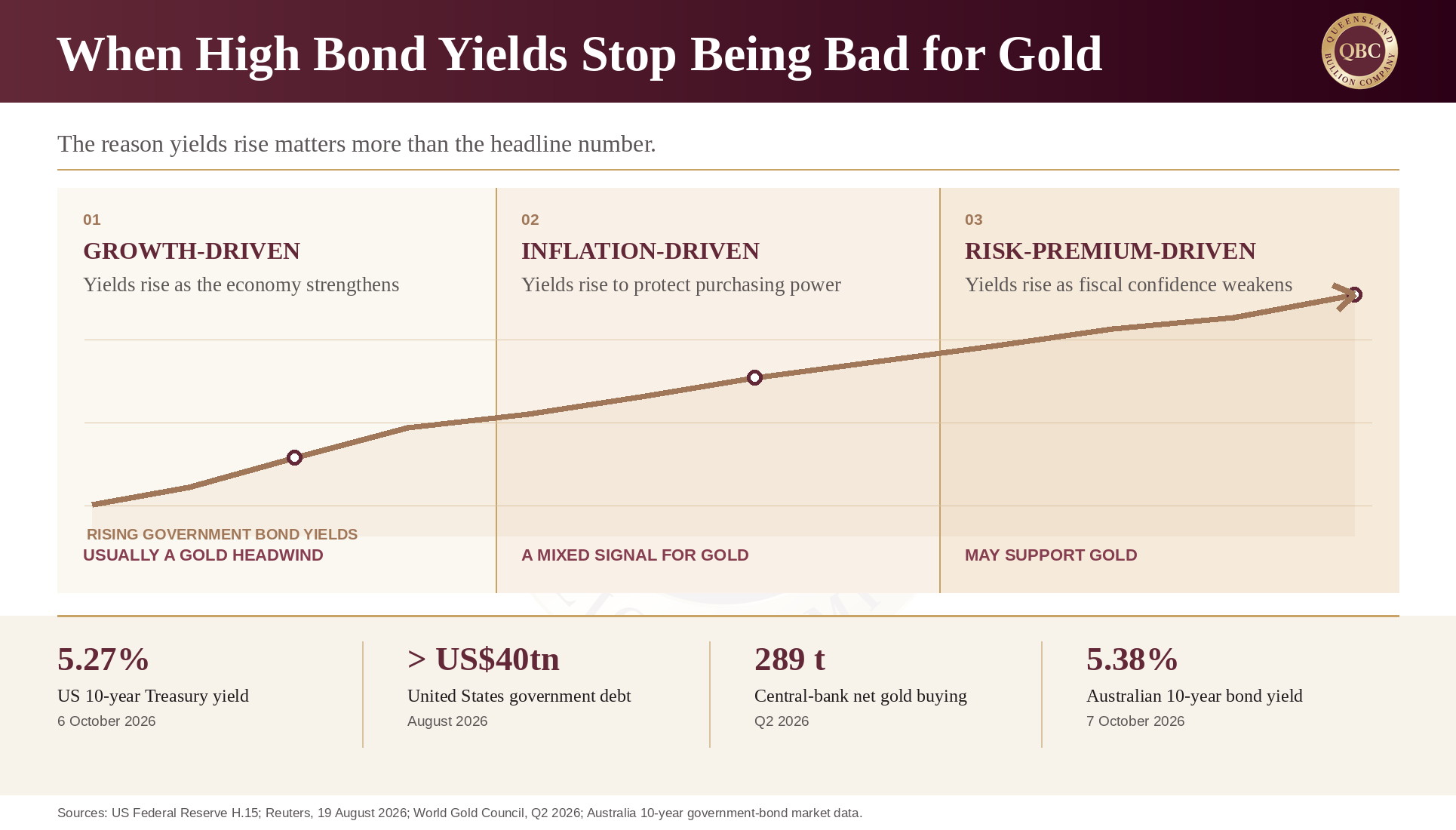
If higher inflation is expected to produce higher interest rates and tighter financial conditions, gold can come under pressure. Gold does not pay interest, so stronger inflation-adjusted returns from cash or bonds raise the opportunity cost of holding it.
This is why real interest rates matter. A nominal rate of 5% produces a real return of roughly 1% before tax when inflation is 4%, but a negative real return when inflation is 6%. Gold has generally faced a greater headwind when real yields are rising and meaningfully positive.
Recent Kitco reporting on analysis by Heraeus made the point directly: the US dollar tends to be an important short-term influence, while real yields are more important over longer periods. Heraeus also noted that central-bank buying and other sources of demand can sometimes outweigh the rates relationship. There is no single indicator that explains every gold move.
The US dollar is another important factor because international gold is principally quoted in that currency. A stronger US dollar can make gold more expensive for buyers using other currencies and can pressure the US-dollar gold price. Conversely, a weaker dollar can support gold.
That relationship is especially important in Australia. The local gold price is broadly the US-dollar price converted through the AUD/USD exchange rate. A falling Australian dollar can cushion a fall in US-dollar gold, while a rising Australian dollar can reduce the local benefit of a rally. Australian inflation and Australian-dollar gold therefore do not move together mechanically.
The type of inflation also matters. A brief rise caused by fuel or supply disruptions may be treated differently from persistent inflation driven by wages, credit growth or monetary expansion. If a shock is expected to fade and policy credibility remains intact, demand for gold may be limited. Entrenched inflation, low real rates, heavier debt burdens or weaker confidence in policy can strengthen the case.
This is consistent with the World Gold Council’s April 2021 research on gold as a strategic inflation hedge, which says gold has been a proven long-term inflation hedge but that its short-term relationship with changes in consumer prices is much less convincing. Its 2026 strategic-asset research also reports that gold has outpaced US and global consumer-price indices since 1971. These are long-horizon observations, not a promise that gold will rise in every inflationary month or year.
Why do investors sell safe havens during a crisis?
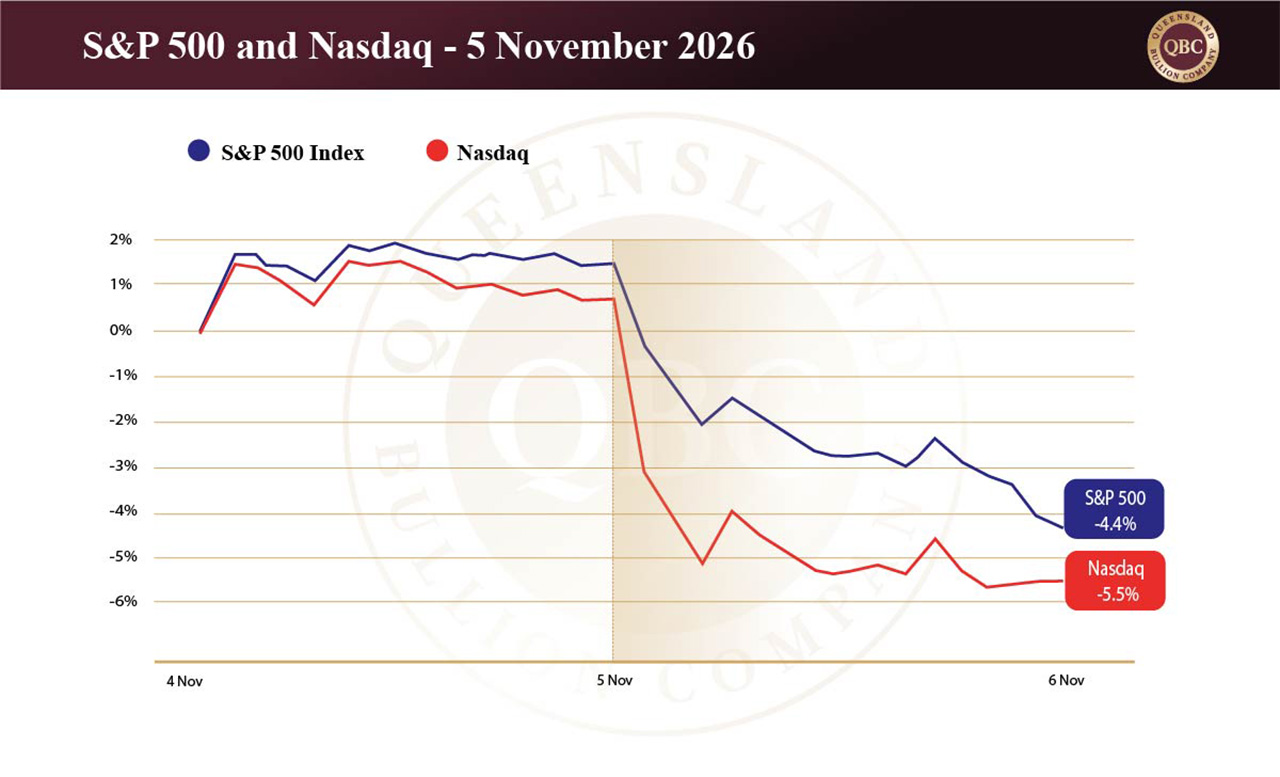
The first phase of a financial crisis is often a scramble for cash rather than a considered decision about long-term value.
An investor who has borrowed to buy shares may receive a margin call when those shares fall. A fund facing withdrawals must raise cash. A business may need US dollars for debt, collateral or operating obligations. The holder may sell whatever can be sold quickly, not necessarily the asset they like least.
Gold is one of the world’s deepest and most liquid asset markets. That is normally a strength. During acute stress, however, it can also make gold a source of emergency funding. Investors may sell gold because there is a ready market for it while less liquid assets are difficult to sell at a sensible price.
The World Gold Council’s review of gold-market volatility and liquidity notes that investors sold gold during both the Global Financial Crisis and the COVID-19 market shock to meet margin calls and other liquidity needs. It also found that gold trading volumes rose sharply during recent sell-offs. In other words, gold’s temporary weakness can reflect its usefulness as a liquid asset rather than a loss of its strategic role.
This explains why a safe haven can fall with shares. The term does not mean “rises every day that risk assets fall”. It means an asset may preserve value, diversify a portfolio or recover differently across the broader crisis cycle.
The sequence matters. Investors initially sell assets and seek cash, often US dollars. If the crisis later produces interest-rate cuts, liquidity support, currency-devaluation or purchasing-power concerns, or declining trust in institutions, gold may benefit. That is not guaranteed, but it is different from what happens during the first days of forced selling.
A recent Reuters analysis published by Kitco reached a similar conclusion: the cause of a shock matters. Government bonds can struggle when the threat is inflation and tighter policy, while gold can also behave unevenly when positioning and liquidity dominate. No defensive asset works perfectly in every crisis.
What did Ray Dalio mean by a 10–15% gold allocation?
Ray Dalio’s argument is about diversification, not a short-term gold-price forecast.
In a November 2026 interview, the Bridgewater Associates founder said most financial markets perform well while the credit system is functioning normally. When excessive debt creates problems in that system, he argued, gold can be an effective diversifier. He put the allocation at between 10% and 15% of a traditional portfolio.
Kitco’s report on Dalio’s comments placed that figure within his broader preference for genuinely uncorrelated assets. The objective is not to find one asset that always rises, but to combine assets that respond differently so no single outcome dominates the portfolio.
Dalio’s 10–15% figure should not be treated as a universal rule or a Queensland Bullion Company recommendation. Its relevance will vary with income needs, debts, liquidity requirements, time horizon, existing assets, risk tolerance and the form of gold exposure. Someone who owns a bullion-related business, for example, may have a different economic exposure from an investor whose wealth is concentrated in shares or property.
Physical bullion serves a different purpose from an exchange-traded product or mining shares. When owned outright, the metal has no issuer credit risk. The ownership and custody arrangement can still involve storage-provider, legal, insurance, security, operational, buy–sell spread and access risks. Mining shares add business and market risk and should not be assumed to behave like physical metal.
What should Australian investors take from this?
Gold is not a direct bet on the next inflation figure, and a safe haven is not an asset that must rise during every sell-off.
The more useful questions are whether real returns on cash and bonds are improving or deteriorating, whether the US dollar is strengthening, whether investors need liquidity, whether confidence in policy is holding and whether the Australian dollar is helping or hurting the local gold price.
Dalio’s argument is that gold can earn a place in a diversified portfolio because it responds differently when the credit system is under pressure. The case is strategic rather than predictive. Gold can be volatile, underperform for long periods and fall when investors urgently need cash.
Gold’s long-term role is not disproved by a weak month during inflation or by an initial fall during a crisis. Equally, its history as a store of value does not remove price risk. Relevant considerations include what risk the holding is intended to address, the ownership and custody structure, and the size of the exposure before a crisis arrives.