Posted on

What Do the US Election, the Market Correction and AI Concerns Mean for Gold and Silver?

Why political gridlock, falling technology shares and questions about AI spending matter to Australian bullion owners?

Three developments are moving through financial markets at the same time. The Democrats are set to control both chambers of the United States Congress from January, the S&P 500 has suffered its sharpest one-day fall since April 2025, with technology and semiconductor shares leading a broader Wall Street decline, and investors are also asking whether the enormous amount being spent on artificial intelligence will produce an adequate financial return.

These developments became linked in market pricing, although no single factor explains the entire sell-off. Investors were reassessing AI spending and data-centre expansion alongside weak semiconductor results, expensive valuations, crowded positions and elevated financing costs.

For gold and silver, this is not a simple “risk rises, metals rise” equation. Gold can benefit from lower yields and a weaker US dollar, but it may also be sold when investors need cash. Silver remains more exposed to industrial activity and risk appetite. At the time of writing, gold trades at approximately AUD $5,892 per ounce and silver at AUD $74.16 per ounce.

The useful question is not whether one election or one difficult trading session guarantees higher bullion prices. It is whether the foundations supporting financial markets have become less certain.


What Did the US Election Change?

The midterm result is set to give Democrats control of both the House of Representatives and the Senate when the new Congress convenes in January 2027, while Republican President Donald Trump remains in the White House.

That is expected to create divided government. The President retains executive and veto power, while Congress controls legislation, funding and investigations. Major legislation may become harder to pass, and some analysts expect more difficult budget and debt-limit negotiations.

Markets initially welcomed the clarity. The next reaction was more cautious as investors considered whether the result could bring greater scrutiny of AI data centres, energy use and the broader technology trade.

For gold, there are two competing implications. First, slower fiscal expansion or weaker growth expectations can reduce bond yields and pressure the US dollar. Gold pays no interest, so falling yields reduce the opportunity cost of holding it. A weaker US dollar also makes gold less expensive for buyers using other currencies.

Second, divided government does not automatically produce fiscal discipline. It may also create debt-ceiling confrontations, delayed budgets and shutdown risks. That kind of uncertainty can support gold’s role as an asset that does not depend on a government or company making a future payment.

The election matters to gold, but not because one political party is inherently “good” or “bad” for the metal. What matters is how the result affects interest rates, the currency, fiscal policy and confidence in financial assets.


Why Did US Markets Correct So Sharply?

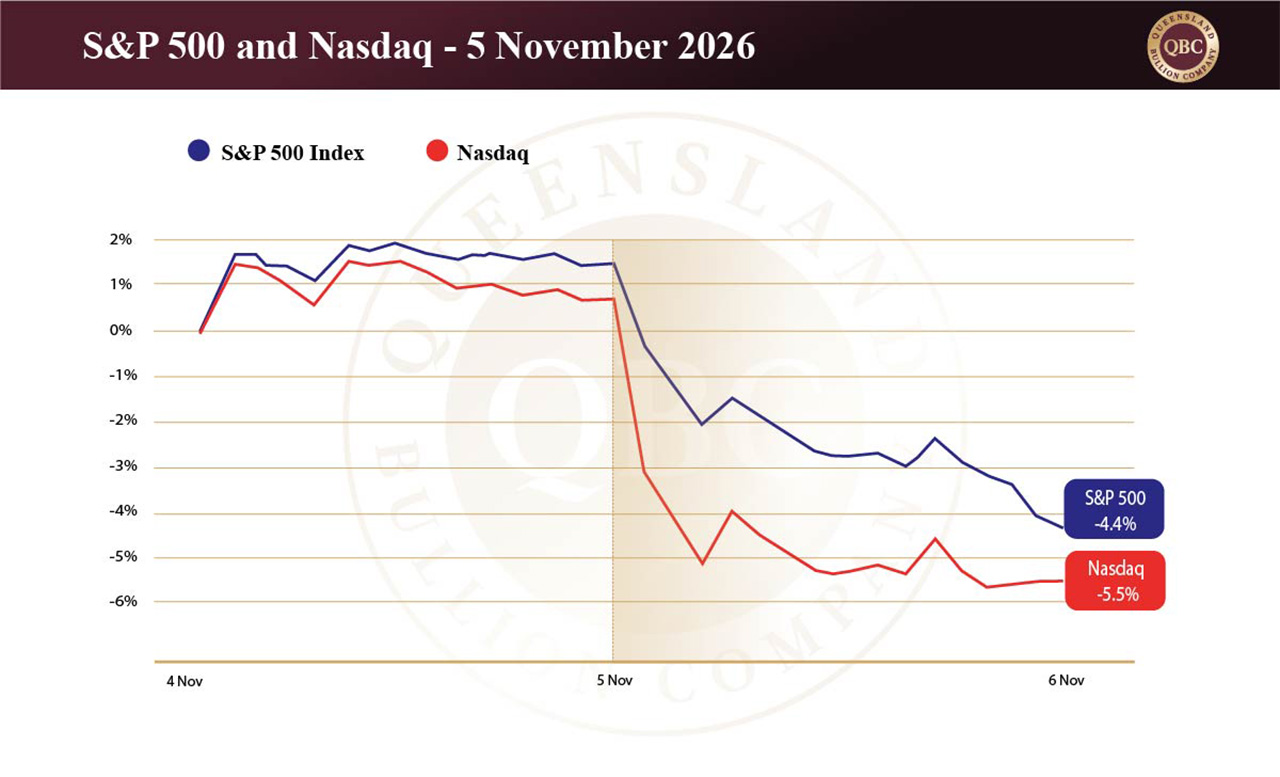
In the US session on Thursday 5 November, which closed Friday morning AEST, the S&P 500 fell 4.4%, the Dow Jones Industrial Average lost 3.4% and the Nasdaq Composite dropped 5.5%.

The Nasdaq closed more than 10% below its October record. A fall of at least 10% from a recent peak is commonly described as a correction. That is serious, but it is not the same as a market crash or a depression. Corrections are a normal part of markets, especially after prices have risen faster than underlying earnings.

What made this correction important was its concentration in technology-related shares, although selling spread across the broader market. Semiconductor, data-centre and other AI-related shares led the decline. The Philadelphia Semiconductor Index fell approximately 12% during the session, while numerous large technology companies recorded double-digit percentage falls.
Several pressures arrived together:

  • Investors saw the possibility of greater scrutiny of data-centre development;
  • Public concern over electricity, water use and local infrastructure had become a genuine planning constraint;
  • Weak results from parts of the semiconductor industry showed that demand is not unlimited;
  • High borrowing costs made debt-funded projects harder to justify; and
  • Crowded positions fell quickly as institutions and leveraged investors reduced risk.
  • The first market reaction after the election was relief. The second was arithmetic.


What Is the Real Concern About the AI Industry?

The concern is not that artificial intelligence has no practical value. It is that a useful technology can still be a poor investment when too much money is committed too quickly or share prices assume years of near-perfect execution. Technology success and investment success are not the same thing.

The good news is that the largest technology businesses generate substantial revenue and operating cash. They are not all speculative start-ups. The bad news is that AI infrastructure is consuming that cash at an extraordinary rate.

Reuters calculated that Microsoft, Alphabet, Amazon, Meta and Oracle generated a combined USD $542.9 billion in operating cash flow during the first nine months of 2026. Their combined capital spending doubled from a year earlier to USD $556.9 billion, exceeding operating cash flow for the first time in data going back to 2011. Together, the five companies moved from a USD $143.5 billion free-cash-flow surplus a year earlier to a USD $14 billion deficit.

Free cash flow is the cash left after a business pays for the equipment and infrastructure required to operate and expand. It can fund debt reduction, dividends, buybacks or further investment.

When an individual company’s investment spending persistently exceeds its internally generated cash, it must draw on cash reserves, raise capital, borrow or slow its plans. New shares dilute existing owners. Debt adds interest and refinancing risk. Slower construction may reduce the growth used to justify high valuations.

Meta illustrates the concern. S&P Global Ratings revised its outlook on the company to negative, citing uncertainty around capital spending and free operating cash flow. Meta forecast full-year 2026 capital expenditure of USD $135 billion to USD $145 billion. S&P said elevated spending could keep free operating cash flow negative beyond 2028 if AI monetisation is delayed or fails to materialise. Meta disagreed with S&P’s assessment and said it sees substantial product and business opportunities ahead.

That disagreement captures the debate. The bullish case is that companies are building essential infrastructure for a major technological shift. The sceptical case is that the industry is committing enormous capital before the revenue model has been proved at the same scale.


Does a Technology Sell-Off Automatically Lift Gold?

No. Gold can behave differently during different stages of a market correction. At first, investors may sell liquid assets such as gold to meet margin calls, repay debt or cover losses elsewhere. A falling share market can therefore pull gold lower temporarily, even when the longer-term source of stress appears favourable for bullion.

The next stage depends on interest rates and the US dollar. If investors move into government bonds, yields may fall. If markets expect slower growth or less aggressive monetary tightening, the US dollar may weaken. Both can support gold. A stronger US dollar, forced liquidation or persistently high real interest rates can have the opposite effect.

This is why gold should not be treated as an inverse stock market fund. A share is a claim on a company’s future profits. A bond is a promise that an issuer will make future payments. Physical gold has no issuer required to perform, but its market price still moves and its ownership arrangement still matters.


Why Is Silver More Complicated?

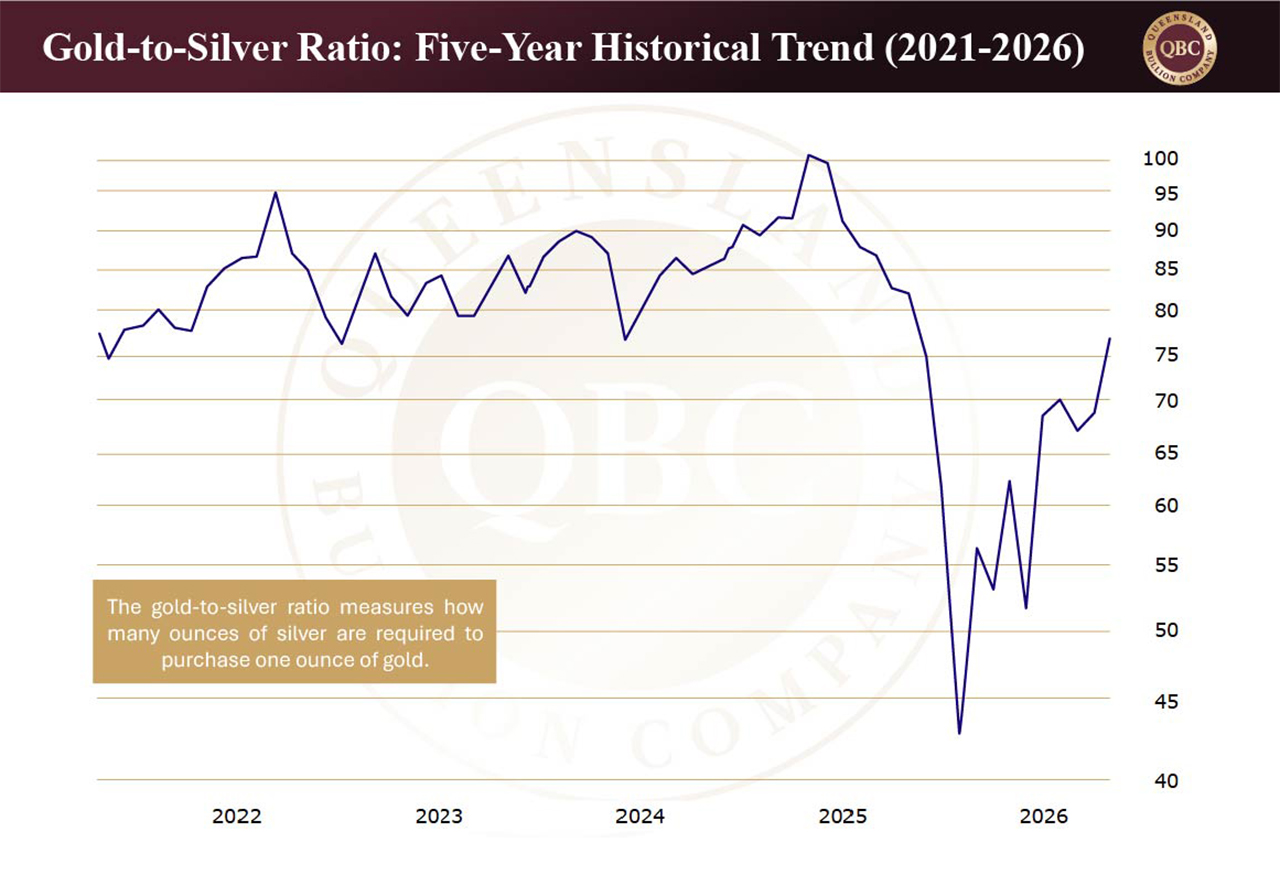
Silver sits between monetary metal and industrial commodity. Like gold, it can benefit from a weaker US dollar, lower interest rates and demand for hard assets. Unlike gold, a substantial part of silver demand is industrial. If the AI correction remains a valuation reset, silver may participate in a precious-metals recovery. If it develops into a growth scare, silver may come under more pressure than gold.

Silver’s market is also smaller, so modest investment flows can create larger percentage moves. It often rises faster than gold during strong metals rallies and falls harder when investors reduce risk.

For a new bullion customer, the simplest distinction is this: gold is primarily a monetary and reserve asset, while silver has both monetary and industrial demand. Neither is “better” in every environment. They respond differently because they perform different economic jobs.


What Should Australian Bullion Owners Watch Next?

Five indicators will help show whether this is a temporary valuation reset or something more serious:

US bond yields: Falling yields reduce one of gold’s main short-term headwinds, while rising real yields have the opposite effect.

The US dollar and AUD/USD: A weaker Australian dollar can support local bullion prices even when USD metals soften, while a stronger Australian dollar can reduce local returns.

Credit conditions: A concentrated technology correction is different from stress spreading into banks, corporate debt and funding markets.

AI company cash flow: Improving cash generation would support the investment case, while further borrowing, share issuance and weak returns would keep concerns alive.

Silver’s industrial signals: Manufacturing activity, physical inventories and investor flows will influence whether silver behaves more like gold or a growth-sensitive commodity.

The strongest counter-case is that new data centres move to more supportive jurisdictions, AI revenue grows rapidly and large technology companies regain confidence. If economic growth remains strong and the Federal Reserve keeps rates higher for longer or raises them further, higher real yields could pressure gold and silver. A stronger Australian dollar would add another local headwind.

The evidence does not justify declaring the end of AI, the collapse of US markets or an inevitable surge in metals. It does justify taking concentration, capital spending and financing risk seriously.


What the Election and AI Correction Mean for Gold and Silver

The election is set to change the balance of political power. Its market importance lies in possible oversight of AI infrastructure and more difficult fiscal negotiations.

The correction in US shares is not proof that artificial intelligence is a failure. It is evidence that investors are no longer willing to treat spending as success. Companies must show that data centres, chips and software can generate returns greater than their cost of capital.

For gold, lower yields, a softer US dollar and greater financial uncertainty can be supportive. Forced selling, higher real rates or renewed dollar strength can interrupt that support. For silver, the result is more conditional because its industrial exposure adds sensitivity to economic growth.

The conclusion is not that investors should chase bullion after one weak night on Wall Street. It is that financial markets have become unusually dependent on a narrow group of companies making very large investments under more difficult political and financing conditions.

AI may still transform the economy. The market correction is asking a different question: who will earn an adequate return from paying for that transformation?
Posted on

Why the Pullback May Strengthen the Case for Long-Term Bullion Ownership

If you own bullion or have been waiting to establish a position, the immediate question is straightforward: do the latest price falls weaken the case for precious metals, or have they created a more attractive entry point while the larger economic risks remain unresolved?

Our view is that the pullback has not removed the reasons investors hold bullion. Inflation remains elevated, interest-rate uncertainty is high and the Australian dollar can materially change local returns. For investors seeking long-term diversification rather than a short-term trade, lower prices may offer an opportunity to build exposure more deliberately.


Three Points to Take Away

  1. A lower price can improve the entry point when the underlying macroeconomic risks have not disappeared.
  2. Physical bullion remains a tangible asset with no issuer that can default, making it different from cash, bonds and bank deposits.
  3. The sensible case is not to predict the exact bottom, but to build an appropriate allocation gradually and understand the different roles of gold and silver.


Why the Australian Picture Supports the Case for Bullion

At time of writing, gold is US$4,015.60 (5,693 AUD) per troy ounce and silver at US$52.06 (73.81 AUD).

Australia faces its own cost-of-living and borrowing pressures. The Reserve Bank of Australia (RBA) raised the cash rate to 4.60% in September. Inflation figures released by the Australian Bureau of Statistics (ABS) on 28 October then showed annual inflation at 4.3% in September, up from 4.0% in August. The next RBA decision is due on 3 November.

That combination matters. Higher rates can make cash and term deposits more competitive, but they do not remove inflation, currency or financial-system risk. If inflation remains difficult to contain, purchasing power can continue to erode. If economic conditions weaken and rates eventually fall, the relative attraction of non-interest-bearing gold may improve. Bullion provides a way to diversify across both possibilities rather than relying entirely on one policy outcome.

The Australian dollar adds another layer of diversification. If it weakens, an unchanged US-dollar metal price converts into more Australian dollars. A stronger Australian dollar can reduce local returns, so this protection is not automatic; nevertheless, internationally priced bullion can help diversify exposure away from the domestic currency.


Why the Pullback May Be an Opportunity

The most comfortable time to buy a safe-haven asset is often after the risk has become obvious, but by then the price may already reflect it. Buying during a pullback requires more patience, yet it can provide a better starting price for investors whose reasons for owning bullion have not changed.

This does not mean the market has reached its final low. Gold and silver can fall further, particularly when interest rates are high, the US dollar is strong or investors sell liquid assets to raise cash. The practical response is not necessarily to wait for a perfect signal that may never arrive. Staged purchases can reduce the risk of committing everything at one price while still establishing exposure before the next period of market stress, although they do not eliminate the risk of further losses.


Why Bullion’s Traditional Safe-Haven Role Still Matters

Bullion’s safe-haven role is not based on fashion. Physical gold is not a promise from a bank, company or government. It has no issuer credit risk, cannot default and is recognised across markets and borders. Those characteristics remain useful when investors are concerned about inflation, currency weakness, heavy debt burdens or confidence in financial institutions.

That does not make bullion immune from price declines, nor does it remove storage, custody and liquidity considerations. Its role is different: it can diversify risks that are difficult to hedge with assets tied to the same banking, currency and credit system. In that sense, bullion has not lost its relevance simply because interest rates are higher or prices have become volatile.


Gold and Silver Offer Different Opportunities

The US Federal Reserve left interest rates unchanged at 3.75% to 4.00% on 28 October. Inflation remained a concern, and two members preferred an immediate increase of 25 basis points. The Fed did not commit to its next move. Higher rates can pressure both metals because neither pays interest, but gold’s lack of issuer risk may continue to support demand for financial protection.

Silver has an additional industrial dimension and normally moves more sharply than gold. Metals Focus reports weaker investment demand and improved wholesale availability, and forecasts a possible silver market surplus in 2027 as manufacturers reduce silver use in some applications. That is a forecast, not an established outcome.

The immediate shortage argument has therefore weakened, but silver’s longer-term case has not disappeared. Renewed investment demand, stronger industrial use or tighter physical conditions could change the balance again.

For investors prepared to accept larger price swings, silver can offer greater upside participation, but also greater downside risk, than gold.


What Bullion Can Protect and What It Cannot

Bullion may help diversify against persistent inflation, a weaker Australian dollar, financial stress and declining confidence in conventional assets. It can also provide direct ownership of an asset outside an issuer’s balance sheet. It does not guarantee a profit, produce income or rise every time shares fall.

For someone considering a purchase, compare the total price, including product premiums and any delivery or storage costs. More metal in wholesale vaults does not guarantee that every retail coin or bar will be available at a lower premium. Product availability, fabrication, freight and demand still matter.

Existing holders should also consider their time frame and need for accessible cash. Understand the ownership, custody and sale arrangements applying to the product. The protective qualities of bullion are strongest when the position is appropriately sized and does not force a sale during short-term weakness.


What do we think?

We believe the present environment remains constructive for long-term bullion ownership. Inflation is still a live issue, policy uncertainty remains high and neither domestic cash nor financial markets provide protection against every outcome. The recent weakness may therefore be a useful opportunity for investors who are underallocated to physical metals to begin, or gradually add to, a strategic position.

Gold remains the stronger core defensive asset because of its market depth, recognition and lack of issuer credit risk. Silver may suit investors who can tolerate more volatility and want exposure to both investment demand and industrial use. Neither metal should be bought on the assumption of an immediate rebound.

The aim is not to chase a headline or call the exact bottom. It is to decide whether a measured allocation to physical bullion improves the resilience of your overall holdings. For many investors, building that allocation during weakness may be more disciplined than waiting until fear has already pushed safe-haven demand and prices higher.

Posted on

Why Are Gold and Silver Falling as Global Market Uncertainty Rises?

Gold and silver came under renewed selling pressure on Thursday as concerns over artificial intelligence investment, rising energy costs and geopolitical tensions unsettled global financial markets. Despite a sharp decline in technology shares and increased demand for US government bonds, precious metals failed to attract the safe-haven buying that investors might ordinarily expect during periods of financial uncertainty.

The contrasting movements highlight a complex market environment in which inflation expectations, financing costs and changing investor sentiment are influencing the performance of traditional defensive assets.

Technology Shares Retreat as Investors Question the Cost of AI

Wall Street ended Thursday’s session with significant losses concentrated in major technology companies. The Nasdaq Composite declined 2.60%, while the S&P 500 fell 1.21%. The Dow Jones Industrial Average, however, edged 0.02% higher, reflecting a market where selling pressure was concentrated rather than widespread.

Investors are increasingly questioning whether the substantial capital being committed to artificial intelligence infrastructure will generate sufficient returns to justify its cost. Meta shares declined approximately 7%, while AI infrastructure provider CoreWeave fell around 10%, as concerns over financing requirements and future profitability weighed on valuations.

The shift in sentiment extended beyond US equities, with Europe’s STOXX 600 declining 1.05% and major Asian markets recording losses during Thursday’s trading.

For precious metals investors, the significance extends beyond the technology sector. When confidence in highly valued investments weakens, investors may reassess their exposure to risk across multiple asset classes, including commodities.

Rising Oil Prices Complicate the Inflation Outlook

Geopolitical tensions in the Middle East added another layer of uncertainty, pushing international oil prices sharply higher. Brent crude rose 4% to settle at USD $113.17 per barrel, while West Texas Intermediate gained 2.39% to USD $99.47.

Higher energy prices can place renewed pressure on inflation by increasing transportation, manufacturing and operating costs. Persistent inflation may, in turn, complicate the Federal Reserve’s ability to lower interest rates, particularly if policymakers remain concerned about price stability.

This creates competing influences for gold. Although geopolitical instability and inflation concerns can strengthen demand for defensive assets, expectations of sustained higher interest rates may reduce gold’s relative appeal compared with income-producing investments.

The relationship is particularly important when assessing short-term price movements. Gold does not respond to geopolitical uncertainty in isolation, and the influence of monetary policy can sometimes outweigh traditional safe-haven demand.

Why Gold and Silver Declined Despite Falling Bond Yields

One of Thursday’s more notable developments was the divergence between US government bonds and precious metals.

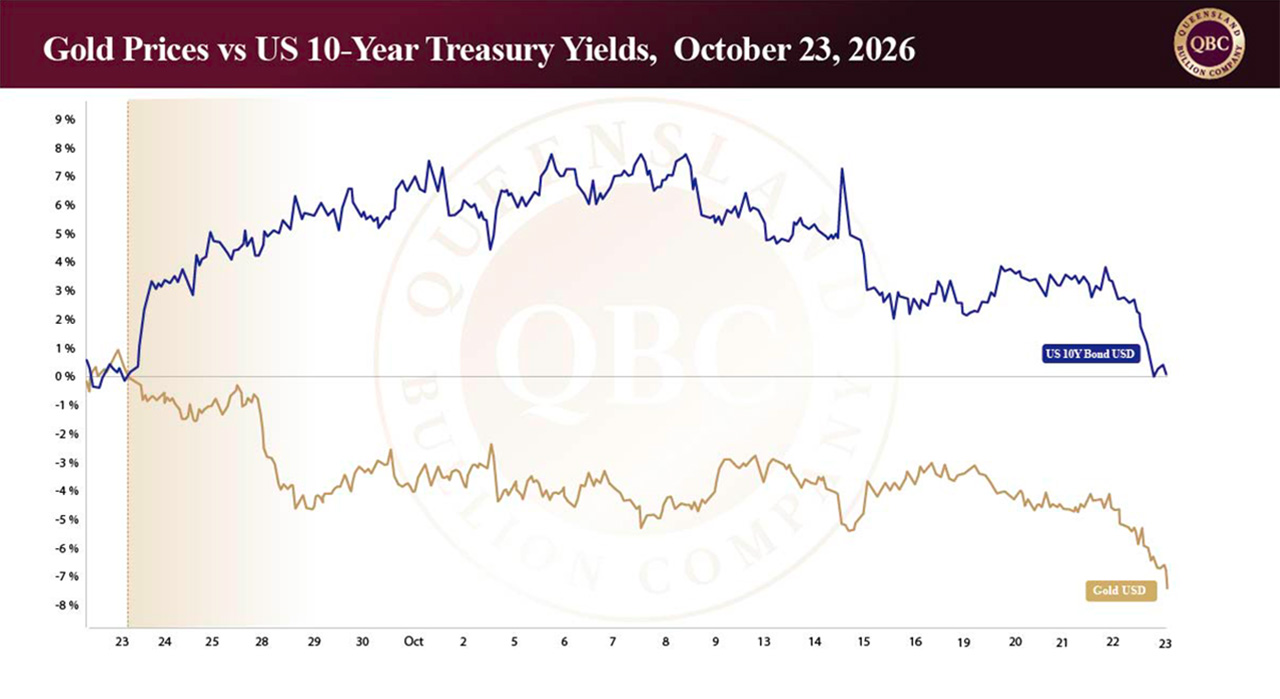
Investors moved towards US Treasuries as technology shares weakened, pushing the benchmark 10-year Treasury yield below 5% in late-session reporting. Falling yields can ordinarily provide support for gold by reducing the opportunity cost of holding an asset that does not generate interest.

However, gold and silver continued to decline, suggesting that broader concerns about inflation, economic growth and investor positioning were exerting greater influence.

Silver faces an additional consideration because of its dual role as both an investment metal and an industrial commodity. While monetary uncertainty can support investment demand, expectations of weaker manufacturing activity may affect its industrial demand outlook.

Platinum and palladium are similarly exposed to changes in industrial conditions, particularly through their applications in automotive manufacturing and other production processes.

The simultaneous weakness across precious metals demonstrates why movements in interest rates or equity markets should not be treated as reliable predictors of bullion prices.

What the Market Volatility Means for Australian Bullion Investors

For Australian investors, international precious metals movements represent only part of the pricing equation. Gold and silver are primarily quoted internationally in US dollars, while local bullion prices also reflect movements in the Australian dollar.

A decline in the international gold price does not necessarily produce an equivalent percentage decline in Australian-dollar bullion prices. Changes in the AUD/USD exchange rate can either amplify or offset movements in global markets.

Physical bullion prices also reflect product premiums and other relevant market costs, making it important to distinguish international spot-price movements from the actual prices available to Australian customers.

Periods of heightened volatility can create opportunities for investors to reassess portfolio diversification and their exposure to precious metals. However, neither gold nor silver offers guaranteed protection against market declines, and short-term price movements remain difficult to predict.

What Investors Should Watch Next

Attention is likely to remain focused on developments in the Middle East, the direction of oil prices and the Federal Reserve’s forthcoming interest-rate decision on 27–28 October.

Further developments in AI-related financing and corporate profitability may also influence broader investor sentiment, particularly if concerns spread into credit markets.

For gold and silver, the central question is whether expectations of persistent inflation and restrictive monetary policy will continue to outweigh demand for defensive assets.

The recent market movements reinforce an important distinction: gold and silver can play a role in long-term portfolio diversification, but their performance during individual periods of financial stress is neither uniform nor guaranteed.

For Australian investors considering physical precious metals, understanding these competing forces and monitoring current Australian-dollar prices remains essential.

Posted on

When Do Rising Bond Yields Benefit Gold Prices?

Global bond markets are sending a message that investors should not ignore. Government borrowing costs across the United States, Australia, France, the United Kingdom and Japan have climbed to levels not seen in decades, placing renewed pressure on households, companies and governments.

Normally, rising bond yields are considered negative for precious metals. Government bonds provide income, while physical gold and silver do not pay interest. As yields rise, investors are offered a higher return for holding government debt, increasing the opportunity cost of owning bullion.

That relationship has certainly affected precious metals throughout 2026. Gold has corrected from the extraordinary highs reached earlier this year, while silver, platinum and palladium have also experienced considerable volatility. At the time of writing, gold trades at approximately AUD $5,954 per ounce, silver at AUD $86.84, platinum at AUD $2,447 and palladium at AUD $1,684.

However, the current rise in bond yields is not simply the result of a strong economy offering investors better returns. Inflation remains elevated, government debt continues to expand, substantial volumes of bonds must be refinanced and investors are beginning to demand greater compensation for lending to governments over longer periods.

This creates an important question for precious-metals investors: at what point do higher bond yields stop competing with gold and begin strengthening the case for owning it?


Why Do Higher Bond Yields Usually Pressure Gold?

A bond yield represents the annual return an investor receives for lending money to a government or company, assuming the bond is held to maturity and the borrower meets its obligations.

If a ten-year government bond offers 2%, investors may be reluctant to lock their money away for a decade, particularly if inflation is running at a similar or higher rate. In this environment, gold can appear comparatively attractive because the income offered by the bond may provide little or no increase in purchasing power.

If that same bond begins offering more than 5%, however, the calculation changes. Investors can receive a substantial nominal return from an asset generally regarded as liquid and comparatively secure. Gold, which produces no income, must then compete against that return.

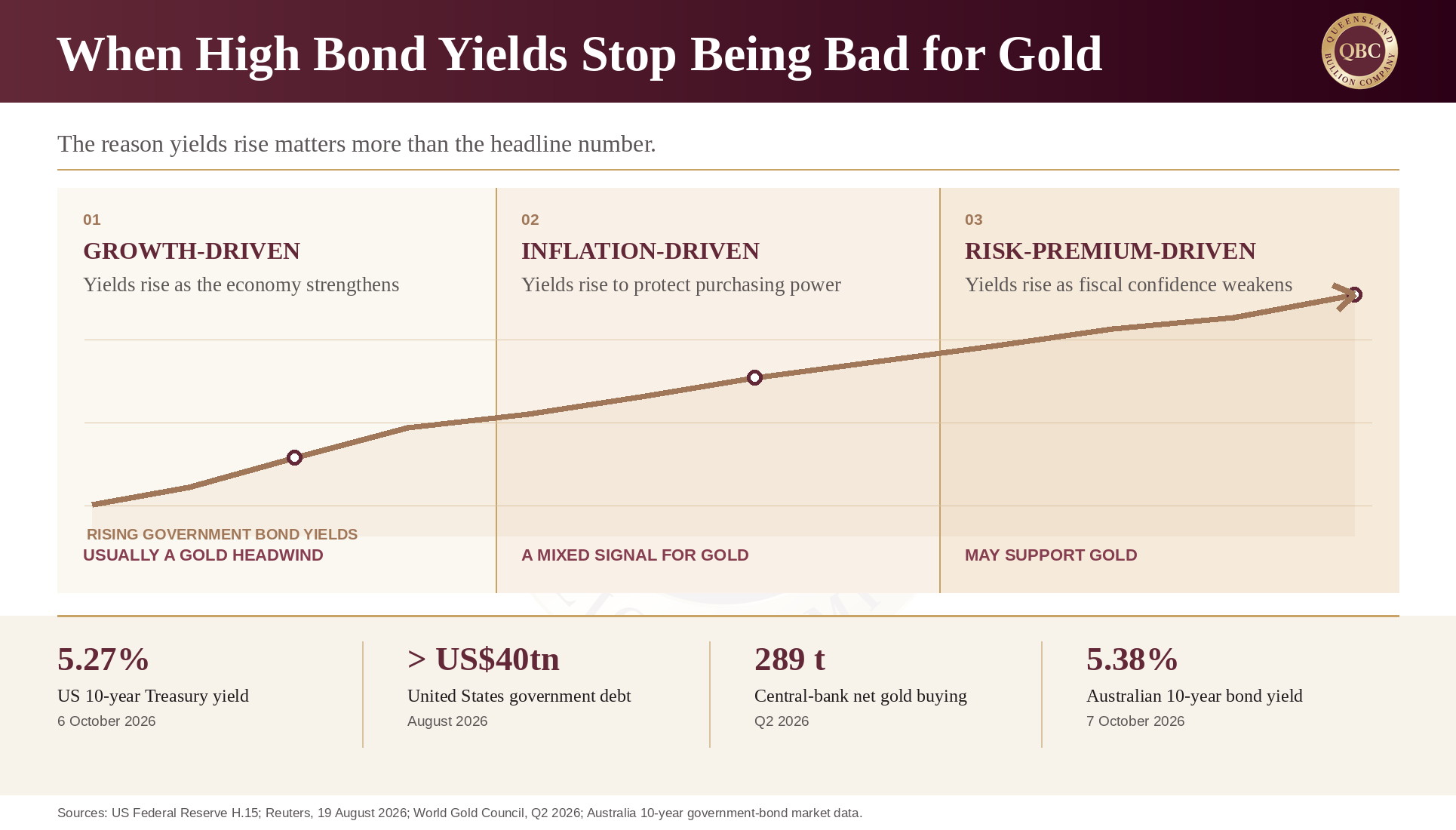
This is one reason the recent rise in US Treasury yields has placed pressure on bullion. Federal Reserve data showed that the ten-year Treasury yield reached approximately 5.27% on 6 October, while the thirty-year yield stood near 5.64%. Australia has experienced a similar move, with the ten-year Australian Government bond yield trading around 5.38% on 7 October.

These returns are meaningful because they affect much more than government bonds. Higher government yields can influence mortgage rates, business lending, property valuations and the discount rates applied to shares and other investments.

Yet the yield itself tells only part of the story.


Why Are Bond Yields Rising?

Bond yields can rise for several different reasons, and the distinction is important for precious-metals investors.

The first is stronger economic growth. If an economy is expanding, businesses are investing and consumers are spending, investors may move money away from defensive assets and towards opportunities offering higher growth. Governments may also have to offer higher yields to compete for capital.

The second is inflation. Investors lending money for ten or thirty years need to consider what that money will be worth when it is repaid. If inflation remains elevated, the future purchasing power of each dollar falls. Bond investors therefore demand a higher return to compensate for that risk.

The third is monetary policy. The Federal Reserve raised its benchmark interest-rate range by 0.25 percentage points to 3.75% to 4.00% in September. Minutes from that meeting showed that all participants supported the increase and that most considered another rise likely to be appropriate before the end of 2026.

The fourth is bond supply. Governments that spend more than they collect must borrow the difference. The more they borrow, the more bonds they must issue. When supply grows faster than investor demand, bond prices can fall and yields rise.

Finally, yields can rise because investors are becoming less comfortable with the borrower’s financial position. This is where the relationship between bonds and gold becomes more complicated.


A High Bond Yield Is Not Always a Sign of Economic Strength

Government bonds are frequently described as risk-free assets. However, no investment is entirely free of risk.

A government that issues debt in its own currency is unlikely to run out of that currency in the conventional sense. It can generally raise taxes, issue more debt or create additional money through its central bank. Nevertheless, each of these options carries a cost.

Higher taxes can weaken economic activity. Additional borrowing increases future interest expenses. Creating money can reduce the value of the currency and contribute to inflation.

The United States’ total government debt exceeded USD $40 trillion for the first time in August 2026. Of that amount, approximately USD $32.3 trillion was held in Treasury securities owned by the public, with the balance held within government accounts.

The Congressional Budget Office expects net federal interest costs to exceed USD $1 trillion in 2026. It projects debt held by the public to rise from approximately 101% of GDP in 2026 to 120% by 2036, while annual net interest costs increase from 3.3% to 4.6% of GDP.

This produces an uncomfortable feedback loop. As debt increases, governments must issue more bonds. If investors demand higher yields, the cost of servicing that debt rises. Higher interest costs then increase the budget deficit, requiring still more borrowing. If the cycle continues, governments may eventually face difficult choices between spending cuts, higher taxes, persistent inflation or monetary intervention.

None of these outcomes is particularly attractive for long-term holders of cash or fixed-rate debt.


Is Rising Government Debt Only an American Problem?

The answer is no.

Government borrowing costs have recently reached multi-decade highs across several major economies. French ten-year yields have approached levels not seen since 2002, British thirty-year borrowing costs have moved above 6% for the first time since 1998, and Japanese government-bond yields have also climbed sharply.

The immediate causes differ between countries, but the broader issue is similar. Governments accumulated large debt burdens when interest rates were low and must now refinance portions of that debt at considerably higher rates.

This does not mean that a sovereign-debt crisis is imminent. Governments refinance debt continuously, and many retain considerable taxation capacity, institutional strength and central-bank support. However, higher borrowing costs reduce the room available for healthcare, infrastructure, defence, pensions and other areas of public spending.

The pressure also reaches households and businesses. Government-bond yields influence mortgages, corporate borrowing, property prices and the value placed on future company earnings. A bond-market problem therefore does not remain confined to bond investors.


When Do Higher Bond Yields Become Positive for Gold?

The relationship between bond yields and gold can be considered in three broad stages.

Stage One: Yields Rise Because Economic Growth Is Strong

This is generally the most difficult environment for gold. Economic confidence is high, company earnings are improving and investors can earn attractive returns from bonds and other financial assets. Safe-haven demand is limited, while the opportunity cost of holding a non-yielding asset increases.

In this environment, higher yields can represent genuine economic strength rather than increasing financial risk.

Stage Two: Yields Rise Because Inflation Is Persistent

The effect becomes more mixed when inflation is the primary driver of higher yields.

A bond yielding 5% may initially appear attractive, but if inflation remains at 4%, the real return before tax is only approximately 1%. If inflation rises above the bond yield, the investor is again losing purchasing power despite receiving interest.

Gold can remain under pressure during this stage because markets often focus first on tighter monetary policy and higher nominal interest rates. Over time, however, persistent inflation may strengthen demand for assets that cannot be created by a central bank.

Stage Three: Yields Rise Because Confidence in Government Finances Is Weakening

This is the point at which higher yields may begin supporting gold.

If investors require additional compensation because government debt is expanding too quickly, political systems appear unable to control deficits or currencies are expected to lose purchasing power, a higher bond yield is no longer simply an attractive return. It is also a risk premium.

Gold does not depend on a government making an interest payment. It has no maturity date, no management team and no requirement for a borrower to remain solvent. This does not mean its price cannot fall, but its value is not based on another party’s promise to repay.

That distinction becomes increasingly important when the reliability of sovereign promises is being questioned.


What Are Central Banks Telling Us About Gold?

Central banks manage some of the largest reserves in the world and hold substantial quantities of sovereign debt. Their behaviour therefore provides useful context for understanding the changing relationship between bonds and gold.

According to the World Gold Council, central banks purchased a net 289 tonnes of gold during the second quarter of 2026, an increase of 62% from the same period a year earlier. Total gold demand during the first half of the year reached 2,522 tonnes, with a record value of approximately USD $380 billion.

Central-bank buying does not guarantee that gold prices will rise. Official institutions can slow their purchases, sell reserves or alter their allocation decisions. Nevertheless, continued buying during a period of high gold prices and attractive bond yields suggests that reserve managers are considering more than immediate income.

They are also considering diversification, liquidity, geopolitical risk, currency exposure and the credit risk contained within large sovereign-debt holdings.

Gold and government bonds therefore serve different purposes. Bonds provide income and liquidity. Gold provides an asset that is not another institution’s liability.


What Does This Mean for Australian Investors?

Australian investors must consider two prices when assessing gold: the international US-dollar gold price and the AUD/USD exchange rate.

Higher US yields can support the US dollar, which normally places pressure on gold in US-dollar terms. However, a stronger US dollar can also weaken the Australian dollar. If the Australian dollar falls faster than the US-dollar gold price, local gold prices may remain comparatively firm or even increase.

Australian bond yields also matter. With the ten-year Australian Government bond yield trading above 5%, local investors are being offered returns not seen for many years. This creates genuine competition for capital and should not be dismissed.

At the same time, higher Australian yields increase borrowing costs across the economy. Mortgage repayments, property valuations, business financing and government interest expenses may all come under greater pressure if elevated yields persist.

For Australian precious-metals investors, the issue is therefore not whether bonds or gold are universally better. The more useful question is what risk each asset is intended to address.

Bonds may provide income and capital stability if held to maturity. Physical gold may provide diversification from currency, counterparty and sovereign-credit risk. They can perform different functions within the same broader investment strategy.


Do Rising Bond Yields Mean Gold Must Rise?

No.

Gold can remain under pressure if inflation falls, government finances stabilise, the US dollar strengthens or investors continue favouring high-yielding assets. Central-bank demand may also slow, and physical bullion remains capable of significant corrections.

The current environment should therefore not be interpreted as proof that a sovereign-debt crisis is inevitable. Nor does a rising bond yield automatically mean investors have lost confidence in a government.

What has changed is the balance of risks.

For many years, falling yields allowed governments, businesses and households to carry larger debts at manageable cost. That process is now moving in reverse. Refinancing is becoming more expensive, interest costs are consuming a larger share of budgets and bond investors are demanding greater compensation for long-term uncertainty.


What Higher Bond Yields Could Mean for Gold Investors

Higher bond yields are initially a headwind for gold because they offer investors income and increase the opportunity cost of holding a non-yielding asset.

However, yields do not rise for only one reason. When they increase because economic growth is strong and inflation is controlled, the environment is generally unfavourable for precious metals. When they rise because inflation is persistent, debt issuance is expanding and confidence in fiscal management is deteriorating, the conclusion becomes less straightforward.

The very yield that attracts capital to government bonds may eventually reveal the pressure building within the sovereign-debt system.

Gold’s role is not to replace every income-producing asset, nor does it protect against every market outcome. Its importance lies in being physically scarce, globally recognised and free from the repayment obligations attached to bonds, bank deposits and other financial claims.

For investors, the central question is therefore no longer simply whether bond yields are high. It is whether those yields represent an attractive opportunity, or compensation for a level of risk that markets are only beginning to recognise.