
Why Did Gold Rise Overnight? Four Forces Driving the Rally
by QBC Analyst
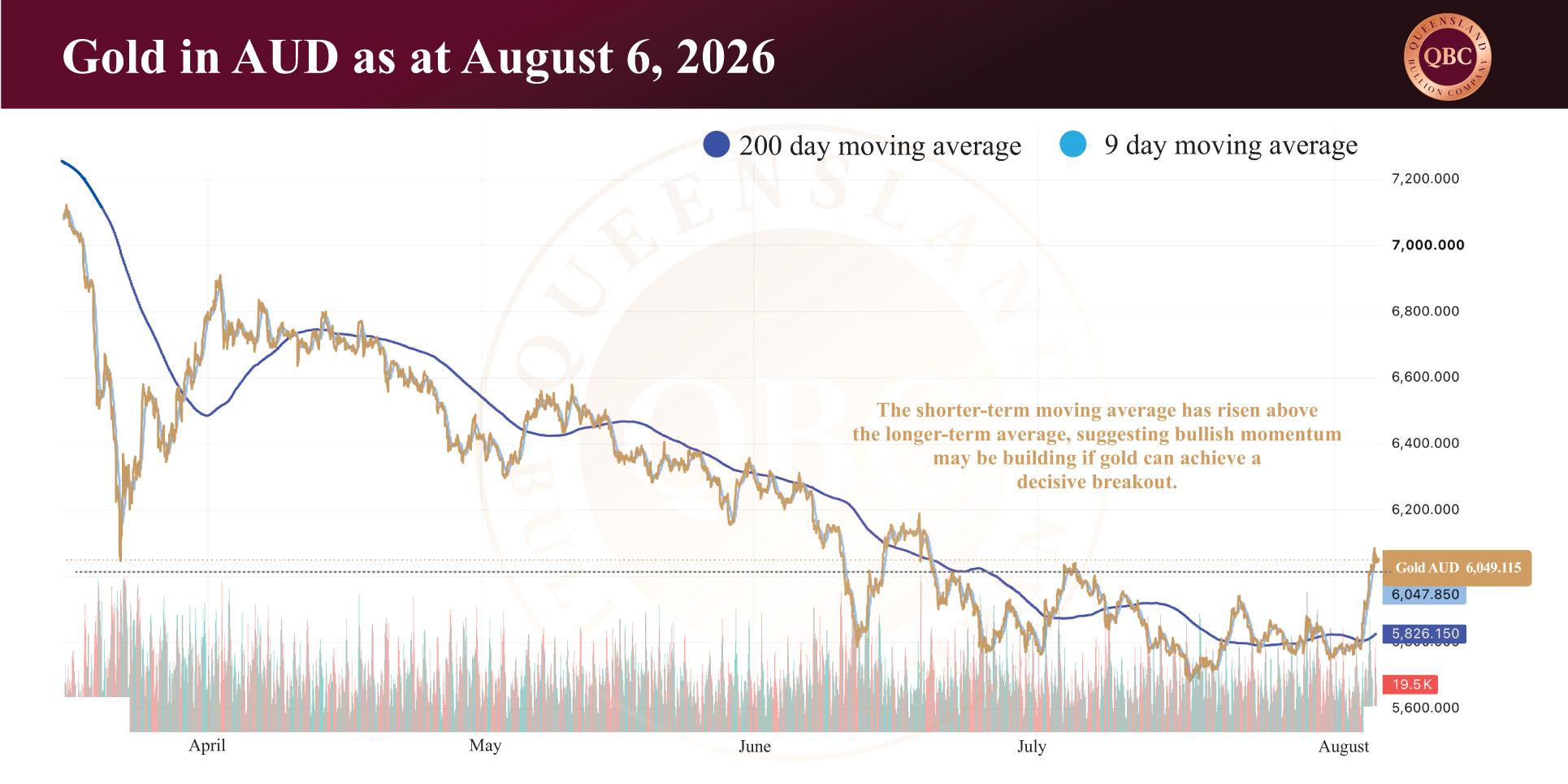
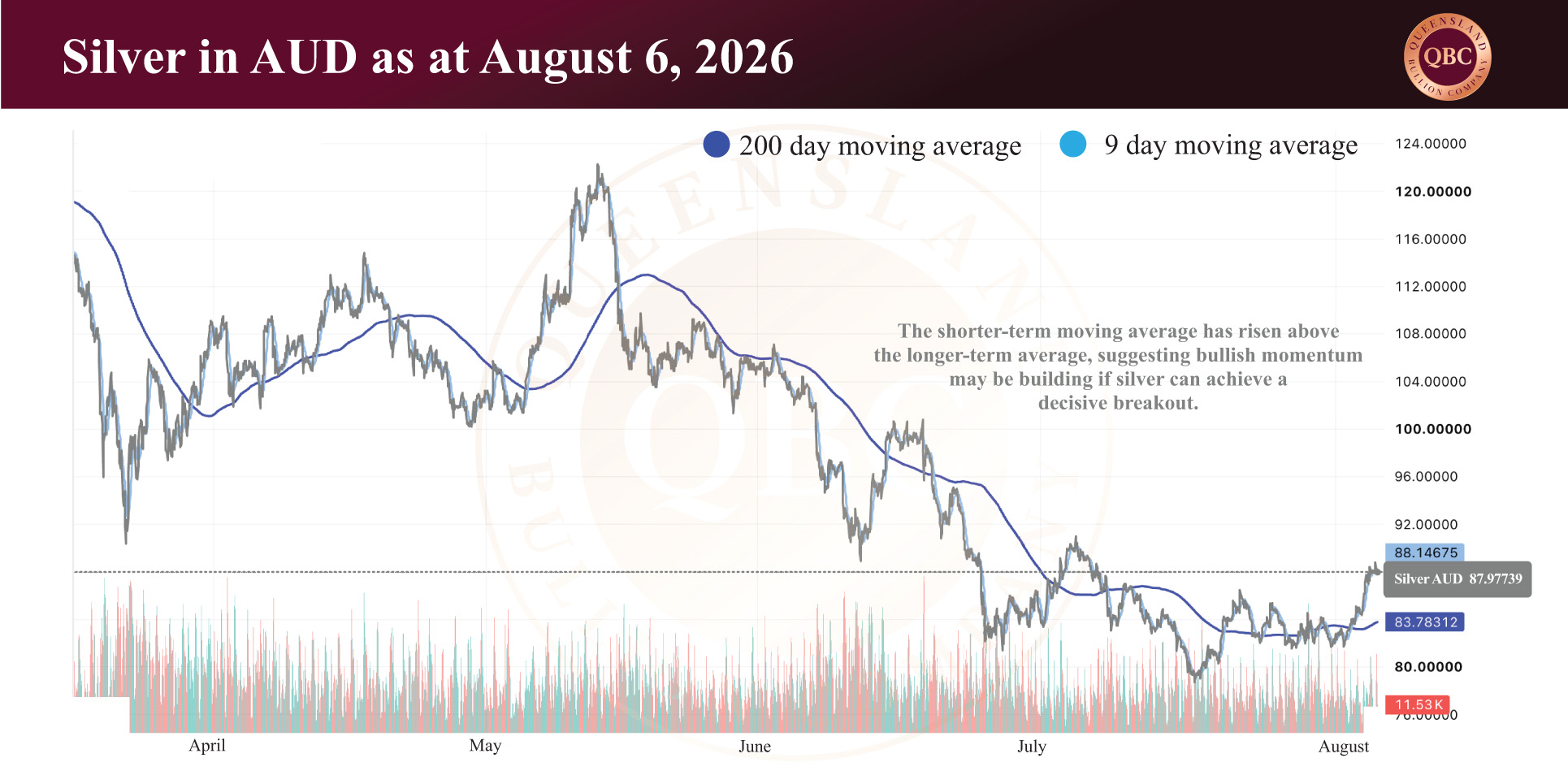
Only days after entering August on uncertain footing, gold and silver delivered one of their strongest single-day advances in weeks. The move surprised many investors given that precious metals had spent much of the past six months correcting from the extraordinary highs reached earlier this year; however, overnight price action was driven less by any single headline and more by a convergence of monetary policy, economic data and geopolitical developments. While gold trades at approximately AUD $6,068 per ounce, silver at AUD $88.34 and platinum at AUD $2,509, these developments have eased several of the short-term headwinds that had weighed on precious metals since the beginning of the year.
Has the Federal Reserve become less certain about raising interest rates?
The most significant catalyst remains the US Federal Reserve. At its July meeting, the Federal Open Market Committee (FOMC) voted to leave the federal funds rate unchanged at 3.50% to 3.75%. While the decision itself was widely anticipated, the voting breakdown was not. The committee voted nine to three, with Cleveland Fed President Beth Hammack, Minneapolis Fed President Neel Kashkari and Dallas Fed President Lorie Logan all favouring an immediate rate increase.
Three dissents are uncommon in modern Federal Reserve history and typically signal genuine disagreement within the committee rather than minor differences in opinion. Until recently, financial markets interpreted this division as increasing the likelihood of another rate hike later this year. Higher interest rates generally support higher bond yields, increasing the opportunity cost of holding non-income-producing assets such as gold and silver. As a result, expectations of further monetary tightening have remained one of the principal reasons precious metals have struggled to regain the momentum seen throughout 2025. Importantly, investors are now questioning whether that hawkish outlook remains justified.
Did the latest U.S. jobs data reduce the chances of another rate hike?
The first major test arrived with the latest Job Openings and Labour Turnover Survey (JOLTS). Job openings declined modestly from 7.6 million to around 7.44 million. The softer labour market data reinforced evidence that demand for workers is gradually easing, reducing confidence that the economy could withstand a more restrictive monetary environment brought about by higher interest rates. Because the Federal Reserve has repeatedly emphasised the importance of labour market conditions when setting monetary policy, the report immediately prompted investors to reassess the probability of another rate increase. The significance of the report lies less in the absolute number and more in its timing. Following a divided Federal Reserve meeting, the weaker labour data reduced confidence that policymakers will ultimately decide another increase is necessary. As expectations for tighter monetary policy softened, bond yields have eased (especially the 10 Year Treasury bond) and gold responded positively.
Financial markets are currently treating each major economic release as evidence either for or against another rate rise. Rather than reacting to individual data points in isolation, investors are attempting to determine whether inflationary pressures continue to justify additional tightening. For precious metals, every report that reduces those expectations removes another short-term headwind.
Are falling oil prices also supporting gold?
While monetary policy dominated investor attention geopolitics provided a second catalyst. Oil prices moved lower following comments from US Treasury Secretary Scott Bessent suggesting that an agreement to reopen commercial shipping through the Strait of Hormuz could be reached within days. Brent crude subsequently declined as investors anticipated that any reduction in regional tensions would improve oil supply and reduce inflationary pressures.
The situation remains far from straightforward. Within hours of those comments, UK Maritime Trade Operations confirmed that a commercial vessel had been struck by an unidentified projectile in the Strait of Hormuz. Iran also denied engaging in direct negotiations with Washington, although reports suggest it is the discussion involving Iran and Oman over future shipping arrangements that could be finalised imminently. The Iran-Oman agreement would see each country controlling different parts of the strait, thus leaving considerable control with Iran. While the U.S. administration was not directly involved, it and its European counterparts had place considerable pressure on Oman to reach an agreement with Iran.
Despite these contradictions, financial markets responded primarily to the possibility that oil supplies may normalise. The connection to gold is indirect but important. Lower oil prices reduce inflation expectations, easing pressure on central banks to continue raising interest rates. If inflation moderates more quickly than previously expected the case for additional Federal Reserve tightening weakens. Once again, this reduces upward pressure on bond yields and improves the investment environment for precious metals.
Did a weaker US dollar add further support?
Outside America gold also benefited from renewed weakness in the US dollar. The US Dollar Index recently traded near its lowest level in almost seven weeks, driven primarily by the Federal Reserve’s decision to leave interest rates unchanged and a decline in U.S. Treasury yields. Coordinated efforts to support the Japanese yen occurred at the same time, adding to broader shifts in currency markets. Because gold is priced globally in US dollars, any decline in the currency effectively reduces the purchase price for international buyers using euros, yen, yuan or Australian dollars.
A weaker dollar therefore tends to broaden global demand for physical gold, particularly among central banks and long-term investors already seeking greater diversification away from US financial assets. While currency movements rarely determine the direction of gold in isolation, they often amplify existing trends already developing elsewhere in financial markets.
Are the short-term headwinds beginning to fade?
No single development explains gold’s overnight rally. Rather, the move reflects several independent factors beginning to align. Expectations of another Federal Reserve rate increase have softened following weaker labour market data. Bond yields have eased accordingly. Lower oil prices have reduced immediate inflation concerns, while a weaker US dollar has improved purchasing power for international buyers.
From a technical perspective, the recent price action is also becoming more constructive. After correcting for much of the past seven months and spending July consolidating within a relatively narrow trading range, both gold and silver have begun showing signs that downside momentum may be easing. Short-term moving averages have strengthened relative to their longer-term counterparts, a development technical analysts often interpret as an early indication that buying interest is improving. Whether this ultimately develops into a sustained rally will depend on incoming economic data, Federal Reserve expectations and the evolution of geopolitical events. For now, however, several of the factors that constrained precious metals throughout the first half of 2026 appear to be becoming less restrictive, providing a more supportive backdrop than investors have seen for some time.