

When Do Rising Bond Yields Benefit Gold Prices?
by Caroline Lima
Global bond markets are sending a message that investors should not ignore. Government borrowing costs across the United States, Australia, France, the United Kingdom and Japan have climbed to levels not seen in decades, placing renewed pressure on households, companies and governments.
Normally, rising bond yields are considered negative for precious metals. Government bonds provide income, while physical gold and silver do not pay interest. As yields rise, investors are offered a higher return for holding government debt, increasing the opportunity cost of owning bullion.
That relationship has certainly affected precious metals throughout 2026. Gold has corrected from the extraordinary highs reached earlier this year, while silver, platinum and palladium have also experienced considerable volatility. At the time of writing, gold trades at approximately AUD $5,954 per ounce, silver at AUD $86.84, platinum at AUD $2,447 and palladium at AUD $1,684.
However, the current rise in bond yields is not simply the result of a strong economy offering investors better returns. Inflation remains elevated, government debt continues to expand, substantial volumes of bonds must be refinanced and investors are beginning to demand greater compensation for lending to governments over longer periods.
This creates an important question for precious-metals investors: at what point do higher bond yields stop competing with gold and begin strengthening the case for owning it?
Why Do Higher Bond Yields Usually Pressure Gold?
A bond yield represents the annual return an investor receives for lending money to a government or company, assuming the bond is held to maturity and the borrower meets its obligations.
If a ten-year government bond offers 2%, investors may be reluctant to lock their money away for a decade, particularly if inflation is running at a similar or higher rate. In this environment, gold can appear comparatively attractive because the income offered by the bond may provide little or no increase in purchasing power.
If that same bond begins offering more than 5%, however, the calculation changes. Investors can receive a substantial nominal return from an asset generally regarded as liquid and comparatively secure. Gold, which produces no income, must then compete against that return.
This is one reason the recent rise in US Treasury yields has placed pressure on bullion. Federal Reserve data showed that the ten-year Treasury yield reached approximately 5.27% on 6 October, while the thirty-year yield stood near 5.64%. Australia has experienced a similar move, with the ten-year Australian Government bond yield trading around 5.38% on 7 October.
These returns are meaningful because they affect much more than government bonds. Higher government yields can influence mortgage rates, business lending, property valuations and the discount rates applied to shares and other investments.
Yet the yield itself tells only part of the story.
Why Are Bond Yields Rising?
Bond yields can rise for several different reasons, and the distinction is important for precious-metals investors.
The first is stronger economic growth. If an economy is expanding, businesses are investing and consumers are spending, investors may move money away from defensive assets and towards opportunities offering higher growth. Governments may also have to offer higher yields to compete for capital.
The second is inflation. Investors lending money for ten or thirty years need to consider what that money will be worth when it is repaid. If inflation remains elevated, the future purchasing power of each dollar falls. Bond investors therefore demand a higher return to compensate for that risk.
The third is monetary policy. The Federal Reserve raised its benchmark interest-rate range by 0.25 percentage points to 3.75% to 4.00% in September. Minutes from that meeting showed that all participants supported the increase and that most considered another rise likely to be appropriate before the end of 2026.
The fourth is bond supply. Governments that spend more than they collect must borrow the difference. The more they borrow, the more bonds they must issue. When supply grows faster than investor demand, bond prices can fall and yields rise.
Finally, yields can rise because investors are becoming less comfortable with the borrower’s financial position. This is where the relationship between bonds and gold becomes more complicated.
A High Bond Yield Is Not Always a Sign of Economic Strength
Government bonds are frequently described as risk-free assets. However, no investment is entirely free of risk.
A government that issues debt in its own currency is unlikely to run out of that currency in the conventional sense. It can generally raise taxes, issue more debt or create additional money through its central bank. Nevertheless, each of these options carries a cost.
Higher taxes can weaken economic activity. Additional borrowing increases future interest expenses. Creating money can reduce the value of the currency and contribute to inflation.
The United States’ total government debt exceeded USD $40 trillion for the first time in August 2026. Of that amount, approximately USD $32.3 trillion was held in Treasury securities owned by the public, with the balance held within government accounts.
The Congressional Budget Office expects net federal interest costs to exceed USD $1 trillion in 2026. It projects debt held by the public to rise from approximately 101% of GDP in 2026 to 120% by 2036, while annual net interest costs increase from 3.3% to 4.6% of GDP.
This produces an uncomfortable feedback loop. As debt increases, governments must issue more bonds. If investors demand higher yields, the cost of servicing that debt rises. Higher interest costs then increase the budget deficit, requiring still more borrowing. If the cycle continues, governments may eventually face difficult choices between spending cuts, higher taxes, persistent inflation or monetary intervention.
None of these outcomes is particularly attractive for long-term holders of cash or fixed-rate debt.
Is Rising Government Debt Only an American Problem?
The answer is no.
Government borrowing costs have recently reached multi-decade highs across several major economies. French ten-year yields have approached levels not seen since 2002, British thirty-year borrowing costs have moved above 6% for the first time since 1998, and Japanese government-bond yields have also climbed sharply.
The immediate causes differ between countries, but the broader issue is similar. Governments accumulated large debt burdens when interest rates were low and must now refinance portions of that debt at considerably higher rates.
This does not mean that a sovereign-debt crisis is imminent. Governments refinance debt continuously, and many retain considerable taxation capacity, institutional strength and central-bank support. However, higher borrowing costs reduce the room available for healthcare, infrastructure, defence, pensions and other areas of public spending.
The pressure also reaches households and businesses. Government-bond yields influence mortgages, corporate borrowing, property prices and the value placed on future company earnings. A bond-market problem therefore does not remain confined to bond investors.
When Do Higher Bond Yields Become Positive for Gold?
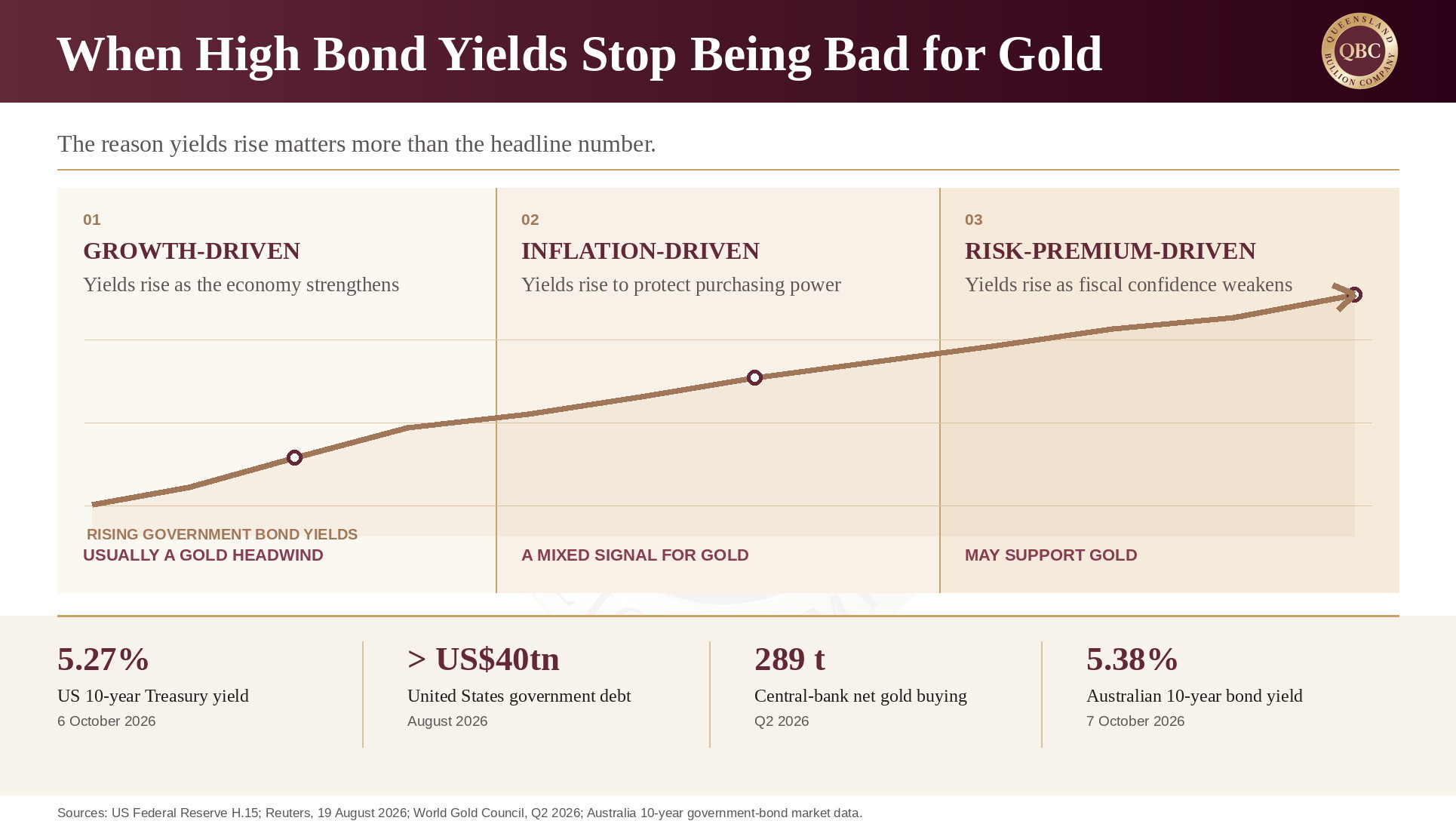
The relationship between bond yields and gold can be considered in three broad stages.
Stage One: Yields Rise Because Economic Growth Is Strong
This is generally the most difficult environment for gold. Economic confidence is high, company earnings are improving and investors can earn attractive returns from bonds and other financial assets. Safe-haven demand is limited, while the opportunity cost of holding a non-yielding asset increases.
In this environment, higher yields can represent genuine economic strength rather than increasing financial risk.
Stage Two: Yields Rise Because Inflation Is Persistent
The effect becomes more mixed when inflation is the primary driver of higher yields.
A bond yielding 5% may initially appear attractive, but if inflation remains at 4%, the real return before tax is only approximately 1%. If inflation rises above the bond yield, the investor is again losing purchasing power despite receiving interest.
Gold can remain under pressure during this stage because markets often focus first on tighter monetary policy and higher nominal interest rates. Over time, however, persistent inflation may strengthen demand for assets that cannot be created by a central bank.
Stage Three: Yields Rise Because Confidence in Government Finances Is Weakening
This is the point at which higher yields may begin supporting gold.
If investors require additional compensation because government debt is expanding too quickly, political systems appear unable to control deficits or currencies are expected to lose purchasing power, a higher bond yield is no longer simply an attractive return. It is also a risk premium.
Gold does not depend on a government making an interest payment. It has no maturity date, no management team and no requirement for a borrower to remain solvent. This does not mean its price cannot fall, but its value is not based on another party’s promise to repay.
That distinction becomes increasingly important when the reliability of sovereign promises is being questioned.
What Are Central Banks Telling Us About Gold?
Central banks manage some of the largest reserves in the world and hold substantial quantities of sovereign debt. Their behaviour therefore provides useful context for understanding the changing relationship between bonds and gold.
According to the World Gold Council, central banks purchased a net 289 tonnes of gold during the second quarter of 2026, an increase of 62% from the same period a year earlier. Total gold demand during the first half of the year reached 2,522 tonnes, with a record value of approximately USD $380 billion.
Central-bank buying does not guarantee that gold prices will rise. Official institutions can slow their purchases, sell reserves or alter their allocation decisions. Nevertheless, continued buying during a period of high gold prices and attractive bond yields suggests that reserve managers are considering more than immediate income.
They are also considering diversification, liquidity, geopolitical risk, currency exposure and the credit risk contained within large sovereign-debt holdings.
Gold and government bonds therefore serve different purposes. Bonds provide income and liquidity. Gold provides an asset that is not another institution’s liability.
What Does This Mean for Australian Investors?
Australian investors must consider two prices when assessing gold: the international US-dollar gold price and the AUD/USD exchange rate.
Higher US yields can support the US dollar, which normally places pressure on gold in US-dollar terms. However, a stronger US dollar can also weaken the Australian dollar. If the Australian dollar falls faster than the US-dollar gold price, local gold prices may remain comparatively firm or even increase.
Australian bond yields also matter. With the ten-year Australian Government bond yield trading above 5%, local investors are being offered returns not seen for many years. This creates genuine competition for capital and should not be dismissed.
At the same time, higher Australian yields increase borrowing costs across the economy. Mortgage repayments, property valuations, business financing and government interest expenses may all come under greater pressure if elevated yields persist.
For Australian precious-metals investors, the issue is therefore not whether bonds or gold are universally better. The more useful question is what risk each asset is intended to address.
Bonds may provide income and capital stability if held to maturity. Physical gold may provide diversification from currency, counterparty and sovereign-credit risk. They can perform different functions within the same broader investment strategy.
Do Rising Bond Yields Mean Gold Must Rise?
No.
Gold can remain under pressure if inflation falls, government finances stabilise, the US dollar strengthens or investors continue favouring high-yielding assets. Central-bank demand may also slow, and physical bullion remains capable of significant corrections.
The current environment should therefore not be interpreted as proof that a sovereign-debt crisis is inevitable. Nor does a rising bond yield automatically mean investors have lost confidence in a government.
What has changed is the balance of risks.
For many years, falling yields allowed governments, businesses and households to carry larger debts at manageable cost. That process is now moving in reverse. Refinancing is becoming more expensive, interest costs are consuming a larger share of budgets and bond investors are demanding greater compensation for long-term uncertainty.
What Higher Bond Yields Could Mean for Gold Investors
Higher bond yields are initially a headwind for gold because they offer investors income and increase the opportunity cost of holding a non-yielding asset.
However, yields do not rise for only one reason. When they increase because economic growth is strong and inflation is controlled, the environment is generally unfavourable for precious metals. When they rise because inflation is persistent, debt issuance is expanding and confidence in fiscal management is deteriorating, the conclusion becomes less straightforward.
The very yield that attracts capital to government bonds may eventually reveal the pressure building within the sovereign-debt system.
Gold’s role is not to replace every income-producing asset, nor does it protect against every market outcome. Its importance lies in being physically scarce, globally recognised and free from the repayment obligations attached to bonds, bank deposits and other financial claims.
For investors, the central question is therefore no longer simply whether bond yields are high. It is whether those yields represent an attractive opportunity, or compensation for a level of risk that markets are only beginning to recognise.