
Part 2: What Happens If the Yen Carry Trade Unwinds?
by QBC Analyst
The yen carry trade has survived because one fundamental condition has persisted for decades: money has been comparatively cheap to borrow in Japan. Investors could borrow yen at low interest rates, exchange those funds for foreign currencies and invest in higher-yielding bonds, equities and other assets overseas. As examined in the first part of this series, the exact size of the trade is impossible to determine because yen-funded exposure exists across banks, hedge funds, pension funds, insurers, institutional investors and derivatives markets alike. What is clear is that the strategy has become deeply embedded in global finance. This creates an uncomfortable problem for policymakers. Japan needs a stronger yen to control imported inflation, but if the currency strengthens too rapidly, the very process of unwinding decades of yen-funded investment could create instability both domestically and internationally. This creates the type of uncertainty that precious metals can traditionally thrive in. Currently, gold trades at AUD $6,471, silver at AUD $96.16, and platinum at AUD $2,633.
What would unwinding the yen carry trade mean for Japan?
The first consequences would be felt at home. Japan’s economy has been shaped by decades of exceptionally low interest rates. Businesses have become accustomed to inexpensive credit, households have adapted to minimal returns on savings, banks have constructed balance sheets around low borrowing costs and the Japanese Government has accumulated one of the largest public debt burdens in the developed world. The International Monetary Fund (IMF) expects gross government debt to remain around 200% of GDP in 2026, meaning even gradual increases in borrowing costs have significant long-term implications for government finances.
The Bank of Japan therefore cannot simply raise interest rates aggressively to rescue the yen. While this would address the fundamental issues that are depreciating the yen, higher rates would also increase financing costs throughout the economy with smaller and more highly leveraged businesses particularly vulnerable. It would also increase Japanese government bond yields which would assist in unwinding the yet carry trade faster.
This is why the speed of monetary tightening matters as much as its direction. Gradual increases (such as 25 basis points over six months) give banks, businesses and government finances time to adjust. Rapid tightening designed primarily to defend the currency (such as 25 basis points or more over three months) would be much more disruptive. The IMF itself has advocated gradual monetary normalisation rather than an abrupt change in policy, reflecting the delicate balance facing the Bank of Japan.
What would unwinding the yen carry trade mean for international markets?
The international consequences potentially become much larger because the carry trade issue does not end simply by not borrowing from Japan in the future. Existing positions must also be closed. Consider an investor who borrowed yen and used the proceeds to purchase US technology shares. If the yen rises significantly, the amount of USD required to repay the Japanese loan increases. If the movement is sufficiently large, the investor may be forced to sell those shares, convert the proceeds back into yen and repay the debt before the currency appreciates further. As this progresses that process can accelerate because lenders may demand additional collateral or force positions to be closed. One institution doing this is irrelevant. Thousands of institutional investors attempting to do it simultaneously can become a market event.
The mechanism is self-reinforcing. Investors sell overseas assets to obtain cash, then purchase yen to repay their loans. Selling places downward pressure on the assets they are exiting, while purchasing yen pushes the Japanese currency higher. A stronger yen then creates larger losses for other carry traders encouraging or forcing them to unwind as well. What begins as currency appreciation can therefore become simultaneous deleveraging across equities, bonds and other risk assets, world-wide.
Markets received a reminder of this vulnerability in August of 2024, when Japan raised rates and the US moved toward lowering rates and the differential between the two narrowed. Under these circumstances, even relatively modest changes in exchange rates could eliminate the narrow returns available from conventional yen-dollar carry trades forcing leveraged investors to reduce positions elsewhere. The important point is that carry trades are sensitive not just to simple interest rates and interest rate changes but equally to changes in currency.
Why do US treasuries matter so much?
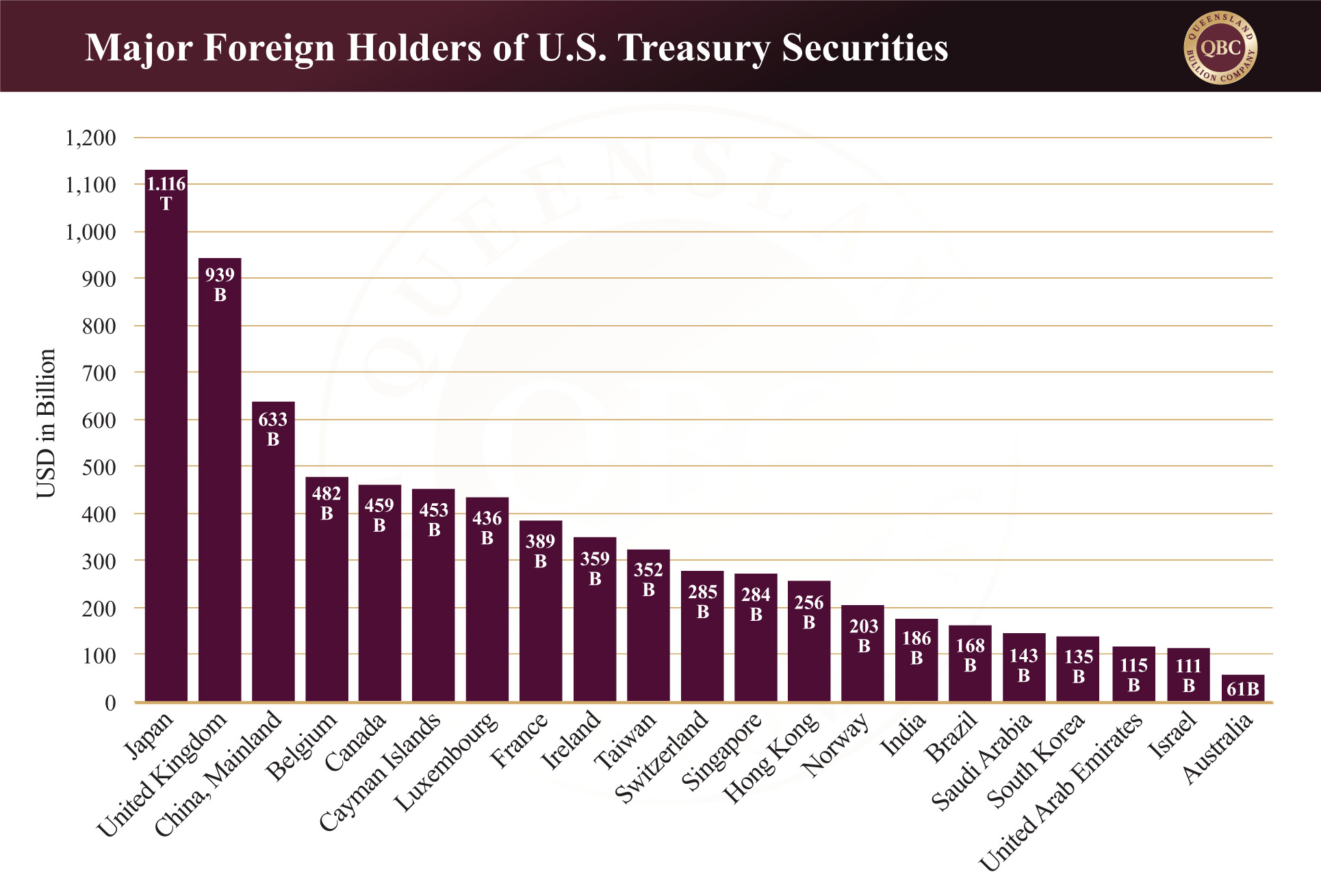
The US Treasury market sits near the centre of the problem. Japan holds more than USD $1 trillion of US government debt and has historically accumulated foreign assets partly because domestic Japanese yields offered comparatively poor returns. A sustained increase in Japanese interest rates changes that calculation. If Japanese government bonds begin offering more attractive returns, Japanese institutions have less incentive to accept currency risk by investing overseas. Significant capital could therefore return home even without a disorderly carry trade unwind.
Currency intervention creates another source of pressure. As covered in Part 1, if the Japanese government needed to strengthen a weakening yen they could potentially need to sell some of their holding in U.S bonds. More U.S. bonds on the market means higher bond yields. Higher bond yields would then flow through to mortgages, corporate borrowing, government refinancing costs and the discount rates used to value equities. This is one reason the United States has an interest in helping Japan stabilise the yen without forcing Tokyo to liquidate large quantities of US government debt.
Could a yen carry trade unwind trigger forced selling?
This is perhaps the greatest international risk. The carry trade has not simply funded U.S. government bonds. Cheap yen has been deployed across equities, corporate debt and a range of higher-risk international investments in various countries. The precise exposure cannot be measured which is part of the problem. Analysts can observe bank lending, foreign portfolio investment and disclosed institutional holdings, but leveraged derivatives and hedge fund positions make the full network considerably less transparent.
The narrowest estimates have previously identified approximately USD $350 billion in short-term external loans by Japanese banks that could potentially be associated with yen-funded strategies. Japan’s broader foreign portfolio holdings have been measured to the tune of USD $20 trillion. Neither figure represents the definitive size of the carry trade, but together they illustrate the amount of capital potentially influenced by Japanese interest rates and currency movements.
Leveraged investors may be forced to liquidate whichever assets can be sold most easily, rather than simply those directly connected with Japan. This is how financial stress can move between apparently unrelated markets. A problem beginning with the yen could theoretically produce selling in US equities, government bonds or other liquid assets because those are the markets investors can access quickly when they need cash. That does not mean a stronger yen automatically causes a global market crash. The size, speed and positioning behind the move would determine the outcome. However, it does mean the yen represents an important source of global leverage (and potential liability) that investors can easily overlook when concentrating exclusively on American or European markets.
Why can’t Japan simply allow the yen to keep falling?
If a rapidly rising yen creates these risks, allowing it to depreciate indefinitely might appear to be the easier option. Unfortunately, that creates a different set of problems. Japan depends heavily on imports, particularly for energy. A weaker yen increases the domestic cost of goods priced internationally in US dollars, importing inflation directly into the Japanese economy therefore rates would need to increase. The U.S.-Israel-Iran War demonstrated the problem clearly as higher oil prices combined with a weaker yen to create a substantial terms-of-trade shock for an economy that imports almost all of its oil. To this end, the country’s petroleum bill increased by 59% as at this June.
Excessive depreciation could also affect Japan’s neighbours. A dramatically cheaper yen makes Japanese exports more competitive against products manufactured in China, South Korea and elsewhere in Asia. Other countries may then face pressure to tolerate weaker currencies of their own to preserve export competitiveness as they are exporters and not importers, potentially creating a broader cycle of currency depreciation way beyond Japan.
There is also a political threshold. The ¥160 region against the US dollar has increasingly become an important psychological level for markets because Japanese authorities have repeatedly demonstrated a willingness to intervene around or beyond it. The recent joint intervention pushed the yen from approximately ¥164 to around ¥155 before the currency began weakening again. By mid-August it had already surrendered approximately half of that improvement. This helps explain why intervention should be viewed less as an attempt to establish a permanently stronger yen and more as a guardrail against disorderly depreciation.
Why does Japan need the yen to be neither too weak nor too strong?
Japan is effectively trying to keep the currency within a range that avoids two very different financial problems. If the yen becomes too weak, domestic pressures build via imported inflation and higher interest rates. Additionally other exporting nations experience pressure to lower their own currencies. If the yen becomes too strong, the carry trade becomes less profitable with investors potentially facing significant losses and consequences rippling throughout global investment markets. The ideal outcome is therefore neither collapse nor rapid appreciation. Japan needs an orderly adjustment that allows the yen to strengthen sufficiently to contain imported inflation while avoiding the kind of sudden currency movement that could destabilise domestic borrowers and force international carry trades to unwind simultaneously.
That is an extraordinarily difficult balancing act because policymakers do not control every variable. The Bank of Japan controls Japanese monetary policy, but it does not control Federal Reserve rates, Middle Eastern oil prices, US fiscal policy or the behaviour of leveraged international investors. The recent intervention illustrates the limits of national monetary policy in a financial system where capital can move around the world almost instantaneously.
Is the yen carry trade a global financial liability?
This does not mean the yen carry trade is destined to collapse or that a global financial crisis is inevitable. Policymakers have substantial tools available to manage liquidity, and gradual adjustment could allow positions to unwind without systemic disruption. However, the recent interventions demonstrate that the margin for error has narrowed. An interest-rate decision in Tokyo can influence a currency trade, which can influence Treasury yields, which can influence American borrowing costs, equity valuations and financial conditions throughout the world.
For investors, this interconnectedness reinforces the value of diversification beyond purely financial assets. Physical gold and silver remain exposed to market prices and currency changes, but the assets themselves do not represent another institution’s liability. In a global financial system increasingly dependent on governments balancing one market against another, that independence remains one of the fundamental reasons physical precious metals continue to serve as a form of financial insurance. Taking Part 1 and Part 2 of this report into consideration, we firmly believe that the fundamental reasons for holding precious metals long term has never been stronger.