Posted on — Leave a comment

How the USD is Supporting Spike in Gold in Australia

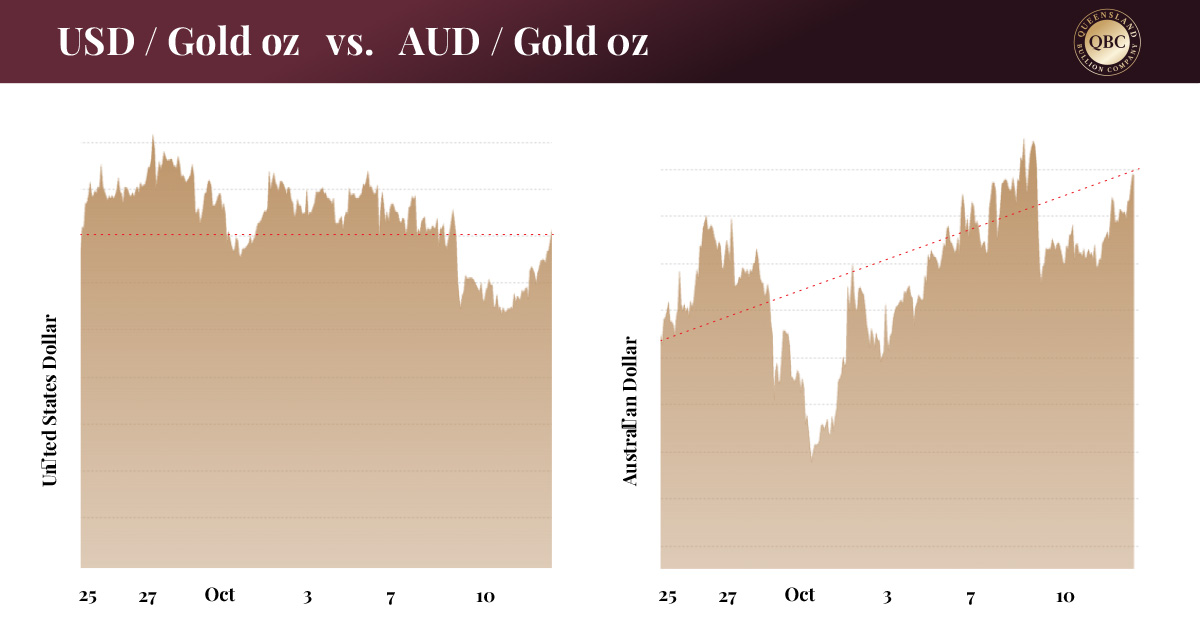
Iran’s recent missile attack recently broke through Israel’s “Iron Dome” affecting markets around the world. The geopolitical conflict in the Middle East has driven Western investors to the traditionally safe United States Dollar.  As investors exit high risk investment and flock to the safety of the dollar the value of the USD increases; however, the value of the Australian Dollar remains relatively unchanged.  Hence, the gold price in the US has effectively traded sideways September 25, yet Australia’s price has risen 3.3% in the same period.  As a case in point, at the time of writing gold currently trades at AUD $3,905.87, silver at $46.18, and platinum at $1,444.57.

So why is the USD considered a safe haven currency?  Simply put, because it always has been.  It has enjoyed no competition to this point. Historically the US has generally been the world arbitrator, the ultimate negotiator, and more importantly, they generally are on the winning side.  It has been a genuinely safe hedge against volatile markets and has the track record to prove it.  But there is a growing alternative perspective based on geopolitical conjecture.

The USA today is not the same USA that entered World War 2.  The bulk of the war was paid for via the introduction of  Victory taxes wherein revenue tripled and even quadrupled at times.  After that the Roosevelt Administration sold Victory bonds to citizens.  Despite the war coming off the back of the Great Depression people still had enough savings to fulfill their patriotic duty fund the war via these bonds.  Confidence in the USD was also peaking due to being gold backed.

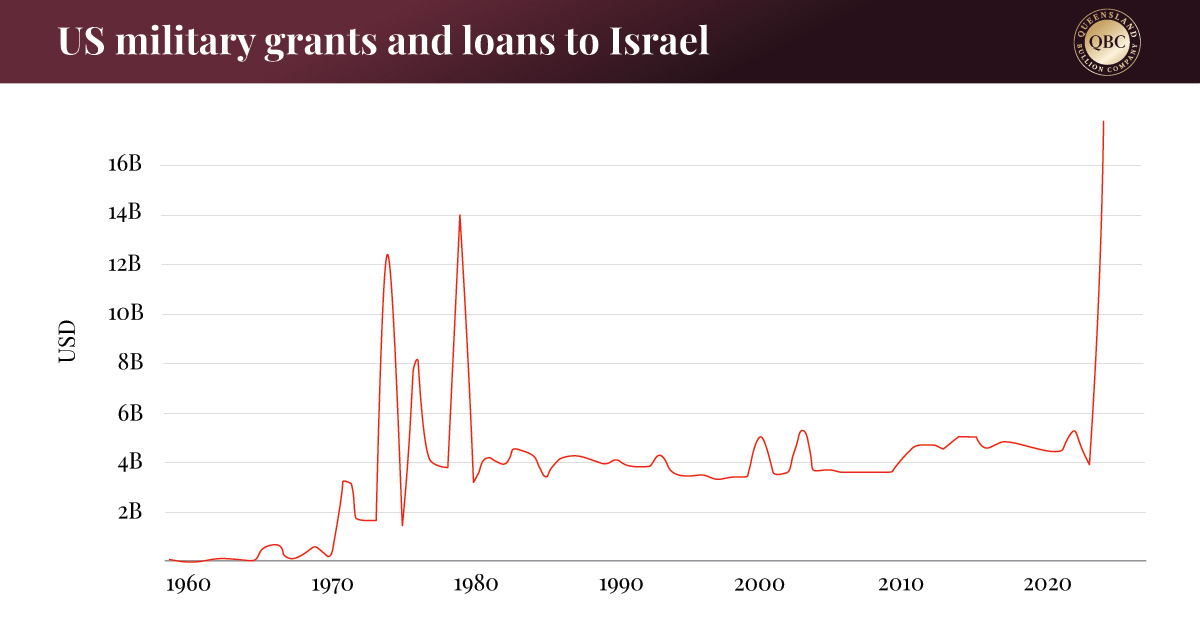
Contrast this to the USA today.  Not only does the petro dollar hold fiat currency status alongside a consumer driven culture.  Public and private debts are at all time highs. And while the Fed says inflation is at 2% and employment levels are healthy, the harsh reality is that the US government and their citizens are not in a position to fund a war, and yet, they are. The table below demonstrates military grants and loans to Israel and recent amounts are staggering.
So how does the US perform this seemingly impossible task?  The main option is simply to print more money.  What is clear is that war and inflation will be inseparable, and in the context of war inflation will support the price of gold.

In summary, the USD has never been challenged.  Western investors who lean toward tradition and historical evidence flock to the USD.  The sophisticated Western investor will also factor in the rise of BRICS and its’ emerging currency with 40% backing in precious metals and the ensuing implications.  Ultimately it is wise to remember that gold is the true safe haven in war, it is what provides confidence in currency.  Gold has a much longer history than the USD.  Those with the foresight to remember this will place themselves accordingly as geopolitical conflict ramps up.


Disclaimer: The views expressed in this article are those of the author and may not reflect those of Queensland Bullion Company Pty Ltd or any other associated entities. The author has made every effort to ensure accuracy of information provided; however, neither Queensland Bullion Company Pty Ltd nor the author can guarantee such accuracy. This article is strictly for informational purposes only. It is not a solicitation to make any exchange in commodities, securities or other financial instruments. Queensland Bullion Company Pty Ltd and the author of this article do not accept culpability for losses and/ or damages arising from the use of this publication.
Posted on — Leave a comment

Is Rising Industrial Demand the Only Factor Supporting a Silver Squeeze?

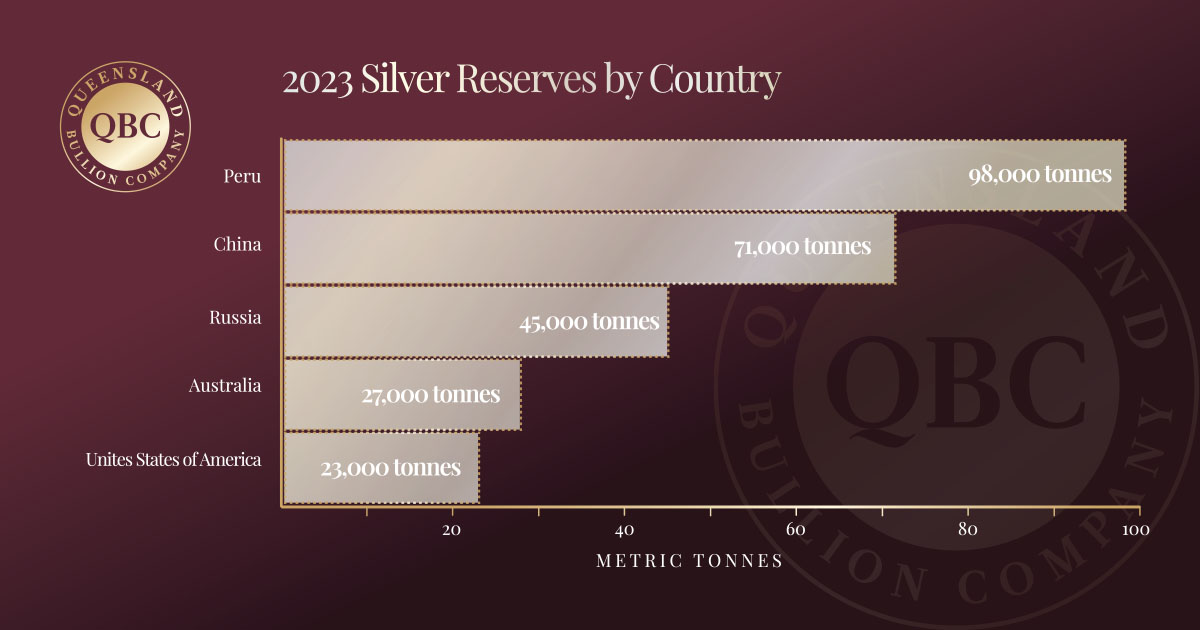
silver reserves by country

In recent months first China, and now Russia, have made aggressive moves to secure more silver in their Central Bank portfolios, enough to raise the eyebrows of Western investors who now speculate what effects this will have on the current Commodities Market moving forward.  With silver trading at $46.42, Gold at $3902.19, and Platinum at $1,439.48 at the time of writing, this coordinated effort to secure the metal certainly deserves the attention it currently receives as a silver squeeze is a likely outcome.

Historically, Central Banks stopped accumulating silver in the mid 19th Century, with USA shortly thereafter opting for the gold standard.  In contrast the Late Qing Dynasty in China embraced the silver standard in the mid 18th Century and did not move over to the gold standard until the 1930s when inflation forced them to. Likewise Russia was on the silver standard in the early 19th Century before transitioning to gold in the very early 20th Century. This provides context for current positions regarding silver among the world’s superpowers.

In 2023 China’s silver reserves were at 71,000 tonnes, second only to Peru at 98,000 tonnes (who is a silver-producing powerhouse in its own right). Russia held 45,000 tonnes, while USA lagged behind at 23,000 tonnes.  Incidentally Australia’s silver reserves were at 27,000 tonnes in 2023.  This reflects USA’s priority being placed on gold holding 8,133 tonnes as at the second quarter of 2024, while China’s gold reserves sit at 2,264 tonnes, Russia’s at 2,335 tonnes and Australia’s just shy of 80 tonnes.  So why is China and Russia placing so much emphasis on securing silver in the current economic and geopolitical environment?

Is it really just the increasing demand on solar panel and electrical vehicle production in the industrial sector?  China may well be getting ahead in this area as silver’s rise in price will increase production costs within industry; however, a fairly superficial glance at the nature of China’s silver purchases prompts one to consider that there may be other reasons for the large purchases.  China has been buying unrefined silver concentrate directly from Latin American miners and refiners.  This allows them to purchase silver without effectively affecting the spot price of the metal.  This also crowds out Western investors from the Latin American markets and also raises concerns about price stability and supply of silver in the future.

Interestingly India, who purchased more silver in 4 months in 2024 than in all of 2023, may be adopting a similar strategy.  India has been purchasing its’ silver through the United Arab Emirates (UAE) to take advantage of lower import duties according to the Comprehensive Economic Partnership Agreement signed by both parties in 2022.

In addition, according to what China has reported they have not purchased any gold for 5 months straight.  Does anyone believe this?  Is it more likely they are simply purchasing over the counter (OTC) in ways that have no direct effect on spot prices?

Enter Russia, who has just come forward with a consideration to spend RUB 52 billion (almost AUD $800 million) on precious metals over the next 3 years as per their Draft Federal Budget, of which it is said that silver is to play a significant role.  Incidentally, they also produced 28% of the world’s platinum last year despite the harsh economic sanctions from the West.

So lets put some pieces together.  China, Russia and India are increasing their silver reserves (amongst other commodities).  And BRICS Nations are about to release their “unit” as a new currency that will be backed 40% by precious metals, thus allowing them to operate amongst each other outside the stranglehold of the USD.  Is it really all about increased demand in the industrial use of precious metal?  The answer is quite simply, no.  The relationship between geopolitics, production industries and finance industries are weaving together so nicely that we could almost make a quilt.

In summary, silver is on the rise in the long term.  A future silver squeeze is almost a done deal.  There are multiple reasons, the BRICS Nations being but one.


Disclaimer: The views expressed in this article are those of the author and may not reflect those of Queensland Bullion Company Pty Ltd or any other associated entities. The author has made every effort to ensure accuracy of information provided; however, neither Queensland Bullion Company Pty Ltd nor the author can guarantee such accuracy. This article is strictly for informational purposes only. It is not a solicitation to make any exchange in commodities, securities or other financial instruments. Queensland Bullion Company Pty Ltd and the author of this article do not accept culpability for losses and/ or damages arising from the use of this publication.

Posted on — Leave a comment

Commodities Bull Cycle on Track Despite Short Term Consolidation in Gold

Despite recent geopolitical upheaval covered in our last article, Geopolitical Conflict Presents Opportunity, and rising concerns of a tightening gold to WTI Crude Oil ratio, precious metals are still set to enter a commodities boom.  With gold trading at $3,878.48 (representing a 0.1% move to the down side over 24 hours), silver at $42.75, and platinum at $1,451.57, some analysts suggest that a consolidation in gold pricing may not be out of turn, nor would it be out of place.  Overall the fundamentals look strong for precious metals and this is what fuels the bullish outlook among most Western investors.

Focussing on long term trends this outlook is substantiated well. When viewing silver’s historical pricing from the 1970s the below graph displays a typical cup and handle that indicates a very optimistic future for the metal.  Interestingly, the current invasion of Lebanon by Israel is an echo of the same conflict in 1978 known at the time as Operation Latini.  The price of silver spiked to record highs during that conflict, and with history repeating itself, could it be that silver will spike to all time highs again?

The below graph shows that commodities are currently trading below what it was before the Oil Crisis of 1973, the Gulf War of 1990, and the Global Financial Crisis of 2008, even lower than the Tech Bubble of 2000.  If history were to repeat, it is possible that as investors look for solace first in the USD and then in gold and silver, the stock market may be the one to see a major correction to the down side while precious metals enter what some call a 10-year bull cycle. Indeed, Bank of America is currently suggesting that commodities are a better investment than bonds citing “debt, deficits, demographics, reverse-globalisation… and inflation” as major contributing factors to the rise in gold and silver.

An interesting factor that plays into the above is what Bank of America calls “reverse-globalisation,” or the localisation of production and supply chains within a smaller geography.  This somewhat reflects the BRICS Nations’ multipolar world they champion, something the West is resisting at this point; however, it seems the reality of what is to come is not entirely ignored by the retail sector with retail giant, Costco, introducing non-refundable gold bullion during Covid.

Meanwhile over in China the State requested that the People’s Bank of China provide options to Chinese citizens to open gold accounts wherein they can purchase shares in allocated pooling for gold.  This State-endorsed exposure to gold will no doubt give their citizens an edge in fortifying against any upcoming financial crises, an edge that Western people do not have.

The cultural difference in attitudes towards precious metal between BRICS nations and the West becomes more pronounced every day.  Savvy Western investors will take advantage of this fact and capitalise as they ride the bull cycle up.

Posted on — Leave a comment

Geopolitical Conflicts Presents Opportunity

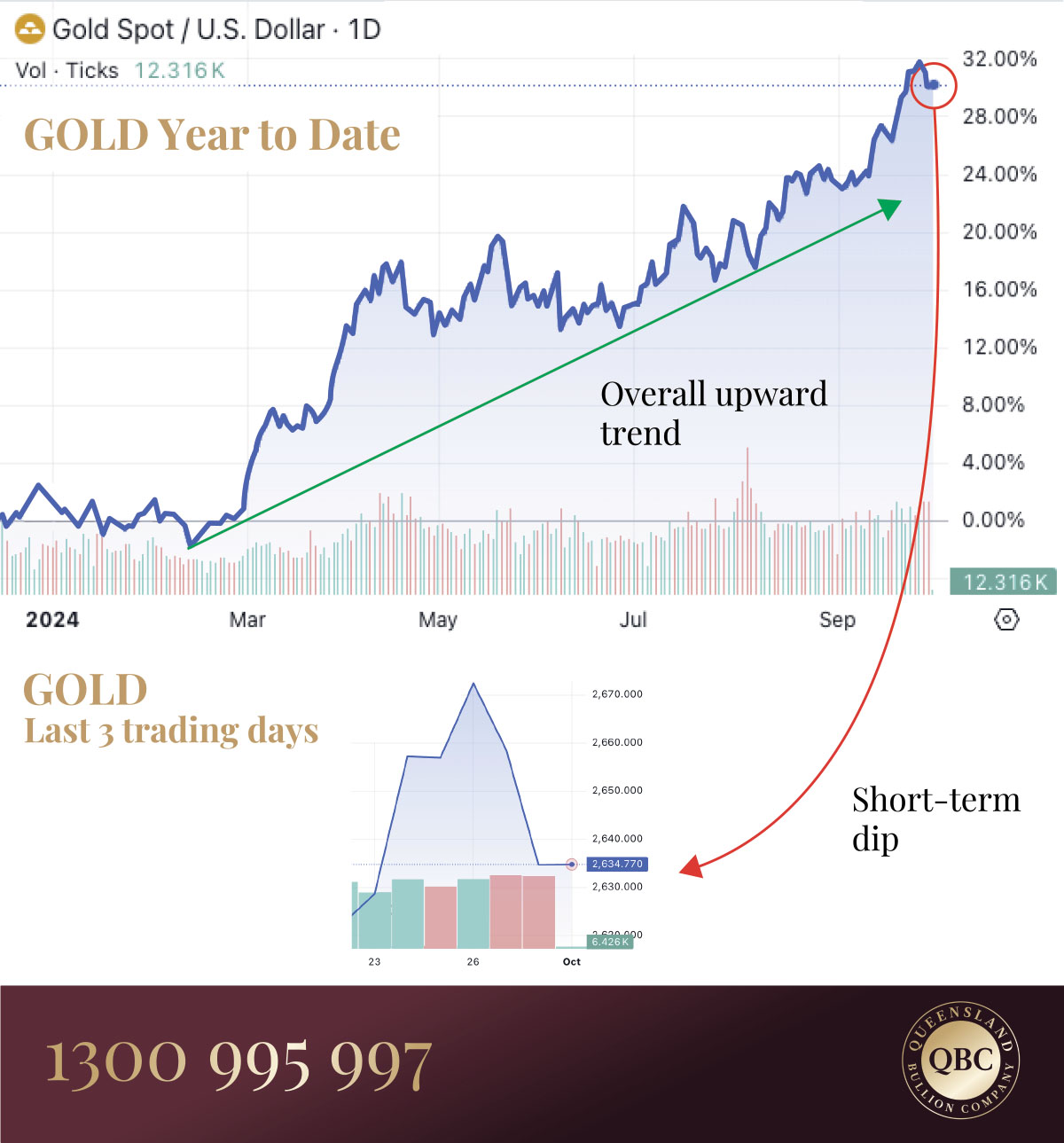
The recent downturn in Precious Metals overnight gives evidence that “something is rotten in the State of Denmark,” as Shakespeare so eloquently phrased it, meaning that something does not match!  At the time of writing Gold trades at $3,862.51, Silver at $45.50, and Platinum at $1,440.68, indicating a pull back over the last 5 days.  This is especially true for gold which dropped over 2% during this time frame and is making a comeback due to geopolitical events.

While this pull-back in metals earlier in the week appears to defy the overall trend, it does not alter the long-term bullish outlook held by nations, central banks and precious metals investors in general. Reserve banks continue to acquire more metal, and as tensions rise, it is expected for this trend to continue with Russia, China and India holding all time high record gold reserves.

This is further underscored by reports indicating a projected decline in gold supply due to diminishing new discoveries. Analysts warn that the limited availability of gold could drive prices even higher in the coming years, potentially pushing Gold past the $4,336 (USD $3000) mark. Indeed, Bank of America and Citibank forecast this figure earlier in the year, with USB the latest to join the choir this month.  Further, Goldman Sachs raised their gold price target to $3922 (USD $2,900) yesterday.

On the geopolitical stage tensions are rising, particularly due to the escalating Israel-Hezbollah conflict.  This is a major factor this week that brings instability to the precious metals sector on an event-by-event basis. Recent responses from Iran to Israel’s invasion of Lebanon have seen an increase in value of the USD as investors flock to it as a safer investment.  In turn this has increased the price of gold in Australian dollars due to USD:AUD exchange rates. As events unfold, interest in gold and silver bullion as safe-haven investments will intensify, first for the USD and inevitably for gold and silver.

As conflict persists, countries in the region, including Saudi Arabia and the UAE, are likely to bolster their gold reserves, viewing it as a hedge against potential economic fallout and instability. This strategic purchasing is expected to increase demand for gold and silver, reinforcing their roles as safe-haven assets.

The dynamics of the U.S. financial markets also play a significant role in shaping gold and silver prices. Recent comments from Federal Reserve Chair Jerome Powell have hinted at potential interest rate cuts, which typically bolster precious metals as lower rates reduce the opportunity cost of holding non-yielding assets like gold and silver. As market watchers anticipate these changes, the attractiveness of gold and silver is likely to be amplified.

It remains to be seen how the Israel-Iran conflict will affect precious metals this week.  While some believe that the rush to the USD and the consequent over-night uptick in price in Australian dollars is a knee-jerk reaction to sensational media headlines, further verified kinetic escalations could turn the said reaction into entrenched panic across various markets.  Fundamentally the macro-economics that supports gold and silver’s rising trajectory remain solid. While the conflict provides fertile soil for volatility it also supports gold and silver as safe investment portfolio options.

Gold peaked at $3,879 in the last 24 hours, only $18 off last week’s all time high of $3,897.  Those focussing on the fundamentals will be looking for any opportunities to buy the dip based on the geopolitical events unfolding this week and they may be the ones who benefit most from any potential volatility.  Trading for the past two weeks have remained between $3,800 and $3,900 with recent events.  We would see that a push past $3900 would see strong momentum for gold prices in the coming weeks.

Disclaimer: The views expressed in this article are those of the author and may not reflect those of Queensland Bullion Company Pty Ltd or any other associated entities. The author has made every effort to ensure accuracy of information provided; however, neither Queensland Bullion Company Pty Ltd nor the author can guarantee such accuracy. This article is strictly for informational purposes only. It is not a solicitation to make any exchange in commodities, securities or other financial instruments. Queensland Bullion Company Pty Ltd and the author of this article do not accept culpability for losses and/ or damages arising from the use of this publication.
Posted on — Leave a comment

The Rising Tide of Gold and Silver Amid Economic Uncertainty

In a notable market update this week, gold prices soared by 2.7% to reach USD $2,672.07 (AUD $3877.08) per troy ounce, while silver experienced an even more robust increase of 6%, now priced at USD $31.96 (AUD $46.37) per ounce. This surge can be attributed to the U.S. Federal Reserve’s recent decision to cut interest rates by 0.50%. This initial reduction is anticipated to be the first in a series, with forecasts suggesting a further 1.90% decrease by the end of 2025. As a result, the gold-to-silver ratio has dropped to 83, indicating an imbalance that may favour silver’s future performance.

The immediate aftermath of the Fed’s announcement saw not just precious metals rallying, but also a broad rise across various risk assets, including equities, commodities, and cryptocurrencies. However, history indicates that while such rate cuts can provide a temporary boost to the markets, they often precede significant pullbacks, especially when recessionary pressures emerge. This trend underscores the importance of including gold and silver in investment portfolios during times of economic turbulence, particularly as core inflation remains an issue.

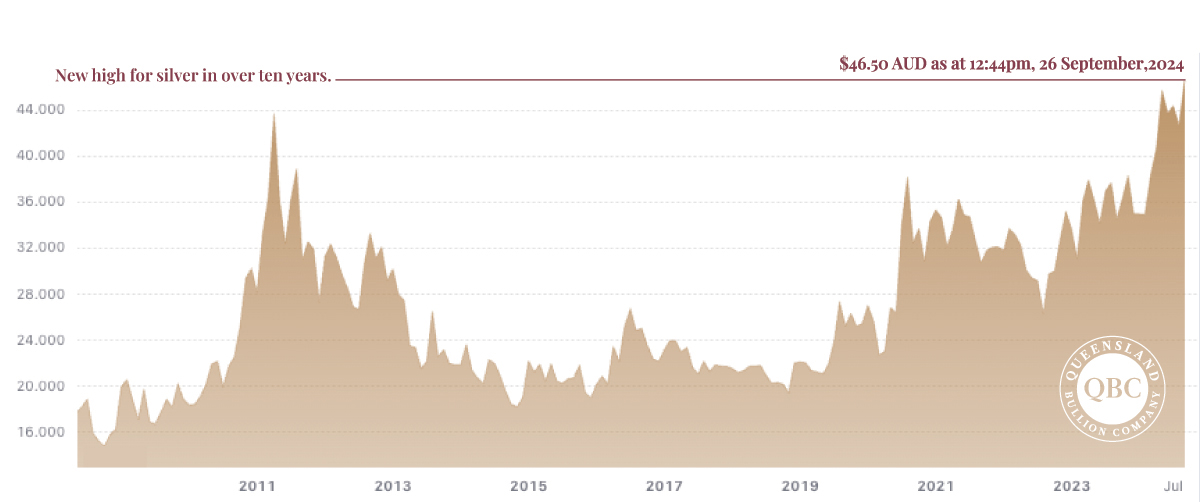
Silver’s potential for outperforming gold is driven by a convergence of factors. Industrial demand is on the rise, and supply constraints further enhance its value proposition. Additionally, silver’s historical performance during inflationary periods positions it as an attractive investment, especially when priced relative to gold. With the gold-to-silver ratio currently favouring gold, savvy investors may view this as an opportunity to capitalise on silver’s potential for appreciation.  This is especially so when considering that silver is at an all-time high over the last ten years.

As we delve deeper into market dynamics, it becomes clear that we are entering a short-term phase characterised by increasing liquidity. While many observers are wary of an imminent market collapse akin to the 2008 financial crisis, a significant influx of liquidity is creating a euphoric environment across various sectors. This is largely due to the fact that the Fed rate cut has allowed those on Wall Street to borrow further funding from banks to invest across a variety of risk assets. Such a cycle of rising asset prices may eventually be followed by a sharp downturn, emphasising the necessity for careful navigation.

During the 2008 crisis, gold and silver proved resilient, gaining value while most assets depreciated. Historically, gold has maintained its status as a safe haven, flourishing amid increased liquidity and market corrections.  Conversely, while both metals can face volatility in the short term, their long-term trends generally remain upward, particularly as investors seek refuge in tangible assets during systemic collapses and unstable geopolitical factors.  In addition, there is a US election looming in November this year that may have a significant impact on asset prices.

In conclusion, the recent moves in gold and silver prices reflect broader economic trends driven by monetary policy changes and market sentiment. While immediate gains are evident, the potential for longer-term appreciation, especially for silver, remains substantial. Investors should remain vigilant, capitalising on historical patterns while being prepared for the inherent volatility that accompanies market cycles. As we navigate this complex landscape, those who focus objectively on data to anticipate crises will likely find themselves in a prime position to seize generational opportunities at this stage in the precious metals bull cycle.