

Why Are Gold and Silver Falling as Global Market Uncertainty Rises?
by Caroline Lima
Gold and silver came under renewed selling pressure on Thursday as concerns over artificial intelligence investment, rising energy costs and geopolitical tensions unsettled global financial markets. Despite a sharp decline in technology shares and increased demand for US government bonds, precious metals failed to attract the safe-haven buying that investors might ordinarily expect during periods of financial uncertainty.
The contrasting movements highlight a complex market environment in which inflation expectations, financing costs and changing investor sentiment are influencing the performance of traditional defensive assets.
Technology Shares Retreat as Investors Question the Cost of AI
Wall Street ended Thursday’s session with significant losses concentrated in major technology companies. The Nasdaq Composite declined 2.60%, while the S&P 500 fell 1.21%. The Dow Jones Industrial Average, however, edged 0.02% higher, reflecting a market where selling pressure was concentrated rather than widespread.
Investors are increasingly questioning whether the substantial capital being committed to artificial intelligence infrastructure will generate sufficient returns to justify its cost. Meta shares declined approximately 7%, while AI infrastructure provider CoreWeave fell around 10%, as concerns over financing requirements and future profitability weighed on valuations.
The shift in sentiment extended beyond US equities, with Europe’s STOXX 600 declining 1.05% and major Asian markets recording losses during Thursday’s trading.
For precious metals investors, the significance extends beyond the technology sector. When confidence in highly valued investments weakens, investors may reassess their exposure to risk across multiple asset classes, including commodities.
Rising Oil Prices Complicate the Inflation Outlook
Geopolitical tensions in the Middle East added another layer of uncertainty, pushing international oil prices sharply higher. Brent crude rose 4% to settle at USD $113.17 per barrel, while West Texas Intermediate gained 2.39% to USD $99.47.
Higher energy prices can place renewed pressure on inflation by increasing transportation, manufacturing and operating costs. Persistent inflation may, in turn, complicate the Federal Reserve’s ability to lower interest rates, particularly if policymakers remain concerned about price stability.
This creates competing influences for gold. Although geopolitical instability and inflation concerns can strengthen demand for defensive assets, expectations of sustained higher interest rates may reduce gold’s relative appeal compared with income-producing investments.
The relationship is particularly important when assessing short-term price movements. Gold does not respond to geopolitical uncertainty in isolation, and the influence of monetary policy can sometimes outweigh traditional safe-haven demand.
Why Gold and Silver Declined Despite Falling Bond Yields
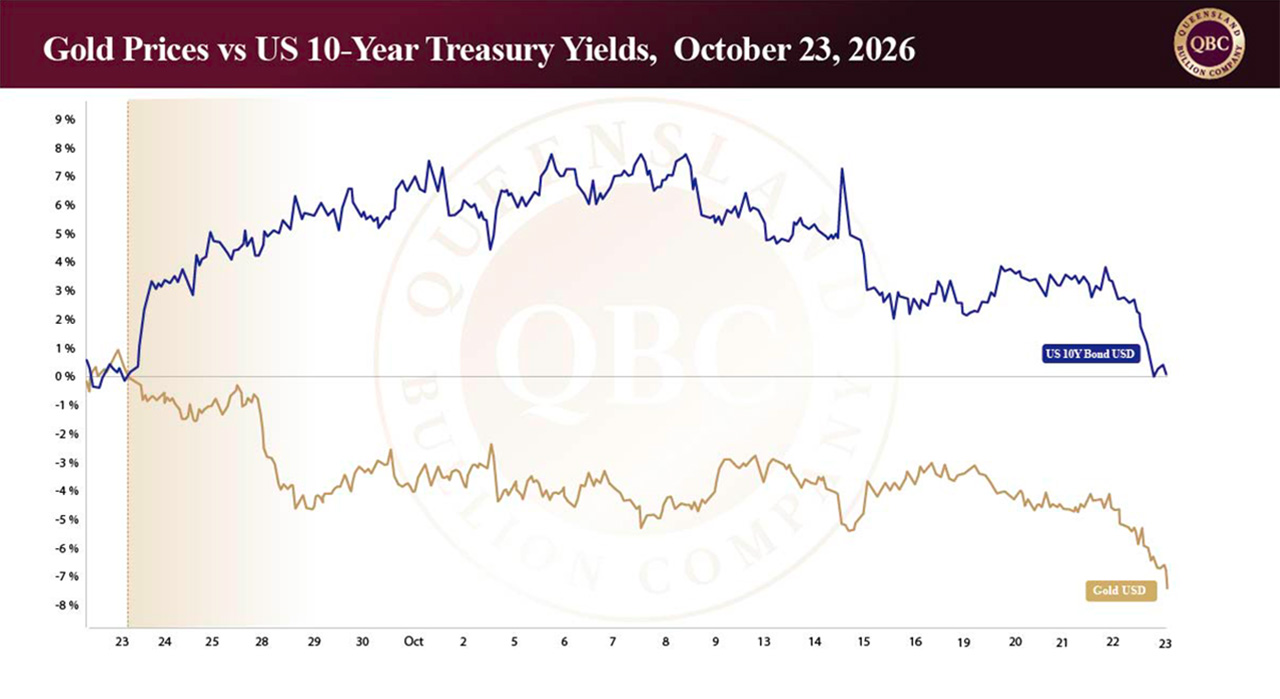
One of Thursday’s more notable developments was the divergence between US government bonds and precious metals.
Investors moved towards US Treasuries as technology shares weakened, pushing the benchmark 10-year Treasury yield below 5% in late-session reporting. Falling yields can ordinarily provide support for gold by reducing the opportunity cost of holding an asset that does not generate interest.
However, gold and silver continued to decline, suggesting that broader concerns about inflation, economic growth and investor positioning were exerting greater influence.
Silver faces an additional consideration because of its dual role as both an investment metal and an industrial commodity. While monetary uncertainty can support investment demand, expectations of weaker manufacturing activity may affect its industrial demand outlook.
Platinum and palladium are similarly exposed to changes in industrial conditions, particularly through their applications in automotive manufacturing and other production processes.
The simultaneous weakness across precious metals demonstrates why movements in interest rates or equity markets should not be treated as reliable predictors of bullion prices.
 What the Market Volatility Means for Australian Bullion Investors
For Australian investors, international precious metals movements represent only part of the pricing equation. Gold and silver are primarily quoted internationally in US dollars, while local bullion prices also reflect movements in the Australian dollar.
A decline in the international gold price does not necessarily produce an equivalent percentage decline in Australian-dollar bullion prices. Changes in the AUD/USD exchange rate can either amplify or offset movements in global markets.
Physical bullion prices also reflect product premiums and other relevant market costs, making it important to distinguish international spot-price movements from the actual prices available to Australian customers.
Periods of heightened volatility can create opportunities for investors to reassess portfolio diversification and their exposure to precious metals. However, neither gold nor silver offers guaranteed protection against market declines, and short-term price movements remain difficult to predict.
What Investors Should Watch Next
Attention is likely to remain focused on developments in the Middle East, the direction of oil prices and the Federal Reserve’s forthcoming interest-rate decision on 27–28 October.
Further developments in AI-related financing and corporate profitability may also influence broader investor sentiment, particularly if concerns spread into credit markets.
For gold and silver, the central question is whether expectations of persistent inflation and restrictive monetary policy will continue to outweigh demand for defensive assets.
The recent market movements reinforce an important distinction: gold and silver can play a role in long-term portfolio diversification, but their performance during individual periods of financial stress is neither uniform nor guaranteed.
For Australian investors considering physical precious metals, understanding these competing forces and monitoring current Australian-dollar prices remains essential.