
What Do the US Election, the Market Correction and AI Concerns Mean for Gold and Silver?
by Caroline Lima
Why political gridlock, falling technology shares and questions about AI spending matter to Australian bullion owners?
Three developments are moving through financial markets at the same time. The Democrats are set to control both chambers of the United States Congress from January, the S&P 500 has suffered its sharpest one-day fall since April 2025, with technology and semiconductor shares leading a broader Wall Street decline, and investors are also asking whether the enormous amount being spent on artificial intelligence will produce an adequate financial return.
These developments became linked in market pricing, although no single factor explains the entire sell-off. Investors were reassessing AI spending and data-centre expansion alongside weak semiconductor results, expensive valuations, crowded positions and elevated financing costs.
For gold and silver, this is not a simple “risk rises, metals rise” equation. Gold can benefit from lower yields and a weaker US dollar, but it may also be sold when investors need cash. Silver remains more exposed to industrial activity and risk appetite. At the time of writing, gold trades at approximately AUD $5,892 per ounce and silver at AUD $74.16 per ounce.
The useful question is not whether one election or one difficult trading session guarantees higher bullion prices. It is whether the foundations supporting financial markets have become less certain.
What Did the US Election Change?
The midterm result is set to give Democrats control of both the House of Representatives and the Senate when the new Congress convenes in January 2027, while Republican President Donald Trump remains in the White House.
That is expected to create divided government. The President retains executive and veto power, while Congress controls legislation, funding and investigations. Major legislation may become harder to pass, and some analysts expect more difficult budget and debt-limit negotiations.
Markets initially welcomed the clarity. The next reaction was more cautious as investors considered whether the result could bring greater scrutiny of AI data centres, energy use and the broader technology trade.
For gold, there are two competing implications. First, slower fiscal expansion or weaker growth expectations can reduce bond yields and pressure the US dollar. Gold pays no interest, so falling yields reduce the opportunity cost of holding it. A weaker US dollar also makes gold less expensive for buyers using other currencies.
Second, divided government does not automatically produce fiscal discipline. It may also create debt-ceiling confrontations, delayed budgets and shutdown risks. That kind of uncertainty can support gold’s role as an asset that does not depend on a government or company making a future payment.
The election matters to gold, but not because one political party is inherently “good” or “bad” for the metal. What matters is how the result affects interest rates, the currency, fiscal policy and confidence in financial assets.
Why Did US Markets Correct So Sharply?
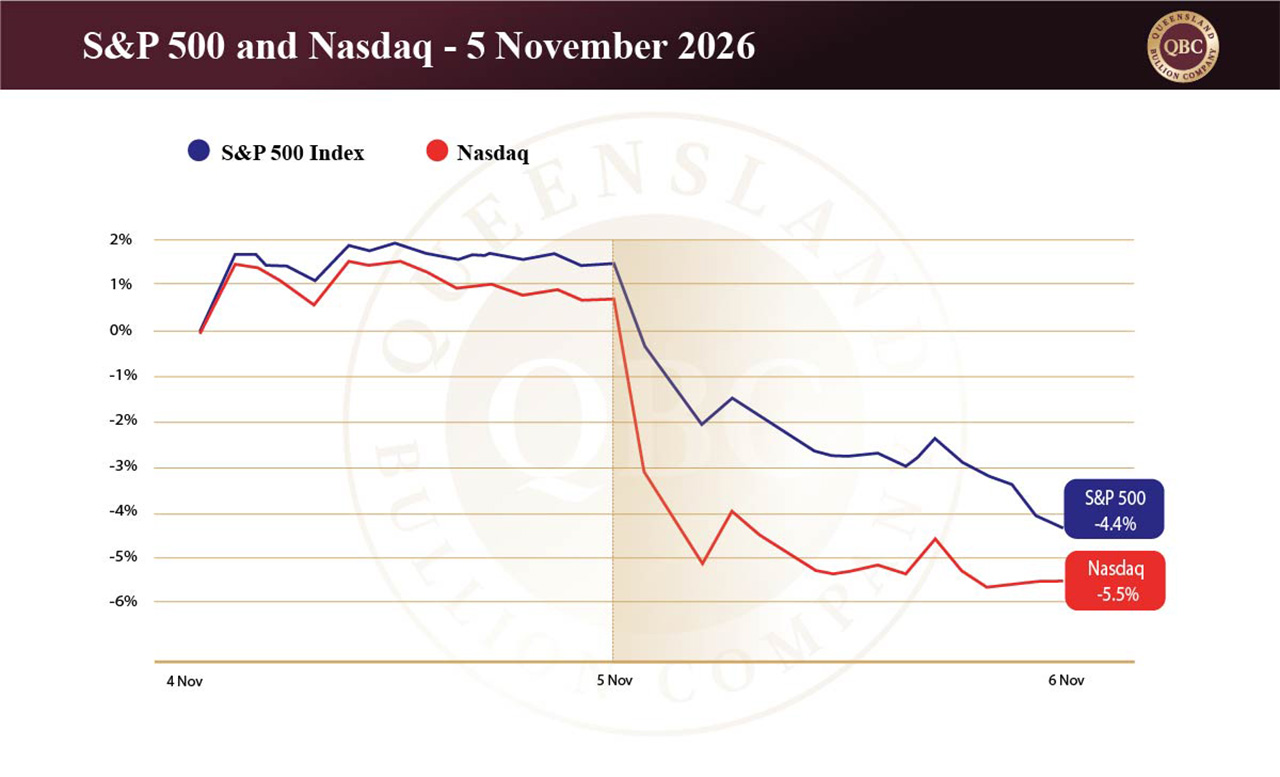
In the US session on Thursday 5 November, which closed Friday morning AEST, the S&P 500 fell 4.4%, the Dow Jones Industrial Average lost 3.4% and the Nasdaq Composite dropped 5.5%.
The Nasdaq closed more than 10% below its October record. A fall of at least 10% from a recent peak is commonly described as a correction. That is serious, but it is not the same as a market crash or a depression. Corrections are a normal part of markets, especially after prices have risen faster than underlying earnings.
What made this correction important was its concentration in technology-related shares, although selling spread across the broader market. Semiconductor, data-centre and other AI-related shares led the decline. The Philadelphia Semiconductor Index fell approximately 12% during the session, while numerous large technology companies recorded double-digit percentage falls.
 Several pressures arrived together:
- Investors saw the possibility of greater scrutiny of data-centre development;
- Public concern over electricity, water use and local infrastructure had become a genuine planning constraint;
- Weak results from parts of the semiconductor industry showed that demand is not unlimited;
- High borrowing costs made debt-funded projects harder to justify; and
- Crowded positions fell quickly as institutions and leveraged investors reduced risk.
- The first market reaction after the election was relief. The second was arithmetic.
What Is the Real Concern About the AI Industry?
The concern is not that artificial intelligence has no practical value. It is that a useful technology can still be a poor investment when too much money is committed too quickly or share prices assume years of near-perfect execution. Technology success and investment success are not the same thing.
The good news is that the largest technology businesses generate substantial revenue and operating cash. They are not all speculative start-ups. The bad news is that AI infrastructure is consuming that cash at an extraordinary rate.
Reuters calculated that Microsoft, Alphabet, Amazon, Meta and Oracle generated a combined USD $542.9 billion in operating cash flow during the first nine months of 2026. Their combined capital spending doubled from a year earlier to USD $556.9 billion, exceeding operating cash flow for the first time in data going back to 2011. Together, the five companies moved from a USD $143.5 billion free-cash-flow surplus a year earlier to a USD $14 billion deficit.
Free cash flow is the cash left after a business pays for the equipment and infrastructure required to operate and expand. It can fund debt reduction, dividends, buybacks or further investment.
When an individual company’s investment spending persistently exceeds its internally generated cash, it must draw on cash reserves, raise capital, borrow or slow its plans. New shares dilute existing owners. Debt adds interest and refinancing risk. Slower construction may reduce the growth used to justify high valuations.
Meta illustrates the concern. S&P Global Ratings revised its outlook on the company to negative, citing uncertainty around capital spending and free operating cash flow. Meta forecast full-year 2026 capital expenditure of USD $135 billion to USD $145 billion. S&P said elevated spending could keep free operating cash flow negative beyond 2028 if AI monetisation is delayed or fails to materialise. Meta disagreed with S&P’s assessment and said it sees substantial product and business opportunities ahead.
That disagreement captures the debate. The bullish case is that companies are building essential infrastructure for a major technological shift. The sceptical case is that the industry is committing enormous capital before the revenue model has been proved at the same scale.
Does a Technology Sell-Off Automatically Lift Gold?
No. Gold can behave differently during different stages of a market correction. At first, investors may sell liquid assets such as gold to meet margin calls, repay debt or cover losses elsewhere. A falling share market can therefore pull gold lower temporarily, even when the longer-term source of stress appears favourable for bullion.
The next stage depends on interest rates and the US dollar. If investors move into government bonds, yields may fall. If markets expect slower growth or less aggressive monetary tightening, the US dollar may weaken. Both can support gold. A stronger US dollar, forced liquidation or persistently high real interest rates can have the opposite effect.
This is why gold should not be treated as an inverse stock market fund. A share is a claim on a company’s future profits. A bond is a promise that an issuer will make future payments. Physical gold has no issuer required to perform, but its market price still moves and its ownership arrangement still matters.
Why Is Silver More Complicated?
Silver sits between monetary metal and industrial commodity. Like gold, it can benefit from a weaker US dollar, lower interest rates and demand for hard assets. Unlike gold, a substantial part of silver demand is industrial. If the AI correction remains a valuation reset, silver may participate in a precious-metals recovery. If it develops into a growth scare, silver may come under more pressure than gold.
Silver’s market is also smaller, so modest investment flows can create larger percentage moves. It often rises faster than gold during strong metals rallies and falls harder when investors reduce risk.
For a new bullion customer, the simplest distinction is this: gold is primarily a monetary and reserve asset, while silver has both monetary and industrial demand. Neither is “better” in every environment. They respond differently because they perform different economic jobs.
What Should Australian Bullion Owners Watch Next?
Five indicators will help show whether this is a temporary valuation reset or something more serious:
US bond yields: Falling yields reduce one of gold’s main short-term headwinds, while rising real yields have the opposite effect.
The US dollar and AUD/USD: A weaker Australian dollar can support local bullion prices even when USD metals soften, while a stronger Australian dollar can reduce local returns.
Credit conditions: A concentrated technology correction is different from stress spreading into banks, corporate debt and funding markets.
AI company cash flow: Improving cash generation would support the investment case, while further borrowing, share issuance and weak returns would keep concerns alive.
Silver’s industrial signals: Manufacturing activity, physical inventories and investor flows will influence whether silver behaves more like gold or a growth-sensitive commodity.
The strongest counter-case is that new data centres move to more supportive jurisdictions, AI revenue grows rapidly and large technology companies regain confidence. If economic growth remains strong and the Federal Reserve keeps rates higher for longer or raises them further, higher real yields could pressure gold and silver. A stronger Australian dollar would add another local headwind.
The evidence does not justify declaring the end of AI, the collapse of US markets or an inevitable surge in metals. It does justify taking concentration, capital spending and financing risk seriously.
What the Election and AI Correction Mean for Gold and Silver
The election is set to change the balance of political power. Its market importance lies in possible oversight of AI infrastructure and more difficult fiscal negotiations.
The correction in US shares is not proof that artificial intelligence is a failure. It is evidence that investors are no longer willing to treat spending as success. Companies must show that data centres, chips and software can generate returns greater than their cost of capital.
For gold, lower yields, a softer US dollar and greater financial uncertainty can be supportive. Forced selling, higher real rates or renewed dollar strength can interrupt that support. For silver, the result is more conditional because its industrial exposure adds sensitivity to economic growth.
The conclusion is not that investors should chase bullion after one weak night on Wall Street. It is that financial markets have become unusually dependent on a narrow group of companies making very large investments under more difficult political and financing conditions.
AI may still transform the economy. The market correction is asking a different question: who will earn an adequate return from paying for that transformation?